
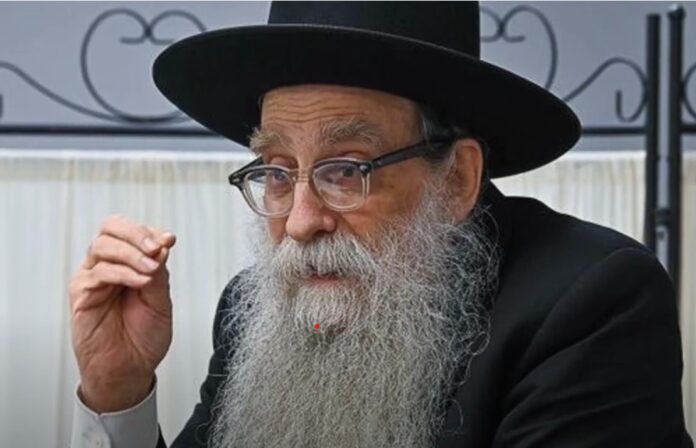

By Rabbi Yair Hoffman
We live in an age of massive accumulation. Bigger and more gorgeous houses. Fancy luxury cars. Exotic vacations posted for the world to admire. We chase these things with a desperation that borders on religious — as if the next purchase might finally fill our void. But what if everything we’ve been told to want is exactly what is keeping us from the life that we were created to live?
What follows is a translation of the 25th Pesach Maamer of Rav Yeruchem Olshin Shlita. It should give us some perspective and begin to stop the insanity.
Ha Lachma Anya
At the Seder we start the Haggadah with the words, “Ha lachma anya — this is the poor man’s bread that our fathers ate in Egypt.”
The Rambam (Hilchos Chametz U’Matzah 7:5) explains that this statement helps us recall the suffering of Egypt — not that we eat this bread out of poverty or because we don’t have, but rather because it is a mitzvah: it is a positive commandment that the matzah be the bread of the poor.
In Egypt it was customary to eat poor man’s bread and bitter water, and so we declare: “This is the poor man’s bread that our fathers ate in the land of Egypt.” Some say the point is to ensure the matzah remains poor man’s bread and does not become enriched matzah, as our Rabbis discussed (Pesachim 36a).
Accordingly, the Rambam teaches that the declaration of Ha Lachma Anya — “this is the poor man’s bread that our fathers ate in the land of Egypt” — refers to the humble bread our ancestors ate there, bread accompanied by affliction and bitter water.
Remembering Poor Man’s Bread After Yachatz the Breaking of the Matzah
This matter is quoted in the name of the Vilna Gaon, of blessed memory (Maaseh Rav, section 185). According to the ruling of the Rambam (Hilchos Chametz U’Matzah 8:6), on the first night it is forbidden to add oil or honey to the matzah — it may be prepared only with water — so that it remain “poor man’s bread” (Devarim 16:3). On this first night, it is thus fitting that there be a remembrance of poor man’s bread.
We may further say that our calling it a “remembrance” of poor man’s bread actually means that Ha Lachma Anya itself embodies poor man’s bread — and additionally, “that our fathers ate in the land of Egypt” is a remembrance of the same humble bread our ancestors ate there. On the first night, one is required both to have poor man’s bread and to invoke a remembrance of it.
This raises a question: why did Chazal introduce this theme at the very beginning of the Seder, before we recount what distinguished this night from all others — and before we have even begun the story of leaving Mitzrayim? Its natural place would seem to be later in the Seder.
The answer lies in the deeper purpose of the passage, as will be explained below.
Matzah: An Eating Compelled, Without Luxury
A wondrous insight appears in the commentary of Rabbi Yitzchak Chaver, of blessed memory, on this passage. He writes that the matter of eating matzah on the night of Pesach is found, according to us, in two contexts. First, the Mishnah of Rabban Gamliel (Pesachim 10:5) teaches that the matzah does not merely satisfy our ancestors’ physical need — rather, it recalls their suffering and affliction. Second, and beyond this, the people of Israel ate matzah in Egypt together with the Korban Pesach, as written in the Torah (Shmos 12:8) and so on.
This eating took place before the Exodus from Egypt — that is, before midnight — and thus the eating of the Pesach offering preceded the actual departure from Egypt.
Yet the matter of the matzah we find carries two distinct dimensions. The first is that it must contain none of the seven enriching ingredients — no oil or honey — and this requirement applies only at night and not during the day; but these are secondary considerations. The primary dimension is this: the eating of the matzah as a mitzvah was the eating of poor man’s bread from the very beginning.
The Meshech Chochma writes that the reason for this is “because they were expelled from Egypt.” Accordingly, it is even permissible to place wine or oil into the matzah — producing enriched matzah — since there is no fixed time requirement for it, and the obligation to eat matzah derives from another source. Nevertheless, the essence and character of the mitzvah-matzah is that it be poor man’s bread.
From this we understand why Ha Lachma Anya is placed at the beginning of the Seder: it is the gateway to standing before the Divine Presence. As it is written (Devarim 5:4): “To come before Him from among the nations.” Drawing near to the place of His service, blessed be He, represents the first mitzvah — the Korban Pesach — whose essence is that man stands before his Creator entirely in His service. Accordingly, it is not fitting for him to pursue the pleasures of this world. Rather, one should live only in the manner of Torah, with just enough to sustain life — poor man’s bread without improvement, only what is sufficient to survive. We are commanded to eat matzah on Pesach in a spirit of concealment and austerity, to demonstrate that every act of bodily need a person performs is only out of necessity, and he should not linger over such things, but sanctify all his time for the sake of Heaven.
This, then, is precisely what the author of the Haggadah declares: “Ha lachma anya di achalu avhatana b’ara d’Mitzrayim” — “This is the poor man’s bread that we eat tonight, the same poor man’s bread without any embellishment, just as it was in Egypt.” The meaning is: this is the very bread our fathers ate while they were still in Egypt, before they were expelled — as the Rambam explains.
The passage that the Vilna Gaon revealed to us is thus a wondrous thing, for it contains within it the entire path of Jewish life. At the Seder night, we enter into the service of standing before the Divine Presence, for this is the time of the Exodus from Egypt and the beginning of the service of Hashem. The first lesson — placed deliberately at the very opening of the Seder — is the distancing from luxuries. We now enter into the service of Hashem, and the first requirement is to distance ourselves from luxury before the Korban Pesach. In recalling that “our fathers ate this in the land of Egypt,” we evoke the matzah eaten in affliction. And now, following this, the lesson of distancing from luxuries continues with the Korban Pesach, as will be explained further. (See Maamar 22.)
The Obligation of Man to Elevate Himself to the Level of a Malach
Indeed all of this is explained at length by the Rav. For in order to learn this, the first thing a person must know in order to enter into the service of Hashem is the matter with which he opens that service.
This is made evident from the explanation of the matter as written in the Torah portion of Bereishis (6:3): the Holy One Blessed be He declared that His Divine Presence would not dwell permanently in the world — “My spirit shall not abide in man forever, for he is flesh” — and they lived one hundred and twenty years. And Hashem said: “I will blot out the man whom I created from the face of the earth” (Bereishis 6:7).
The Rambam explains: the divine spirit cannot permanently dwell within man because man is flesh — like the beasts that crawl on the earth, like the birds and animals — and we do not see the divine spirit resting within him. The reason is that Hashem created man with the capacity to elevate himself like His angels, granting him a divine soul. But afterward, the physical body drew him along, and in his physical character man came to resemble the animals. And therefore the divine spirit of Hashem will no longer dwell within him — for he has become bodily flesh, and not Godly — so says the Rambam.
It is clear from the words of the Rambam in the Mishneh Torah that the very essence of man’s creation in this world is to become like Hashem’s angel — elevated above all beasts, birds, and creatures. For Hashem created man with the capacity to be elevated like His ministering angels, by placing a divine soul within him. If this purpose is not realized, man’s creation is unfulfilled. And therefore, when the Holy One Blessed be He saw that people had likened themselves to animals in their deeds, drawn after the physical and the body, no longer worthy to bear the image of man whom He created above the earth — He immediately declared: “I will blot out the man from the face of the earth.”
The Service of Man and the Ultimate Purpose of the Commandments: To Become Like the Supernal Angels
And we find that this is truly the ultimate purpose of all the commandments — that man should elevate himself to become like the supernal angels of holiness. As it is written: “I sent him so that you would remember and perform all My commandments and be holy unto your God” (Bamidbar 15:40). The Targum of Yonatan ben Uziel, of blessed memory, renders this: “And you shall be like the supernal angels of holiness before Hashem your God.” For the ultimate purpose of the commandments is to elevate man and raise him above all physical and earthly matters, so that he stands not merely among mortal men but among Godly beings, distanced from the lowly and separated from them.
And this is accomplished especially through engagement with the holy Torah, which trains man to reach this elevated level. As our teacher the Chozeh of Lublin, of holy and blessed memory (as in Igeret HaKodesh, section 15), wrote: though such a person walks among people and appears to their eyes as one of them, in truth he is genuinely an angel — living among mortals yet elevated above all of them. For it is the study of Torah and the acquisition of its knowledge that draws a person toward the level of an angel. And as the Chozeh further writes (Igeret, section 23): the Shechinah rests upon Israel in every generation, guiding their laws and judgments, deepening their understanding of halachah. The spirit from above hovers over them. Their eyes and faces are constantly turned upward, occupied with the sublime matters of Torah — for they are like the angels who emerge elevated above the worldly.
The means by which man becomes like the ministering angels is precisely this: that his spirit soars above, distancing itself from the physical and material, resembling the ministering angels — who, as it is written (Shmos, Vayeira 1), are spiritual servants and not physical ones. As the Chozeh wrote: the supreme work of elevation is that a person transforms the body into soul and the physical into spirit — so that the soul fashions the body into soul, and from the body a spirit is formed, the material becoming spiritual. Then man truly resembles the ministering angels and bears no likeness to the animals, birds, or any of the physical and material creatures.
“All That I Have in This World Is of No Interest to Me”
This is what the Chozeh, of blessed memory, said (Derech Etz Chaim 5a), in the manner of his disciples the sages — he was humble, light-spirited, and so on — and he declares: “All that I have in this world is of no interest to me according to my perception of this world as mine.” The explanation is that the criterion of true spiritual attainment is that the matters of this world should hold no attraction for a person whatsoever, and he should not be drawn toward this world at all. This is the hallmark of the wise disciple: that this world means nothing to him, and he is not drawn to it — for the desires of this world are nothing but the demands of the body, the purely physical.
The Beis HaLevi distinguishes between one who is truly spiritual and one who merely appears so: the test is whether a person’s spirit is drawn after material pleasures or not. One who praises the pleasures of this world is, in truth, not yet spiritual. The Beit HaLevi holds that a truly spiritual person takes only what is indispensable — only what is necessary to sustain life, nothing beyond bare need. This is what the Chozeh meant when he said: “All that I have in this world is of no interest to me” — for this world is simply not his, because he is G-dly and not physical.
Avraham Avinu Died ‘Full of Days’: He Was Not Drawn to Luxuries
We find that this very quality is what the Torah praises in our father Abraham. As it is written in the portion Chayei Sarah (25:8): upon the death of our father Abraham, “Abraham died at a good old age, old and satisfied — and he was gathered to his people.” The Rambam writes that “old and satisfied” means he was an elder full of all goodness — he had seen the goodness of Hashem, and all was good for him. He was not drawn to luxuries, of which it is said “the desire of his heart You have given him” (Tehillim 21:3). As it is also said: “A lover of money will not be satisfied with money” (Kohelet 5:9) — for no person leaves this world with even half of what he desires, and the craving for more ensures he is never satisfied with what he has.
The Gaon Rabbi Simcha Zissel of Kelm wrote in his work Derech HaEtzem HaNifla’ah that our father Abraham — who is called “the great man among the giants” (Yehoshua 14:15) — achieved his greatness through his powerful and unwavering faith in the Shechinah. He declared the names of the heavens by his own inner strength, elevated himself until Yitzchak was bound upon the altar and was prepared with joy to fulfill the will of his Father in Heaven. And he elevated the Torah so as not to be drawn to luxuries — the seven things he found in his house were Torah and not the pursuit of comfort. This, as the author says, is the wondrous great elevation and the highest level that can be said of a great person — and the matters are truly wondrous.
To understand this properly: there is a particular and elevated quality in the world, which is not simply counted among ordinary good deeds — and this was the very reflection of our father Abraham’s conduct in the world. In all his humble service he was not drawn to the Divine Presence for personal gain, and he took from the world only what the body requires to sustain itself. For in truth he was genuinely an angel living among mortals, not drawn to this world, and not attached to it at all.
Accordingly, it is understood that the praise with which the Torah praises “the great man among the giants” touches on the very essence of man’s creation: to elevate himself and become like an angel, lifted above all physical things. Abraham was not in the category of mere flesh at all, and therefore he sought nothing of this world and nothing of its luxuries. This is the core of the Torah’s praise of him: that he was “full of days,” distanced from luxuries, and this was the ultimate fulfillment of his creation — full of days, elevated and removed from material concerns, like the ministering angels. And this is the ultimate purpose of his creation.
The Disciples of Avraham Avinu: Elevated Above the Material and the Worldly
This lesson we learn from the Mishnah in Pirkei Avos (5:19): “Whoever possesses these three qualities is among the disciples of our father Abraham” — a good eye, a humble spirit, and a meek soul, and so on. The disciples of our father Abraham are characterized precisely by the opposite of the disciples of Bilaam: not a bad eye, not a haughty spirit, and not an expansive soul. For indeed the remembrance being invoked here is the matter of Hashem’s kindness toward our father Abraham — not his faith in the Shechinah and his devotion to his mission, but rather these three qualities themselves: a good eye, a humble spirit, and a meek soul. One must learn these three qualities deeply, as they need to be learned.
And the author of Derech HaChaim elaborates on the depth of these three qualities, of blessed memory, for the wisdom of elevating oneself is fitting for Abraham — as it is written: “Abraham rose early in the morning and saddled his donkey” (Bereishis 22:3) — meaning that he was elevated above the material level. For the seeing of this — that Abraham had no attachment to the material level at all — is the matter, and he was drawn to rise above it and elevate himself above the material, just as Abraham was elevated from the material level above, and so on. And the Rav elaborates to explain that the foundation of the three qualities of our father Abraham — a good eye, a humble spirit, and a meek soul — is that Abraham elevated himself in all things with his whole power to the highest elevation, and through them he acquired the three qualities of holiness, which are distinguished from the material: from all above, everything is elevated, and this is as Abraham was, elevated above the material level, and so on.
For it is clarified that the foundation of the path of our father Abraham was that he was distinct and elevated above the material and the worldly. And this is precisely what we have seen: that our father Abraham reached the ultimate purpose of man — to be Godly and not physical, elevated above material concerns. And this is the praise of our father Abraham at the time of his death: that he sought no luxuries, for his world had no need to force him toward them, for he was truly elevated above material things, found in the quality of an angel among mortals. And this is what is meant when our Sages speak of Abraham in the quality of an angel among mortals.
The Introduction to the Seder Night — Distancing from Luxuries
Now, let’s understand the fundamental lesson of the Seder night in the declaration of Ha Lachma Anya — “this is the poor man’s bread that our fathers ate in the land of Egypt” — before we go forth to become servants of Hashem.
When a person demonstrates that he or she is a genuine servant of Hashem, this shows that he or she recognizes himself as capable of truly serving Him. The essential introduction and preparation for this is that he or she does not seek luxuries, for this world is not his world — he is, rather, like an angel among mortals. And in that very hour of the Exodus from Egypt, the children of Israel went out and separated themselves from the materiality of Egypt, clinging to the matzah, the lechem oni — elevated above the material, distanced from all luxuries, just as the Vilna Gaon, of blessed memory, explained — and thus they were prepared to receive the Torah and its commandments, to be holy unto God: “like ministering angels serving before Hashem your God.”
This, then, is the service of every Jew at the Seder night: to resemble our ancestors who went out from Egypt on that very night. For as we declare in every generation, a person is obligated to see himself as if he or she personally went out from Egypt. Just as they went out from the materiality of Egypt and elevated themselves above it — going out from Egypt with the ministering angels — so too we, at the Seder night, must elevate ourselves to become like ministering angels. This is the introduction and preparation for becoming a true servant of Hashem: to be G-dly and not material, like an angel and not like an animal.
The path of life for a Jew who sincerely desires to arrive at his ultimate purpose is to separate himself from luxuries and to elevate himself above all material concerns. Only through this — through the power of the Seder night — does he or she fulfill the ultimate purpose of his creation. For Hashem made man upright: “to be like the ministering angels, by placing a divine soul within him.”
The translator can be reached at [email protected]