

The US Takes Up the fight Against Belgium’s Bigotry
Belgian police raided the homes of three respected mohalim in Antwerp. Their alleged crime: performing bris milah without a medical license.
Under current Belgian law—as interpreted by authorities—only licensed medical professionals may perform circumcisions. Unlike neighboring countries such as the Netherlands and Germany, Belgium hasn’t created a clear exemption or certification pathway for religious circumcision performed by trained mohalim. During the raids, the police confiscated their equipment and demanded the names of the Jewish infants they circumcised in the past, raising the possibility of retroactive prosecution.
At present, there is only one Jewish doctor in Belgium who is also a mohel. Strict enforcement of the law would therefore render most bris milahs in the country impossible. Families would be forced to either travel abroad or conduct the bris discreetly, which some observers have likened to the underground religious practices that were caused by Soviet-era repression.
The court case against the mohalim remains ongoing. Belgium’s Jewish community has argued that the prosecutions violate the country’s constitutional protections for freedom of religion. At the same time, communal leaders have sought a practical solution: a certification framework that would allow qualified mohalim to perform bris milah legally.
To that end, representatives of the Jewish community approached Belgium’s minister of health, Frank Vandenbroucke, requesting the creation of a regulatory pathway. Thus far, however, Vandenbroucke has declined to propose legislative adjustments or administrative accommodations.
That refusal drew a sharp response from the United States ambassador to Belgium, Bill White. A businessman and philanthropist appointed in 2025, White has made religious liberty and the fight against anti-Semitism central themes of his diplomatic tenure. On Monday, February 16, 2026, he publicly demanded that Belgium drop the “ridiculous” and “anti-Semitic” investigation into the three men.
In a social media post, White called on Belgium’s “very rude” socialist health minister to stop the “unacceptable harassment” and “disgusting” treatment of the mohalim, and he urged the country to do “a much better job” on anti-Semitism. White insisted that Belgium either change its law that circumcision must be carried out under strict conditions by a medical professional or recognize that the investigation into the “three beautiful religiously qualified and wonderful men” was anti-Semitic. He dismissed accusations that he was interfering in Belgium’s judicial affairs as a “political distraction.”
White’s posts were explicit. He wrote:
“TO BELGIUM, SPECIFICALLY YOU MUST DROP THE RIDICULOUS AND ANTI SEMITIC ‘PROSECUTION’ NOW OF THE 3 JEWISH RELIGIOUS FIGURES (MOHELS) IN ANTWERP!”
He then criticized Vandenbroucke personally:
“You must make a legal provision to allow Jewish religious MOHELS to perform their duties here in Belgium. Take action NOW! The world is watching. America is counting on you to do the right thing. Frank, you should do it NOW so this case ends!”
White also claimed that at their first meeting, Vandenbroucke had refused to shake his hand or pose for a photograph together, adding, “He was very rude and was quite obnoxious. I was told he does not like my great President.”
After Belgium’s Foreign Minister Maxime Prévot publicly condemned White’s comments, White posted again:
“In NO way, shape or form have we ever suggested that a political person in the Gov’t should interfere in a judicial case. That said, the case should be immediately dropped. It is ABSOLUTELY an issue of anti-Semitism. You either have to make a change to the procedural accreditation or you have to call prosecution of these three beautiful religiously qualified and wonderful men anti-semeitc [sic].”
Belgian officials responded forcefully. Prévot called White’s accusations “false, offensive and unacceptable,” accusing him of violating “fundamental diplomatic norms.” Authorities reminded the ambassador of the Vienna Convention on diplomatic relations, stating that personal attacks on a member of the government and interference in Belgium’s internal affairs are contrary to basic diplomatic rules. The ministry emphasized that while Belgium values its relationship with the US, dialogue “must be based on respect for our institutions and our sovereignty,” and reaffirmed its condemnation of anti-Semitism and racism.
The diplomatic row escalated further when White reportedly threatened Conner Rousseau, leader of the Flemish socialist Vooruit Party, with a travel ban to the US. Rousseau had posted on social media comparing the actions of US Immigration and Customs Enforcement to historical atrocities, drawing parallels with the Holocaust. Rousseau said that he was unrepentant:
“I posted that on social media five weeks ago, and yesterday it suddenly turns out to be a problem. I suspect [White’s] intervention regarding the circumcision did not go as he would have liked. I can only say that we in Belgium have the right, and I also believe a political duty, to express our concerns about what’s happening in the US. I respect the ambassador’s opinion, but I also ask for respect for ours.”
The controversy also involved Belgium’s lone Jewish member of parliament, Michael Freilich, who had discussed the circumcision controversy publicly, including conversations with American lawmakers. Critics accused him of inviting foreign interference in domestic judicial matters. Among them was Sammy Mahdi, head of the Christian Democratic and Flemish Party, who compared Freilich’s actions to “a member of parliament with a Muslim background lobbying in Morocco or Qatar to influence a court case in Belgium.” Freilich denied attempting to orchestrate US pressure. The European Jewish Association condemned the public questioning of Freilich’s loyalty as a “public lynching,” warning that it echoed one of Europe’s oldest anti-Semitic tropes.
White’s intervention has made it clear that Washington sees this case as part of a broader transatlantic concern over rising anti-Semitism and the protection of minority religious practices. It is worth noting that some 60 Jewish leaders wrote to European Commission President Ursula von der Leyen last May, urging the EU to condemn Belgium after the police raid the homes of the three mohalim in Antwerp, but no condemnation was forthcoming.
The attitude of the Belgian authorities is a concern. And while there is no direct link between the Belgian government’s controversial policies and random anti-Semitic acts in the country, such incidents are certainly concerning. A shul in the Belgian city of Liège was damaged in an explosion during the early hours of Monday, according to police.
The blast occurred around 4:00 a.m. local time in front of the shul, shattering windows across the street but causing no injuries, officers said.
Willy Demeyer, the city’s mayor, described the incident as “an anti-Semitic act,” while Prime Minister Bart De Wever expressed solidarity with the Jewish community on social media.
The Belgian federal prosecutor’s office, responsible for terrorism and organized crime, is leading the investigation, an official confirmed.
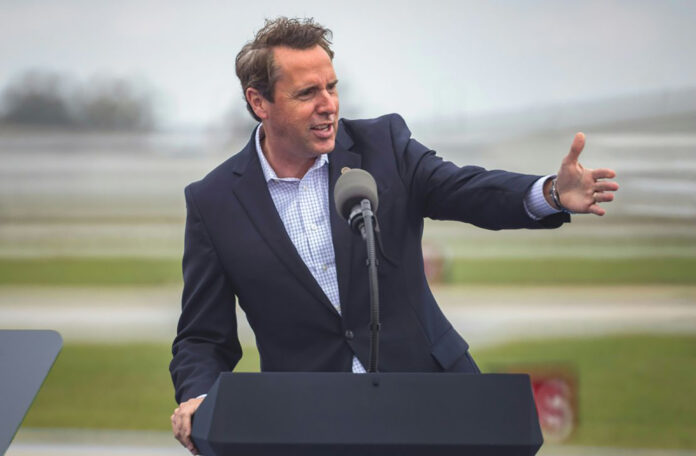
To better understand the American position and the evolving diplomatic tensions, we spoke with Mark Walker, principal adviser for global religious freedom at the United States Department of State. Walker outlined the US government’s perspective on Belgium’s actions and discussed the measures the administration may take to press Belgium to safeguard the religious liberties of its Jewish community.
Mark Walker is a former US representative from North Carolina, serving from 2015 to 2021. In April 2025, he was nominated to serve as ambassador-at-large for international religious freedom, but after delays in his Senate confirmation he withdrew on January 8, 2026, and was appointed as State Department adviser on global religious freedom, where he focuses on advancing religious freedom initiatives around the world.
During his time in Congress, Walker was active on issues connected with US-Israel relations. He cosponsored bipartisan legislation to strengthen cooperation between the two countries, and he supported efforts opposing the delegitimization of Israel and the global BDS movement. He also advocated for policies addressing security concerns for Jewish institutions and took positions critical of the Iran nuclear deal, reflecting a pro-Israel stance.
As the Trump administration’s nominee for the global religious freedom post, Walker visited Israel in 2025, including Jerusalem and the Kosel, where he pledged to combat anti-Semitism, promote interfaith cooperation and reaffirm the ties between the United States and Israel. He met with religious leaders and families of hostages taken during the 2023 Hamas attacks, emphasizing the shared commitment to defending religious liberty and promoting coexistence.
Walker ran for the US Senate in North Carolina in 2022, seeking the Republican nomination, and later pursued the Republican nomination for governor of North Carolina in 2024. He has also been involved in national politics, including serving on former President Donald Trump’s campaign staff. Throughout his career, Walker has focused on legislative efforts and advocacy related to both conservative policy initiatives and religious liberty.
Thank you for taking the time to speak with me. You’re doing incredible work. Please describe your role at the State Department.
I serve as Secretary Rubio’s principal adviser on religious freedom issues, whether that involves the Druze in Syria, anti-Semitic incidents, or Christians in Africa.
We currently designate 13 countries as Countries of Particular Concern. There are actually two tiers to the CPC list. The first is a lower-level designation known as the Special Watch List. The second is the more serious list. If a government isn’t taking steps to prevent attacks on Christians or address anti-Semitic behavior, it can trigger economic sanctions and other measures.
I oversee a team of about three dozen people who focus on different regions. We monitor these governments closely to assess whether there are intentional violations of religious freedom.
If a government is engaging in acts of religious discrimination, to whom do you report it?
I report to Marco Rubio, and on occasion to President Trump. But my direct supervisor is Secretary of State Rubio.
Every administration has its priorities. How important is religious freedom to the Trump administration?
It’s huge. I think he set a real precedent during his first administration when he became the first president to address religious liberty and host a conference on it at the United Nations. No American president had ever done that before.
We know that President Trump has placed a lot of strong voices in key positions when it comes to calling out anti-Semitic behavior. Even in this day and age—when over the past few years it has become more common for entertainers and leaders to be weaker on these issues—he continues to be a strong voice, and he is well aware of the role I serve.
I served in Congress for six years, and my dear friend Mike Huckabee is someone with whom we have worked with closely over the years. We are both grateful for the opportunity to work for both President Trump and Secretary Rubio.
To read more, subscribe to Ami

