
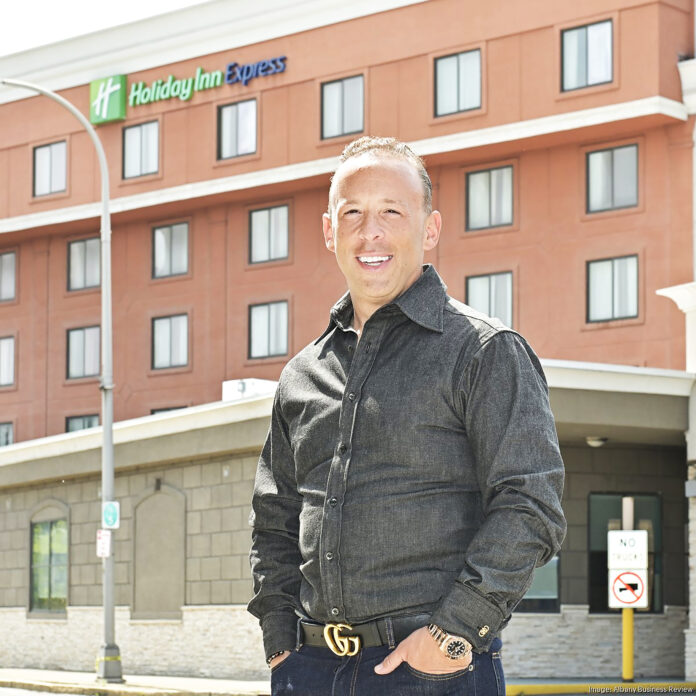

Moshe (Morris) Oiring runs a network of healthcare companies that serve thousands of people every day. In recent years, he has also begun expanding into kosher hospitality, opening the first glatt kosher hotel in Albany and now working on a new one in Manhattan.
In our conversation, we discussed the broader scope of his work—how his healthcare enterprises serve communities daily, how his newer hospitality projects reflect the same philosophy, and why he believes affordability and access should matter more than simple profit maximization.
He also shared ideas about community building and entrepreneurship that I found both new and inspiring. I hope you do too.
—Dovid
My father was born in Russia and grew up on Webster Avenue in the South Bronx,. My grandmother liked the Bronx, until two bullets flew in through my father’s bedroom window. Then she conceded, ‘Maybe it’s time to leave.’
“The family moved to Eretz Yisrael, settling in Meah Shearim. My first cousin, Bentzi Oiring, is the head of ZAKA there. My parents met and married in Israel, but my mother suggested they go to America for parnasah. They settled in Boro Park, and my father taught in Dyker Heights.
“My mother told me that her father had played a role in bringing Rav Yisrael Meir Lau to a position of leadership. I didn’t really believe her, but years later, I met Rav Lau at an event and mentioned that I was Penina Slavaticki’s son. At first he didn’t react, but his rebbetzin immediately turned and said, ‘What did you just say?’ She pulled me aside and told her husband, ‘This is Penina’s son.’ Rav Lau then asked, ‘Why did she leave Israel?’ He said that without her help, he would not have been able to accomplish what he did. Later, when I dedicated a volume of Encyclopedia Talmudit in memory of my mother’s father, Rabbi Lau wrote to me reiterating how my grandfather had helped him and encouraging me to continue helping others in the same way.
“We lived on 48th Street and 12th Avenue. I started in Bobov for Pre-1A, then went to Kamenitz, and then to the Yeshiva of Brooklyn. My father’s brother was chasidish, and my father wanted to bring us up that way too. My mother, having grown up in Tel Aviv, had a somewhat different outlook. She said, ‘Morris can learn Yiddish from your brother, but he will go to a more modern school.’
“After college, I went straight into politics. My first job was working on Hillary Clinton’s first campaign for the US Senate. After that, I served as Jewish liaison on campaigns for the New York City mayor and the New York State governor. Following a long tenure as an aide and Jewish affairs adviser to Brooklyn Borough President Marty Markowitz, I joined Mayor Bloomberg’s campaign staff during his second mayoral run, and I later worked on the reelection campaigns of Governors Eliot Spitzer and David Paterson.
“During Paterson’s campaign, I visited Touro College to help mobilize voters. When the founder, Dr. Bernard Lander, asked if I was an alumnus, I admitted I had dropped out years earlier for financial reasons. ‘Every Jewish boy needs a degree,’ he insisted. He arranged a scholarship on the spot, allowing me to finally graduate. Twenty years later, I returned the favor by establishing a scholarship in honor of both Dr. Lander and Governor Paterson. In 2024, Touro College honored me in recognition of that effort.
“At one point I considered running for office myself. I was a leading contender to succeed Simcha Felder, alongside David Greenfield and Joe Lazar. Before committing, I asked Governor Paterson for his endorsement. He was willing to give it, but he also gave me some surprising advice: ‘Don’t run.’
“‘You like helping people,’ he said. ‘You’ve spent 14 years giving your life to others. It’s time to start thinking about yourself.’
“He suggested I go into healthcare instead. I took his advice and transitioned into adult day care.
“Although David Greenfield is a personal friend, I did not endorse him during that campaign. He won, and Joe Lazar lost. Later, Joe helped me get started in the healthcare business. He taught me the value of dealing with people with honesty, loyalty and transparency.
“Our company, the Oiring Group, is based in Queens. We’re focused on providing assisted living and home healthcare services that prioritize dignity and quality of life. Unlike traditional nursing homes, our assisted living facilities are site-specific communities designed for independence. Our residential division includes a 172-bed assisted living facility in Queens and a 120-bed site in Buffalo, and we are expanding with a projected 165-bed private-pay site in Albany and another 200-bed facility in Rochester.
“True Blue Care at Home, our home healthcare division, currently provides nurses, aides and therapists in 51 counties across New York State.
“About five years ago, my father and I traveled to Albany for Governor Andrew Cuomo’s State of the State address. My father, who was then 85 years old, wanted a tuna sandwich, but we couldn’t find a kosher one anywhere in that neighborhood.
“My father turned to me and said, ‘Moshe, enough with the home care and assisted living. It’s time to make a kosher hotel in the state capital. Our people deserve it.’
“‘Tatty,’ I protested, ‘I don’t know anything about hotels.’
“‘But you know how to help people,’ he countered, ‘and you know how to bring people together.’
“I found a hotel in downtown Albany that was in bankruptcy. We purchased it and invested about $3.4 million in renovations, transforming it into a beautiful glatt kosher hotel. It has 134 rooms, each equipped with Shabbos keys, and two kitchens—one kosher and one not. A camp rents the entire hotel for about six weeks every summer.
“It’s a resource in other ways, too. Albany is close to Jewish communities in Canada as well as New York. Wedding costs can be prohibitive whether you’re in Monsey or Montreal. We wanted to provide these communities with a beautiful yet affordable venue for simchos. Today we partner with different groups, including Satmar families, enabling almanos and yesomim throughout the region to celebrate their milestones with dignity.
“Building on that success, with Hashem’s help, we’ll soon be closing on a property on 42nd Street in Manhattan with the goal of turning it into a glatt kosher hotel. Right now, Midtown Manhattan doesn’t offer a proper kosher option.
“In earlier generations, there were always people who would pause in the middle of their day and ask, ‘How can we help the community?’ That’s the model I try to follow: building spaces that make life easier for the community.”
You mentioned three business fields: assisted living sites, home healthcare and hotels. Which do you consider your primary business?
My core business is assisted living and home care. Both fulfill my personal mission: helping people. I had many opportunities to sell the business in the past few years, but when you build something from the heart, you don’t sell it. I truly love what I do.
The healthcare industry generally has a large turnover rate. Our company has an 87.6% retention rate, which says a lot about the culture we’ve built.
You seem to gravitate toward upstate.
All our business are based in New York, but yes, we do like upstate.
Is the healthcare business dependent on programs or support from the state?
Some funding comes from state programs and some from private pay. The individual situations differ. The bottom line is that we try not to turn people away.
Many of our residents receive SSI, SSD or Social Security benefits. If someone qualifies for SSI or SSD, we can often bring them into the facility without it costing the family anything out of pocket.
The residences are government-connected, but the hotel is purely private sector.
Do you personally manage all three businesses, or do you have other managers running them?
I oversee them, but each company also has its own CEO. We have well over 600 employees, combined.
Are they all equally profitable?
No. Some are more profitable than others.
Which one takes up most of your time?
The healthcare side almost runs itself by now. The hotel requires a lot more creativity and hands-on involvement. For example, the hotel has its own spokesperson. To create more of a community atmosphere, I hired someone to oversee public events and community engagement opportunities.
Each business requires different expertise. Are you basically a jack of all trades?
In the Hamptons, I daven with Adam Neumann, the former CEO of WeWork. One Shabbos I asked him what he thought was the difference between a millionaire and a billionaire. He answered, “A billionaire never stops learning.”
That stuck with me. I’m not an expert in every field, but I surround myself with the best people in those fields, and I try to keep learning.
You’ve called your work a “labor of love.” Do you mean mainly the kosher hotels?
No. I mean the home care and assisted living as well. My goal is to make sure we have the best people representing us and caring for families.
Business is usually about self-interest. Ideally, my self-interest and yours don’t collide so we can both succeed. But the point of business is to gain something, usually money.
I think you’re looking at it a little differently than I do.
As an entrepreneur, you lead by example. I’m a CEO. As such, I’m responsible for an army of people whose work touches about 3,000 lives every day. When I entered healthcare, the industry was very dysfunctional. My approach was simple: treat people well and pay them well. When employees feel respected and valued, they stay. When they stay, clients are happy. And when clients are happy, the business grows.
When organizations are purely self-serving, they rarely succeed in the long run. Leadership keeps leaving for the next opportunity. But if people feel that you genuinely care about them, they care about you too.
That’s an interesting perspective.
Mike Bloomberg once told me,“Fifty percent of life is just showing up. Go places, meet people and build relationships.”
I tried to adapt that philosophy as a frum Jew. In a sense, every entrepreneur represents their community. When I go to events and meet people, I try to represent our community with dignity.
The question isn’t, “How much did you accumulate?” It’s, “What impact did you have while you were here?” Eventually, when a person leaves this world, the government takes most of his wealth. Positive actions reverberate. If you give even a quarter to someone who needs help, that small act creates a ripple effect.
It sounds like you’re describing a higher calling for a businessman.
It’s a universal lesson. When I was in ninth grade at Chofetz Chaim, my rebbi told me I wouldn’t amount to anything. I came home very upset. My father told me a pretty strong message for a 14-year-old to hear, “If you want to show him he was wrong, then be successful.”
Years later, I was at an Agudah dinner with Mayor Bloomberg, and the rabbis were lined up to greet him, and my ninth-grade rebbi was among them. As each rabbi came up, I would quietly whisper their names in Bloomberg’s ear so he could greet them personally. When that rabbi reached us, he shook my hand and said, “I always knew Moshe Oiring would amount to something.”
Perseverance has an impact. So does paying it forward. Don’t get so busy with your life that you forget to give back.
To read more, subscribe to Ami

