
 Yeshiva World News
MUST WATCH: Leaked Audio Reveals Panic Inside Iran’s Basij as Israeli Drone Strikes Shake Tehran
Israeli drone strikes targeting Iranian security checkpoints are sowing fear and confusion inside Tehran, as revealed by newly surfaced audio allegedly featuring a local Basij commander urging his forces not to abandon their posts.
The recording, circulated on the Telegram channel Mamlekateh, captures a commander addressing Basij fighters through a messaging platform used by units operating in one district of the Iranian capital. In the message, the commander pleads with his personnel to remain calm amid intensifying Israeli drone attacks and warns them not to flee their positions.
“Do not panic,” the commander says in the recording, acknowledging that many members are scanning the skies in fear that fighter jets will strike them. He urges the fighters to “control their fear and not be scared for no reason.”
But accounts from residents in Tehran suggest that anxiety is already taking hold among the regime’s paramilitary forces.
One resident of southern Tehran told The Media Line that a relative assigned to a nearby Basij checkpoint abruptly switched off his phone and fled the city after recent strikes. When fellow Basij members later contacted his family asking why he had failed to report for duty, relatives said they had no idea where he was.
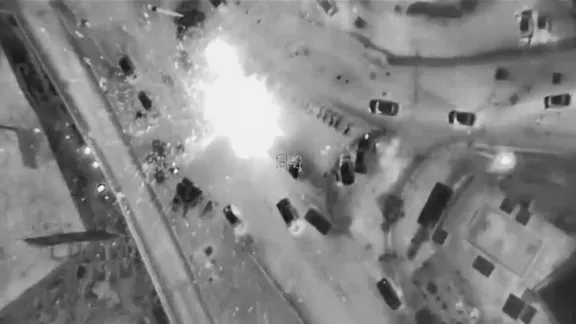
According to the commander in the leaked audio, Israeli forces are increasingly relying on drones rather than fighter jets as they expand operations inside Tehran. He identifies one drone used in the attack as a Heron TP — an Israeli unmanned aerial vehicle capable of remaining airborne for up to 16 hours and carrying multiple missile payloads.
The commander tells his forces that traditional airstrikes have become less frequent because there are “few military targets left” for fighter jets, suggesting drones are now being used to hunt down individual units and checkpoints throughout the city.
He also warns that large clusters of mobile phones can expose the location of personnel to Israeli surveillance.
In response, he instructs Basij fighters — many of whom he says are hiding in schools, mosques, and other civilian buildings — to immediately turn off their phones when they hear drones overhead. Fighters are also told to temporarily abandon their positions and relocate nearby to avoid being killed if missiles strike their checkpoint.
“If armed individuals arrive, confront them,” the commander says, while also advising his forces to reposition in order to reduce casualties from missile attacks.
The warnings come as the IDF has released multiple videos in recent days showing strikes on Revolutionary Guard and Basij checkpoints across Tehran. Telegram channels sympathetic to the opposition have also circulated images claiming to show similar attacks.
The strikes appear to be intensifying fear among the regime’s internal security forces, who have long served as the Islamic Republic’s frontline defense against domestic unrest.
Even as the attacks continued, Iranian leaders attempted to project normalcy.
On Friday, the government held its annual Quds Day rally in Tehran, drawing senior officials including President Masoud Pezeshkian and Chief Justice Gholam-Hossein Mohseni-Eje’i. State television praised the president as “brave” as he walked among regime supporters with only a limited security presence.
But the event was briefly interrupted when an explosion occurred near Enghelab Square while Mohseni-Eje’i was speaking. Security personnel quickly rushed the chief justice away from the area while the broadcast continued.
State media later reported that a woman was killed by explosive shrapnel during the rally.
The unrest comes amid a dramatic escalation in joint Israeli and U.S. operations targeting military infrastructure in and around Tehran. Residents have reported massive explosions across large sections of the capital in recent nights, particularly in the eastern and western districts, as well as in the nearby city of Karaj.
At the same time, the Iranian government has tightened its grip on information inside the country. A resident of eastern Tehran told The Media Line that access to virtual private networks (VPNs) had been blocked and satellite television channels jammed, leaving many residents unable to access outside news about the war.
The regime has also deployed heavily armed security units across Tehran, placing machine-gun-equipped vehicles on city streets and warning that any public demonstrations will be met with a severe crackdown.
(YWN World Headquarters – NYC)