
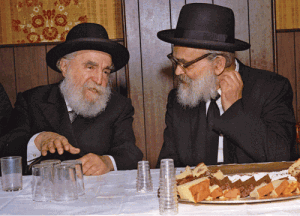

I remember it clearly. It was blow after blow, and klal Yisrael was reeling. Some 40 years later, the Torah world is still limping from the loss of two gedolei Yisrael—spiritual giants who complemented each other in their knowledge, wisdom, and the ability to bear the weight of powerful decisions on their shoulders, together.
Wednesday marks the 40th yahrtzeit of my zeide, Rav Yaakov Kamenetsky, zt”l, who was niftar on 29 Adar I 5746/1986. Two weeks later, on 13 Adar II, Taanis Esther, his dear friend and confidant, the posek hador who guided klal Yisrael for decades, Rav Moshe Feinstein, zt”l, was niftar. In a leap year, like the year they left this world, Rav Yaakov’s yahrtzeit comes first. In a regular year, like this year, Rav Moshe’s yahrtzeit precedes that of Rav Yaakov. Sometimes one is first, sometimes the other.
It is reminiscent of Rashi’s comment that in the Torah sometimes Moshe is mentioned before Aharon and sometimes Aharon before Moshe, to teach that they were equal in stature. While it is not for us to suggest comparisons between gedolei Yisrael (even if one is my own grandfather), this alternating order is striking. It reflects, in a small symbolic way, the shared leadership they provided.
Numerous biographical articles and books have been written about each of these gedolei hador individually. I would like, however, to reflect on a specific aspect of both their lives: the extraordinary relationship between Rav Yaakov and Rav Moshe.
To casual observers, they seemed cut from the same cloth: two Litvishe rabbanim who both became roshei yeshivah and stood together at the helm of American Torah life for decades, carrying the burden of klal Yisrael with mutual respect, deep affection and agreement on almost every critical matter. In reality, however, they came from different backgrounds and different schools of thought, and they often approached critical issues from completely different perspectives.
Rav Moshe was a talmid of Rav Pesach Pruskin, and his outlook was shaped by the Lithuanian rabbinic tradition. His clarity, precision and confidence in psak made him the address for halachic questions from across the United States and around the world. Rav Yaakov, a talmid of Slabodka, carried the imprint of the Mussar movement—measured, thoughtful and attuned not only to the letter of the law but to how that letter would live in the hands of people. He was known for guiding klal Yisrael in general matters with prescient vision that extended far beyond the moment. Yet those differences never became divisions.
I once read about a meeting at which Rav Moshe had rendered a decision on a matter of public concern, and that was how the matter was ultimately adjudicated. Rav Hutner, zt”l—who, like Reb Yaakov, had learned in Slabodka—disagreed with Rav Moshe’s decision, later commenting to Rav Yaakov that “had Rav Moshe learned by our rebbe, he might not have held that way.”
In a different instance, my zeide quietly noted to me that he might not have expressed a certain ruling in the same way Rav Moshe had—because while Rav Moshe was technically correct, my zeide was worried that his ruling in this case might later lead to manipulation in other circumstances—but such observations were never criticisms. (He may have wanted to teach me how he approached certain issues.)
Once, my zeide’s talmid came to him with a very complicated sh’eilah. He refused to rule on it. “This you must ask Rav Moshe. Only Rav Moshe has shoulders broad enough for this,” he said. Then he added, “If Rav Moshe tells you that you may be lenient, you should follow him one hundred percent. It is one hundred percent mutar, and I stand behind it equally.”
After the petirah of Rav Aharon Kotler, zt”l, in the early 1960s, the American Torah world entered a new phase. Rav Ahron’s fiery drive was almost impossible to replicate, but it had to be sustained with steadiness. For the next 20 years, Rav Moshe and Rav Yaakov did that together.
They addressed the concerns of Agudas Yisrael, Chinuch Atzmai, and countless other communal organizations and matters that shaped Torah life. Their affection and reverence for one another was transcendent. Rav Moshe once said, “I love Rav Yaakov, and I am certain he loves me as well,” quoting the pasuk in Mishlei, “Kamayim hapanim lapanim kein leiv haadam laadam—As a face sees its reflection in the water, so does one man’s heart reflect another’s feelings.” Rav Yaakov beamed when he heard this.
Rav Yaakov’s admiration for Rav Moshe was of public record. He once addressed a group who had just visited Rav Moshe, telling them a personal anecdote. “When I was a five-year-old boy,” my zeide said, “everyone in my town envied an old man of about 90 who had, at the age of five, shaken the hand of Rav Chaim Volozhiner. I assure you that in years to come your grandchildren will boast that their zeide had the privilege of meeting Rav Moshe Feinstein.”
My grandfather lived in Monsey. Rav Moshe would sometimes come to Monsey to stay at the home of his son-in-law, Rabbi Moshe Tendler. On those occasions, my grandfather would always go to visit him. I remember driving my zeide to the Tendlers’ home after Rav Moshe had taken ill. Rav Yaakov urged him to rest properly, even bringing proofs from Chazal about guarding one’s health that fit his particular situation. Rav Moshe smiled. One sentence, I can’t forget. With that trademark twinkle in his eye, my grandfather exhorted him gently in Yiddish, “Kenst mir folgen. Ich bin a bissel elter fun eich. You can listen to me. I’m a little older than you.”
Rav Moshe smiled and assured him that he would indeed get more rest.
After we left, Rav Moshe reportedly turned to one of his grandchildren and said, “Now it’s our turn for me to visit Rav Yaakov.”
To read more, subscribe to Ami

