
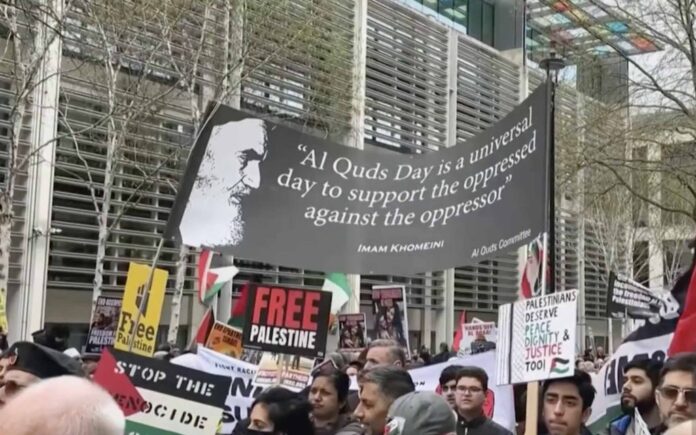

Meet two brave souls, a Muslim lady in London and a Jewish man in Tehran.
First, some background:
A British group, the Islamic Human Rights Commission (IHRC), holds an annual Al-Quds Day march in the UK capital. Al-Quds is the Arabic name for Yerushalayim and, as decreed in 1979 by Ayatollah Ruholla Khomeini, the first Iranian supreme leader [read: “ruthless dictator”], the last Friday of the month of Ramadan is occasion to host marches and demonstrations to express opposition to Israeli control over the Holy City.
Following the vaporization of Iran’s more recent and newly late supreme leader, Ayatollah Ali Khamenei, who ordered the murders of some 30,000 Iranian protesters earlier this year, the IHRC lamented him as “a rare role model” who would be “mourned by freedom-loving people all over the world.”
Now the group is upset. Its planned march through London this year was nixed by British Home Secretary Shabana Mahmood, the Muslim daughter of Pakistani immigrants. She unapologetically approved a request from the Metropolitan Police to ban the march in order “to prevent serious public disorder.” Both Labor and Conservative members of Parliament backed the banning of the march.
A spokesman for the IHRC, Faisal Bodi, told the BBC’s The World Tonight that it was “a sad day for freedom of expression, freedom of assembly and the right of people to legitimately protest about issues they feel strongly about.” Not to mention to incite hatred of Israel and Jews.
Kudos to Home Secretary Mahmood, brave soul #1.
A couple thousand miles away, in Tehran, lives a second intrepid, a Jewish Iranian restaurant owner by the name of Arash.
Middle East Eye is a news medium whose focus lies in its name. It is owned by a company with a single director, Jamal Bessasso, a Kuwait-born resident of the UK. MEE is rumored to be funded by the government of Qatar and is a go-to site for anti-Israel “reportage.”
But it also carries some worthy stuff. Like a recent lengthy piece titled “Iran’s Jews feeling fear and heartbreak as US-Israeli strikes rain down.” It featured quotes from interviews with members of Iran’s small Jewish community—some 9,000 people in a country of 90 million.
One interviewee, Yosef (last names are omitted in the article), “trying to stay safe from air and missile strikes that often originate in Israel, a country he is supposed to feel some affinity with,” according to the interviewer, is critical of Israel, which he says “has damaged [its] reputation around the world.’
“Yes, I’m Jewish,” he explains. “But I cannot see the country where I was born and raised as my enemy.”
Then there’s “Daniel,” a 52-year-old Jewish worker in a jewelry shop in the capital city.
“I don’t remember the time before the revolution,” he says. “But my parents and older relatives always told us that Iran and Israel once had close relations. They never imagined that one day the two countries would be in a situation like this.” (They never imagined Islamist terrorists becoming their country’s government.)
And then there is the aforementioned Arash, 71, who owns a small restaurant in Tehran.
Asked about his own feelings regarding the conflict, he says, “It’s not easy to talk about these things, especially during wartime. This is a war between two countries that you feel connected to.”
He then dares to claim that many of his fellow citizens who are Muslim are resentful of the Islamist regime.
“The level of anger toward the Islamic Republic is so high,” he says, “that many Iranians today see Jews as friends.”
And then he waxes more daring still, and asserts a truth that justifies the omission of his surname, “The real question,” he states, “is: who first promised to destroy the other?” And, in case the interviewer somehow missed the point, Arash makes it explicit: “The policies of the Islamic Republic,” he explains, “helped bring the situation to this point.”
Although he sees himself as an Iranian, he says, “It makes me sad that the policies of this government have brought the country to this situation.”
At some times and in some places, stating an obvious truth, like addressing an obvious danger, is an act of courage.
To read more, subscribe to Ami

