
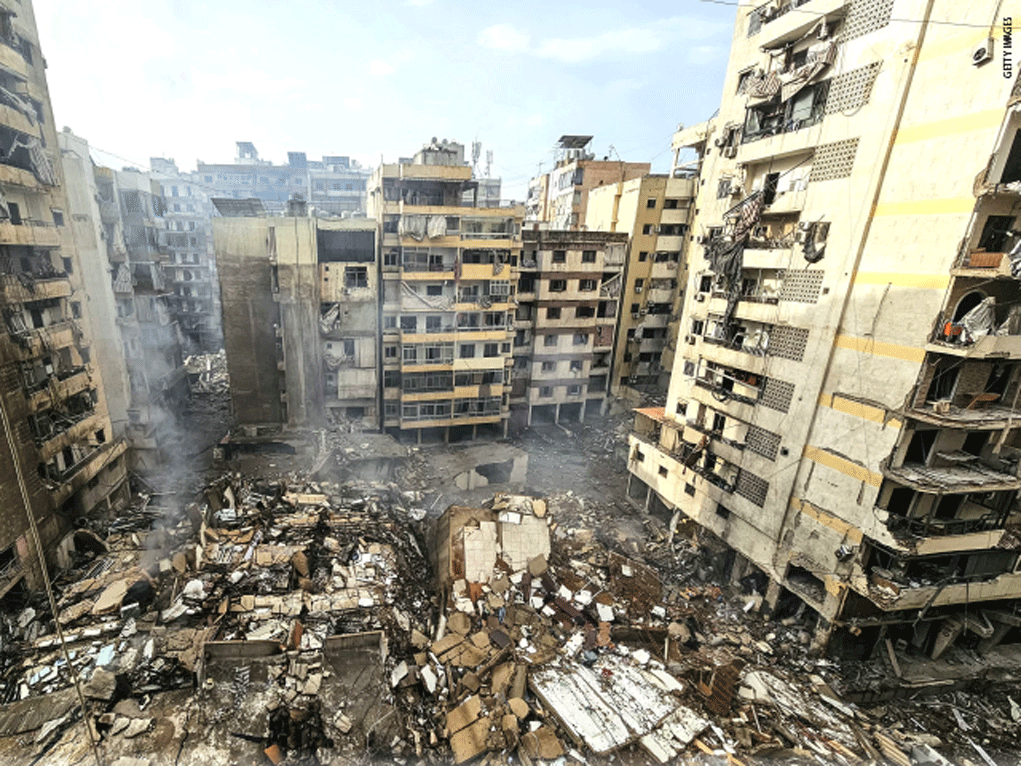

As the joint U.S.-Israeli air war against Iran entered its third week, Iran has been launching far fewer missiles and drones than it did during the opening days of the war, a telling indication of the effectiveness of that joint effort to reduce Iran’s ballistic missile and drone threat. According to a report issued last Sunday on the progress of the war by JINSA, the Washington-based Jewish Institute for National Security of America, Iran had launched roughly 2,800 drones, 1,247 ballistic missiles, and 28 cruise missiles since the war began.
In his comments on the war, Tuesday, during a White House press conference with the visiting prime minister of Ireland, Micheal Martin, President Trump praised Israel’s success in killing two more top Iranian leaders. One of them was Ali Larijani, the head of the Supreme National Security Council, and the man who an IDF statement said had been Iran’s de facto ruler since Supreme Leader Ayatollah Ali Khameini was killed by the devastating Israeli first strike on Tehran, which began the war. The other Iranian regime leaders whose death was announced on Tuesday were Gholamreza Soleimani and his deputy. They commanded the Iranian Republican Guard’s violent Basij paramilitary force that was responsible for executing more than 32,000 Iranian citizens because they protested against the Islamic regime.
Trump also said, “We’re not ready to leave Iran yet, but we will in [the] very near future.”
Israeli Prime Minister Binyomin Netanyahu said that the killing of Larijani was part of Israel’s efforts to “destabilize” the Iranian regime, in an effort to give the Iranian people “the opportunity to remove” the regime from power.
“This will not happen all at once; it will not happen easily,” Netanyahu cautioned. “But if we persist, we will give [the Iranian people] the opportunity to take their fate into their own hands,”
Trump Expresses His Disappointment With NATO
Trump also said Tuesday that he was very disappointed with the refusal by NATO, Great Britain, France, and other U.S. allies to respond to his call for their naval assistance in helping the U.S. to break Iran’s blockade of the Straits of Hormuz, which has disrupted the flow of 20% of the world’s supply of crude oil from the Persian Gulf. Trump also said that NATO’s refusal to help break the blockade confirmed his suspicion that NATO would fail to come to America’s assistance during its hour of need.
“NATO is making a very foolish mistake,” Trump said. “You would’ve thought that they would’ve said, ‘We’d love to send a couple of mine sweepers.’ It’s not a big deal. It doesn’t cost very much money. But they didn’t do that.”
Iran’s Missile Barrages Have Been Reduced
Meanwhile, the number of missiles and drones that Iran is now launching daily against Israel and other Arab states in the region has been reduced drastically from the first days of the war, when Iran was firing 80-100 missiles at a time, in salvos of up to 20 at a time, in an effort to overwhelm Israel’s multi-layer anti-missile system. By last weekend, Iranian capabilities had been reduced to the point that they were launching no more than 10-15 missiles each night, 2 or 3 at a time, at roughly 90-minute intervals.
While the Iranians are still believed to have plenty of missiles stockpiled, the limiting factor has been the number of fixed and mobile missile launchers the Iranians have left with which to fire them. When the joint U.S.-Israeli military planning for the air attacks on Iran began last December, the intelligence services of both countries focused on finding out where those launchers were located so that they could be targeted in the first round of air strikes. As a result, the IDF believes, the number of missile launchers Iran has available for use has been reduced from 460, just before the February 28 first strike was launched, to no more than 140 after just two weeks of precision bombing.
Homefront Command Missile Warnings Becoming More Localized
Because of the reduced volume of the missile fire, Israel’s Home Front Command is modifying its early warning system, which currently sends a preliminary alert to every cellphone across a wide swath of the country as soon as any Iranian missile launch has been detected. As a result, millions of Israelis have been awakened by these preliminary alerts several times in the middle of the night, each night, disrupting their sleep and putting the whole country on edge.
Under the modified system, the Home Front Command will wait before issuing its preliminary alerts until the specific area of Israel at which each Iranian missile has been aimed can be determined. The new, much more localized early warning alerts will cut down on the number of Israelis whose sleep has been interrupted every night by alarms triggered by Iranian missiles falling outside of their immediate vicinity.
Israel’s Walla News service reports that the IDF estimates that Iran has fewer than 150 operational ballistic missile launchers left with which it can continue to attack Israel. That number is being steadily reduced because each time an Iranian missile is launched, the position of its missile launcher is revealed on radar, enabling that launcher to be quickly attacked and eliminated.
IDF Hunting for Iran’s Remaining Missile Launchers
As a result, it is now believed that almost all of the permanent missile launching sites Iran had before the war started have been destroyed. Its remaining mobile missile launchers are now being aggressively hunted by the Israeli and U.S. warplanes constantly patrolling the skies over Iran.
Also, according to Walla News reports, senior IDF officers believe that Iran, in recent days, has increasingly been struggling to coordinate its missile launches because of the tremendous damage that has been done by repeated Israeli and American air strikes to the Iranian missile command and control infrastructure. Another factor is the fear of exposure by the Iranian missile launching crews, who know that they are likely to come under an almost immediate U.S. or Israeli air attack because their location will be revealed by the launch.
The nature of the threat from the Iranian ballistic missiles to Israel has also changed because about half of them are now being armed with cluster warheads.
Iran Using Cluster Munitions to Maximize Civilian Casualties
The conventional warheads of long-range missiles launched from Iran have typically contained several hundred pounds of high explosives. A single direct hit can destroy or badly damage several adjacent large buildings, killing or seriously injuring those inside, even if they are in a basement bomb shelter or the reinforced room of an apartment. On March 1, the second day of the war, an Iranian missile with a conventional warhead landed on top of a shul in Beit Shemesh. The blast collapsed the building, which fell into the bomb shelter in the basement below, killing nine people and injuring dozens more.
But a cluster bomb warhead is designed to maximize casualties rather than to destroy a building or some other military infrastructure. The warhead is filled with a large number of smaller bomblets, each weighing between 7 and 11 pounds. The warhead is designed to release them at high altitude over the missile’s general target area, scattering the bomblets over a radius of up to six miles. When they hit the ground, the bomblets are designed to explode and spew deadly pieces of metal shrapnel in all directions.
The military use of cluster munitions is banned under a 2008 international convention, which has been signed by over 100 nations around the world, including Great Britain, Australia, and Canada, but not Israel, Iran, or the U.S.
Even though each bomblet is relatively small, Aaron Godiner, the former commander of the Fire and Rescue Authority for Ramat Gan and Givatayim, told a reporter from Maariv that they can still do “severe damage,” depending upon the type of building they strike and exactly where the bomblet hits it. They can also destroy a vehicle on the road, start fires, or create dangerous craters in roads.
For example, last Friday, missile alert sirens sounded across central Israel seven times. While nobody was injured, the bomblets released from the cluster warheads of those Iranian missiles damaged an empty school building in Rishon Letzion and set fire to residential buildings in Shoham and Holon, destroying the homes of dozens of people.
The falling debris from an intercepted Iranian missile, or the Israeli missile that intercepted it, can also be very dangerous. That is why, Godiner said, any Israeli who finds themselves traveling in a vehicle when a missile alert is sounded must get out immediately and seek a proper shelter, and stay there until the all-clear is sounded.
Furthermore, Israeli civilians who find missile debris or unexploded bomblets on the ground should steer well clear and report them to the police immediately.
The Iranian and Lebanese War Fronts Have Converged
From Israel’s perspective, this current two-front war is much more than just another round of the recurring military campaigns that Israel has been fighting for two decades in response to terrorism. Some Israeli strategists have called these occasional, limited wars against enemies such as Hamas in Gaza or Hezbollah in southern Lebanon “mowing the lawn,” because they know that, over time, the terrorists will be able to recover and threaten Israel again.
But this time, a senior IDF official told Ynet reporter Yehoshua, “We are fighting the head of the octopus [Iran and] to solve Israel’s biggest strategic problem, you have to [definitively] defeat it.” At the same time, the IDF official stressed that, in addition to the imperative of defeating the head of that octopus, Israel must also cut off one of that octopus’s strongest arms, Hezbollah, located just north of the Israeli border.
As IDF forces on the ground pushed deeper into southern Lebanon Monday evening, IDF Chief of Staff Eyal Zamir declared that the campaign against Hezbollah has become another central front in the war against Iran. He also observed that, “any damage to the military buildup capabilities of Iran and the Revolutionary Guards also harms Hezbollah’s arming and financing capabilities. The shockwave of the strikes and the weakening of the radical regime in Iran are also felt in the campaign against Hezbollah,” Zamir said.
IDF chief spokesman General Effie Defrin reported on March 15 that the IDF had “attacked more than 2,000 targets in Iran and eliminated thousands of commanders and soldiers from the regime.” He also attributed the sharp increase in the number of daily Hezbollah missile and drone attacks to “the increasing pressure” on Hezbollah from IDF attacks over the previous two weeks.
“So far, we have attacked more than 700 targets of the [Hezbollah] missile system in real time. We have managed to reduce the firing and have taken more than 70% of the ballistic missile launchers out of use,” Defrin claimed.
One of the prerequisites for the intensified Israeli air campaign against Iran to succeed was the rapid neutralization of Iran’s air defenses to give Israeli warplanes the ability to roam freely across the skies over Iran in search of their targets on the ground without fear of being shot down. The IDF was able to achieve absolute air superiority over almost all of Iran within 24 hours of the initial attack, by destroying more than 200 Iranian anti-aircraft radar and air defense installations, and reducing Iran’s overall air defensive capabilities by an estimated 85%.
Israeli leaders also believe that the joint U.S.-Israeli air strike campaign against Iran was launched just in time to prevent Iran’s existential threat to Israel’s survival from reaching an even higher level. They cite the fact that Iran’s negotiators had boasted to U.S. negotiators Steve Witkoff and Jared Kushner in the latest round of negotiations that Iran had enough highly enriched uranium on hand to build 10 or 11 atomic weapons almost immediately. Iran was also rapidly ramping up its production of long-range ballistic missiles with which to bombard Israel’s population centers, having already added 1,000 of such weapons to its arsenal since the joint U.S.-Israeli 12-day air campaign against Iran last June.
Current Israeli Attacks Are Intended to Do More Permanent Damage
The current Israeli air strike campaign against Iran is much more ambitious than its attacks on Iran last June. Instead of aiming to inflict just enough damage to push back Iran’s nuclear and ballistic missile programs by a few years, the IDF’s current Operation Roar of the Lion is being described as a “deep plowing operation,” designed to cripple all aspects of Iran’s sophisticated military capabilities for many years to come.
In its previous wars against Hamas, Hezbollah, and Iran, Israel’s leaders were content to end the fighting after having achieved relatively limited military goals, leaving the enemy regimes weakened but still capable of recovering and renewing their attacks on Israel within a few years. But in its current air strikes against Iran, the IDF is seeking to inflict much more serious and widespread damage to Iran’s entire military-industrial complex, which is largely under the control of the regime’s powerful Islamic Revolutionary Guard Corps (IRGC).
Last June, Israeli air strikes against Iran’s ballistic missile program targeted the Chinese-built planetary mixer machines that it used to create the solid fuel for its most deadly ballistic missiles. But in the current war, the Israeli air strikes have been designed to systematically destroy the entire industrial supply chain for Iran’s ballistic missile program.
Similarly, last June, both the U.S. and Israel specifically targeted the most advanced elements of Iran’s nuclear weapons program. which the Iranians hid so deep underground that only America’s largest and most powerful bunker buster bombs could reach and destroy them. This time, the U.S. and Israel are working their way down through a much more detailed and comprehensive target list that includes the dozens of different Iranian suppliers for every significant component of a nuclear weapon, in addition to the 960 pounds of 60% enriched, near-weapons grade uranium which Iran had produced before American B-2 stealth bombers buried much of it last June deep under the rubble of the destroyed Isfahan nuclear facility.
According to a Jerusalem Post report, the IDF believes that even if the air war against Iran were to stop immediately, it would take Iran’s military-industrial complex years to recover its former capacity for producing all kinds of weapons and munitions.
Before the current war started, the United States military and the IDF had identified 2,600 Iranian military-industrial targets to be attacked. Just two weeks after the war started, the IDF believed that two-thirds to three-quarters of those sites had already been destroyed, and that the remainder had been marked for rapid destruction, which has effectively rendered Iran’s military incapable of recovering from its material losses.
Disrupting the Chain of Command of Iran’s Missile Force
In addition to dismantling Iran’s military-industrial infrastructure, U.S. and Israeli air strikes have focused upon disrupting the entire chain of command and control for Iran’s ballistic missile force, by disabling its command centers and by targeting its senior and mid-level commanders, both at work and in their homes. That is believed to be one of the reasons why the total number of ballistic missiles that have been fired by Iran at Israel since the current war started is so much smaller than in the missile attacks that Iran launched last June over roughly the same period of time.
The IDF has also been trying to undermine the stability of Iran’s Islamic regime by targeting its internal security forces, starting with the leadership of the IRGC, and including the army of roughly one million Islamic-indoctrinated members of the Basij militias whose assignment is to terrorize the rest of Iran’s civilian population and keep it aligned behind the regime.
The Israeli defense establishment reportedly believes that the side effects due to the damage it has inflicted upon Iran’s military establishment over the past two weeks are already starting to become evident. In addition to its elimination of most of the top two tiers of Iran’s political and military leadership, and the infliction of thousands of military casualties, Israel also claims it has detected telltale signs of a decline in the morale of the typical Iranian soldier, including an increase in the reported instances of insubordination and outright desertion.
A senior Israeli official told The Times of Israel that he sees “signs of cracks” within the Iranian government and that the U.S. and Israeli militaries “are creating the conditions” for its collapse. However, he noted that “at the end of the day, it’s up to the Iranian people” to ultimately overthrow the regime, and the current harsh security crackdown by the regime against any sign of public resistance makes any such effort highly unlikely, at least for the moment.
Signs of Stress Appearing in Iran’s Security Apparatus
However, according to a report by David Patrikarakos in Britain’s Daily Mail newspaper, the “Iranian security apparatus [is] under severe and accelerating internal strain. [Over a recent four-day period,] more than 60 incidents have been documented across virtually every branch of the regime’s military and security apparatus. . .
“There are many reports of IRGC soldiers being executed for desertion,’ the source for the Daily Mail report continues. ‘It’s happening constantly. IRGC leaders are also regularly executing subordinates for refusing to carry out orders.”
According to the report, “The killings are often carried out under secret orders so tightly classified that even fellow officers are kept in the dark. . .
“[Iranian] authorities suspect sabotage and the incidents are followed by investigations, arrest, and yet more executions.”
Meanwhile, President Trump has continued to threaten the Iranian authorities behind the mass murder of civilian Iranian protesters during the January uprising. Trump has said, “We have them on tape — we know who they are,” and “when they’re caught, they will be tried and executed.” Meanwhile, the IDF posted on its Persian-language social media account that some members of the notorious, Islamic regime-backed Basij militia have gone into hiding because some of the most recent Israeli air strikes have targeted the most prominent of the Basij operatives and their street checkpoints across Tehran.
Iran’s Leaders Realize They Are Fighting for Their Own Survival
On the other hand, because those who control Iran’s Islamic regime now realize that they are in a fight for their own lives as well as the regime’s survival, they have further intensified the reign of terror against any sign of dissent displayed by the Iranian people. Ever since the initial U.S.-Israeli decapitating air strike on February 28, suspected Iranian dissidents are reportedly being arrested by the thousands, and armed members of the Basij militias are patrolling the streets of cities across Iran with orders to shoot to kill anyone who appears to be protesting against the regime.
But because of that unprecedented level of government-sponsored repression, there are not yet any signs on the ground in Iran of a return of the kind of open public resistance against the Islamic regime which broke out in late December and early January, and which was put down cruelly by the reported mass murder, by agents of the regime, of more than 30,000 unarmed civilian protesters.
President Trump said publicly, on the morning after launching the first attack of the current war, that the U.S. was now delivering the help that he had promised to the protesters. He then told the protesters, “When we are finished, take over your government. It will be yours to take.”
But now Trump realizes that immediate regime change through another uprising by the Iranian people was an unrealistic expectation. In a radio interview with Brian Kilmeade of Fox News last week, Trump now concedes that when the Iranian people are told by their rulers that, “‘Anybody who protests, we’re going to kill you in the streets,’ I really think that [regime change is] a big hurdle to climb for people that don’t have weapons.”
Iran’s People Are Being Kept Captive in Their Own Homes
According to the sources inside Iran of Daily Mail reporter Patrikarakos, daily life there has become very bleak. The Iranian people “are mostly confined to their homes while U.S. and Israeli airstrikes continue to pound Iran. Trips out into the street and shops are few and mainly for basics, and retribution for those who step out of line is swift. . .
“Across the board, there is extremely heavy repression. There are checkpoints everywhere in Tehran. People are being beaten, investigated, and detained.”
Iran’s national police chief, Ahmad-Reza Radan, recently said in a state network broadcast, “If anyone comes forward in line with the wishes of the enemy, we will no longer see them as merely a protester, we will see them as an enemy, and we will do to them what we do to an enemy.”
But according to the Daily Mail report, it has also become increasingly apparent that, despite the highly organized repression, “Regime forces are more scared of a mobilized [Iranian] population than [the American and Israeli] air strikes.”
Patrikarakos quotes a friend he calls “Mahmoud” who lives in Tehran as saying, “‘It’s terrifying. The bombs are very loud, and we hear them through the night. I gather with my family and try to tell them we will be OK. We are very afraid. It’s a terrible war. But we hope the Americans will succeed.”
Another friend of the reporter, identified as a 45-year-old office worker named Bager, says that, “Right now, it seems little has changed. But we hope the regime will be much weaker when this war ends. One day, Trump and Netanyahu will finish the job. Then, believe me, our time will come,” he says.
Unpaid Iranian Security Personnel Growing Resentful
According to the same Daily Mail report, “another growing source of chaos is the regime’s failure to pay its thugs. Across Iran, soldiers and security personnel from multiple branches have reportedly staged protests, threatened to abandon their posts, and, in some cases, deserted after months of unpaid salaries and pensions. Critically, the anger cuts across the ranks, from ordinary troops to senior officers.
“[But] instead of addressing the mounting financial crisis, [Iranian] authorities are doing what they always do: lash out. The result is more surveillance, more intimidation, more punishment.
“The effect is merely to breed yet more resentment among the very forces the regime relies on to keep it. . . in place.”
As a result, Daily Mail reporter Patrikarakos concludes, “When the smoke clears, people will be surprised at how degraded the regime’s machinery of terror is. It’s only a matter of time before it starts breaking down. No one seems to understand just how much trouble the regime is now in.’
More Top Iranian Leaders Reported Killed
As the U.S. and Israeli air strikes have continued to target Iran’s remaining leaders, Israel’s Defense Minister, Israel Katz, announced that one of Iran’s top longtime security officials, Ali Larjani, was the latest to be killed. The IDF also announced Tuesday that it assassinated the head of the IRGC’s Basij paramilitary militia, Gholamreza Soleimani, and his deputy, Seyyed Karishi, as well as the IRGC’s Aerospace Force chief.
Since the start of the war, Larijani has played a far more visible role in ruling Iran than its new supreme leader, Mojtaba Khamenei, who has not been seen in public since he was appointed by a committee of Iran’s top Islamic leaders to replace his father, who was slain in the massive Israeli attack that began the war on February 28.
Iranian sources have confirmed that the new supreme leader was also wounded in the same attack that killed his father, but the extent and exact nature of his wounds remain a topic of widespread speculation. On March 14, President Trump cited reports suggesting that Mojtaba Khamenei might be too seriously wounded to appear in public, and that he might not even be still alive.
By contrast, according to a report from the France 24 news service, Larijani allowed himself to be seen in public “walking with crowds at a pro-government rally last week in Tehran as a sign of defiance against Israel and the U.S.”
Some observers had suggested that Mojtaba Khamenei was only appointed to serve as a figurehead replacement for his father and that Larijani was the person who was actually running the government of Iran on a day-to-day basis after the February 28 attack.
For the last two decades, Larijani had been widely known in Iran for being particularly “adept at balancing ideological loyalty with pragmatic statecraft.” He had also been closely associated in recent years with the management of Iran’s nuclear policy and its strategic diplomacy.
Last year, Larijani was appointed to head Iran’s top security body, the Supreme National Security Council. His death, if confirmed, would be yet another major blow to the leadership of the Islamic regime.
Hezbollah’s New Leader Is an Iranian-Controlled Puppet
Meanwhile, as the daily Hezbollah rocket attacks have continued to exceed those from Iran, it has become apparent to Israeli officials that Hezbollah’s current leader, Naim Qassem, is not just “giving in” to Iranian pressure.
Instead, Qassem appears to be fully committed to the destruction of northern Israel, regardless of the consequences to Lebanon and its people from the inevitable Israeli retaliation. He is acting like a puppet controlled by Iran by putting his allegiance to the radical goals of Iran’s Shiite Islamic regime first, far above his loyalty to the best interests of his country, Lebanon. Qassem’s determination to destroy Israel is not just political in nature, but rather appears to be the result of a deep ideological and religious commitment.
Therefore, when Hezbollah decided to join the fighting on March 2, it did not limit itself to largely symbolic missile fire against targets in northern Israel, which is what his predecessor, Sheik Nasrallah, did to support Hamas in Gaza soon after its October 7 attack. When Hezbollah escalated its attacks on Israel last week by firing a barrage of about 200 rockets and around 20 drones in one night, it signaled to the IDF that it was facing a major new enemy it must deal with immediately, while continuing to press its attacks on Iran.
Israel Denies That the Escalation Against Hezbollah Is a Distraction
The New York Times has reported that some people within the Trump administration view Israel’s decision to devote more of its military assets to finishing the job of destroying Hezbollah as an unwelcome distraction from the fight against their main common enemy, Iran.
But from the Israeli perspective, Iran and Hezbollah, especially today, are virtually the same. Therefore, the Israelis believe, the best time to put an end to the threat from Hezbollah to northern Israel, once and for all, is when the Iranian regime is too preoccupied with fighting for its own survival to give Hezbollah much help.
Denying suggestions that Israel’s decision to ramp up its war against Hezbollah has become a source of contention with U.S. leaders, the IDF issued a statement Sunday insisting that the Israeli and U.S. militaries are continuing to maintain a “close and ongoing security and strategic cooperation, based on professional dialogue and the highest level of transparency.”
The IDF statement also declared that, “the claim that the IDF deliberately opened an additional front with Lebanon is incorrect and misleading.” It then explained that, “Hezbollah made a deliberate decision to join the war being waged by Iran against Israel and launched a wave of strikes, acting [under] the direction of the Iranian regime.”
High Level of U.S.-Israeli Military Cooperation Still Unprecedented
It is also clear that the closeness of the cooperation between the U.S. and Israel in their joint war against Iran, at the very highest levels, remains unprecedented. Since the war began, Trump and Netanyahu have been talking to each other almost every day, and Netanyahu has clearly decided to allow Trump to make all of the most important decisions about how their joint war will be conducted against Iran, from beginning to end.
This is the first time that the Israeli military has fought a war alongside another country’s military shoulder to shoulder — or more precisely, in this case, wing to wing. As a result, there are now units within the IDF that are conducting roughly half of their internal communications in English. IDF Chief of Staff General Eyal Zamir is now speaking with the Chairman of the Joint Chiefs General Dan Caine and CENTCOM commander Admiral Brad Cooper to coordinate U.S.-Israeli military cooperation daily. Some Israeli commentators have quipped that this is the first war that the IDF has ever conducted in the English language.
The groundwork for the current high level of cooperation between the two military organizations was established with the creation of the joint U.S.-Israeli Civil-Military Coordination Center (CMCC), located in Kiryat Gat, to oversee the implementation of Trump’s 20-point ceasefire agreement for Gaza. That center has served ever since as a model for the ever-closer military cooperation between the two countries. As a result, when the political call was made by Trump and Netanyahu to use their forces jointly to attack Iran, both CENTCOM and the IDF were well-prepared to work closely together.
As of now, more than a thousand Americans are in Israel, and in both military organizations, and there are joint coordination cells, both for defensive and for offensive operations, where senior military officers from the other country are present to actively participate in the planning and real-time direction of military operations against Iran.
The division of labor between the two militaries in attacking Iran is either geographic or by specific mission. Geographically, the IDF is responsible for handling the surface-to-surface missile batteries in western and central Iran firing at Israel, while the Americans handle the southern surface-to-surface missile batteries firing at their installations across the region.
However, in some cases, so much close coordination has been required that U.S. and Israeli fighter pilots have flown joint missions against Iranian targets.
It also should be noted that the Iranians are firing missiles with a shorter range (typically 200-300 miles) at closer American targets in the region, while the missiles that Iran is firing at Israel need a range of at least 1,000 miles to reach their targets.
At this point, the greatest concern of Israeli officials is that Trump may feel compelled to give in to the growing domestic political pressure from those within his own Republican Party and MAGA movement to declare an end to the war before the Iranian regime is totally defeated.
According to a New York Times report, Trump has also been talking frequently with Saudi Arabia’s Crown Prince, Mohammed Ben Salmon, and like Netanyahu, the Saudi crown prince has been urging President Trump not to end the war against Iran before its military capabilities have been completely destroyed, even though Saudi Arabia itself has not retaliated against Iran for its recent missile and drone attacks on Saudi oil facilities.
Trump Now Facing Two Crucial Decisions on the Future of the War
The two most important strategic military decisions that Trump will have to make, that will determine the future course of the war against Iran, are whether to use the 2,500-man U.S. Marine expeditionary force now on its way from Japan to Middle Eastern to forcibly remove the 970 pounds of near-weapons quality 60% enriched uranium from Iranian territory, or to invade and take over Iran’s Kharg island oil export terminal in the northern Persian Gulf, further crippling Iran’s oil exporting-based economy.
Many believe that the U.S. air strikes targeting Iran’s military assets on Kharg Island last week were intended to make it easier for the Marines to invade the island and gain direct control over most of Iran’s oil exports if and when Trump decides to give that order as commander-in-chief. On March 14, following those air strikes, Trump announced that the United States had “executed one of the most powerful bombing raids in the history of the Middle East” and had “totally obliterated every military target in Iran’s crown jewel, Kharg Island.” He added that he decided “not to wipe out the oil infrastructure on the island,” but then warned that if Iran continues to interfere with “the free and safe passage of ships through the Strait of Hormuz, I will immediately reconsider this decision.”
But when asked by reporters whether he was willing to send the Marines into Iran to seize and remove the enriched uranium from the tunnels in Isfahan, he admitted that, “We haven’t made any decision on that. We’re nowhere near it.”
In the meantime, the high level of cooperation between Israel and the United States has been replicated throughout the command structure of the military organizations of both countries. For the past several months, senior Israeli and American general officers have been in constant consultation with one another in developing and implementing their joint military plans for the attack on Iran.
IDF Now Admits That It Underestimated the Threat From Hezbollah
Nevertheless, the morning after Hezbollah launched its 200-missile barrage, the leadership of the IDF publicly admitted that it had failed to properly prepare the civilians of northern Israel for the possibility of renewed missile attacks of that magnitude. They also apologized for failing to notify local elected leaders, such as Nahariya Mayor Ronen Marli and Mateh Asher Regional Council head Moshe Davidovich, so that they could anticipate the emergency needs of the residents of northern Israel, many of whom have only recently returned to their homes, due to the renewal of Hezbollah missile attacks.
In response to the daily barrages of Hezbollah missiles, the IDF responded by increasing its air strikes against the remaining Hezbollah targets in southern Lebanon. The IDF has called for the evacuation of all Lebanese civilians from the area south of the Litani River, and expanded the number of mobile Israeli military outposts deep inside southern Lebanon, and far beyond the border fence along which they had been deployed since the November 27, 2024, ceasefire.
Displaced Lebanese Won’t Return Until Northern Israel Is Safe
In addition, Israel’s Defense Minister, Israel Katz, has publicly declared that the hundreds of thousands of Lebanese civilians who have been forced to evacuate their homes in southern Lebanon will not be permitted to return until the Israeli citizens who have been forced by the current Hezbollah missile and drone attacks to abandon their homes in northern Israel will also be able to return in safety.
Towards that end, the IDF has been gearing up for a major ground invasion to seize virtually all of Lebanon south of the Litani River and destroy all Hezbollah installations in that area. Israel is surging troops to its northern border as it expands operations against Hezbollah.
The operation would, according to reports, involve a larger number of ground troops than Israel’s 2024 ground operations inside Lebanon. Two brigade-level combat teams and multiple combat engineering battalions will soon be joining the IDF’s Northern Command, and the IDF’s Golani Brigade is also now ready for redeployment in the North. All together, the additional Israeli troops will provide the IDF with enough additional manpower to push the Hezbollah fighters now in southern Lebanon further away from Israel’s northern border, while systematically eliminating all of their arms depots, missile launching sites, and other pieces of military infrastructure that Hezbollah had recently placed in that region to renew their attacks on Israel’s northern communities.
The IDF announced that it began conducting targeted raids last week to combat Hezbollah activity in the southern Lebanese town of Rab al Thalathine, less than three miles from the Israeli border. During those operations, Israeli forces reported killing dozens of Hezbollah operatives and destroying Hezbollah weapons storage facilities, a command post, and observation sites.
Weakening Hezbollah Enabled Israel to Attack Iran Directly
But if Hezbollah had been allowed to remain at the high military operational level it achieved just before the Israeli invasion of Lebanon two years ago, the IDF likely would never have attacked Iran at all, neither last June nor three weeks ago, for fear of a devastating ground and missile attack on northern Israel by Hezbollah, for which Iran had been helping it to prepare.
But Hezbollah is no longer the same formidable paramilitary organization that was ready to launch an invasion of northern Israel even more devastating than the Hamas October 7 attack. The Hezbollah attack would have been supported by a barrage of thousands of rockets per day, with enough range to inflict major damage on Tel Aviv’s skyline and every other major Israeli population center as far south as Be’er Sheva.
During Operation Northern Arrows in late 2024, which began with the detonation of Mossad-provided exploding pagers and featured the assassination of Hezbollah’s longtime leader, Sheik Hassan Nasrallah, the IDF thoroughly defeated and demoralized the Iranian-backed Lebanese terrorist organization. The only force that ultimately prevented Hezbollah’s complete destruction at that time, Israeli officials say, was the United States under President Biden, who pressured Israel into accepting another toothless ceasefire agreement in Lebanon, which Hezbollah never had any intention of keeping.
Finishing Off Hezbollah Won’t Be Quick or Easy
But Israeli officials are still warning against harboring the illusion of a quick and decisive IDF victory over Hezbollah today, even in its current severely weakened state. “There is no such thing,” they say, according to Ynet military analyst Yossi Yehoshua.
While he writes that the IDF’s military achievements against Hezbollah since the current war started on February 28 are “enormous,” he warns that it still retains “roughly about 20% of [the capabilities] it had on the eve of the war. That is still enough to launch dozens of precision [longer-range] rockets toward central Israel [each day] as well as [an arsenal of] about 20,000 shorter-range rockets [with which it could once again paralyze] northern Israel.
As a result, Yehoshua concludes, the complete dismantling of Hezbollah’s remaining military capabilities must remain one of Israel’s central objectives of this war. But the challenge for the IDF will be finding enough military resources to pursue that goal while at the same time keeping up its pressure on the main enemy, Iran, which created, supported, and now largely directs Hezbollah’s much more numerous missile attacks, primarily against targets in northern Israel, on a day-to-day basis.
Hezbollah Now Facing More Opposition From Within Lebanon
However, by dragging Lebanon into Iran’s war with the U.S. and Iran, Hezbollah has further weakened its domestic political influence. As a result, Hezbollah has, for the first time, come under direct public criticism from Lebanon’s president, Joseph Aoun, for dragging Lebanon, against its will, into the war between Iran and Israel. President Aoun has also made no secret of his desire to negotiate a separate ceasefire agreement with Israel, which would include the complete disarmament of Hezbollah by the Lebanese army.
The disarmament of Hezbollah by the Lebanese army had been one of the conditions of the November 2024 ceasefire agreement. But the Lebanese government at that time did not have the courage to carry out that task, which permitted Hezbollah to rebuild its military capabilities, despite frequent IDF raids and attacks intended to interfere with Hezbollah’s recovery.
Reportedly, former Israeli Minister for Strategic Affairs Ron Dermer has been invited by Prime Minister Netanyahu to rejoin his government in order to explore those diplomatic possibilities, not only with the non-Hezbollah-affiliated leaders of the Lebanese government, but also with the blessings of Saudi Arabian officials.
The United States and France are also said to be interested in helping to create a new post-Hezbollah Israeli-Lebanese relationship tailored on the Abraham Accords, and based upon direct negotiations between Israeli and Lebanese officials hosted by a neutral third country. According to an Axios report, France has already put forth a draft of such a ceasefire agreement, which would also require mutual diplomatic recognition between Israel and Lebanon for the first time since Israel declared its independence in 1948.
Closure of the Straits of Hormuz Is an Open Challenge to Trump
However, there is no such ceasefire agreement yet in sight between the U.S. and Israel on one side, and Iran and its weakened proxies on the other. In fact, by announcing that it was closing the Straits of Hormuz to peaceful passage by tanker ships from the Persian Gulf carrying 20% of the world’s crude oil supplies, Iran has defiantly challenged President Trump and the U.S. Navy to prove that they can break the blockade.
In response, Trump has tried to calm the panic, which has already driven the price of crude oil above the psychologically significant $100-a-barrel level on international markets, by arranging for the worldwide release of 400 million barrels of oil from the emergency reserves of several pro-Western nations, including 172 million barrels to be drawn from the American Strategic Petroleum Reserve (SPR).
The need to draw on the oil stored in the SPR to deal with Iran’s wartime closure of the Straits of Hormuz has caused some Republicans to renew their prior criticism of then-President Joe Biden. They blame him for withdrawing a total of 230 million barrels of oil from the SPR during 2021 and 2022, purely for his own domestic political benefit, by reducing the cost of gas at the pump for American consumers. But by reducing the amount of oil in the SPR by almost half, Biden made the U.S. and its allies much more vulnerable to Iranian oil blackmail by closing the Straits of Hormuz, as we have seen over the past week.
Trump Frustrated by the Response to His Call for Persian Gulf Help
Trump is also urging those nations that rely heavily on Persian Gulf oil to join with U.S. Navy ships to provide an effective military escort for their tankers. These convoys would enable those ships to pass safely through the Straits of Hormuz, once the U.S. military has had enough time to fully eliminate Iran’s ability to attack them.
On March 14, President Trump said, “Many countries, especially those who are affected by Iran’s attempted closure of the Hormuz Strait, will be sending warships, in conjunction with the United States of America, to keep the Strait open and safe.” He then added that, “Hopefully China, France, Japan, South Korea, the United Kingdom, and others that are affected by this artificial constraint [on the international oil trade] will send ships to the area.”
In a conversation the next day between Trump and British Prime Minister Keir Starmer, they discussed the “importance of reopening the Straits of Hormuz to end the disruption to global shipping, which is driving up costs worldwide,” according to a spokesperson for the prime minister, after Trump had belittled Starmer last week for offering to send two British aircraft carriers to the Middle East to protect its own bases as well as the oil facilities of its allies in the Gulf which have come under Iranian missile and drone attacks. Trump said at that time that “We don’t need them [the British aircraft carriers] any longer [because] we don’t need people that join wars after we’ve already won!”
Iran’s Initial Advantage in the Straits of Hormuz
Trump did not yet realize that the battle for control over the Straits of Hormuz with Iran was just beginning, with Iran holding the initial advantage by virtue of its geographical location on one side of the Straits and its forty years of military preparations for that phase of the war.
On Monday, President Trump said that his call upon nations heavily dependent upon Persian Gulf oil exports to provide escort ships for their tankers had met with a mixed reaction, and that even some of America’s closest allies rejected his request because they did not want to risk being attacked by Iran.
Trump also suggested that their responses were proof of their ingratitude for many years of generous U.S. support. When asked about the response to his requests for warships from Great Britain and France, Trump said that he was still expecting them to cooperate, but that their lack of enthusiasm was troubling. He also said that reopening the Straits was much more important to America’s European allies, because thanks to his leadership, the United States is now energy independent and no longer heavily dependent on imported oil.
Even though the Pentagon has sent dozens of warships, including three aircraft carriers, and hundreds of warplanes to the Persian Gulf region over the past two months, those forces are now fully committed to staging daily air strikes against targets in Iran, or defending Israel and other pro-American states in the Gulf region against the retaliatory missile and drone strikes still being launched by Iran. That is why the regional U.S. military commanders of CENTCOM have asked the Pentagon to send at least two more U.S. Navy destroyers to the region to escort civilian ships through the Straits without having to divert the other U.S. Navy ships in the area from their current missions.
In an apparent response to Israel’s controversial decision last week to attack and set fire to three oil storage depots in Tehran, Iran has attacked at least 16 oil tankers and other civilian ships in the Persian Gulf. Those attacks prompted Lloyd’s of London to cancel its war risk insurance policies on any other ships that might dare try to pass through the Straits of Hormuz without Iran’s permission. That, in turn, brought an immediate halt to shipments of oil from the Gulf through the Straits to pro-American countries around the world. It also generated a panic that spiked the price of oil on international markets, even though current supplies of oil are ample worldwide, and the promised release of an additional 400 million barrels from strategic oil reserves should prevent any shortages from developing in the near future.
Why Trump Underestimated the Difficulty of Clearing the Straits
Reportedly, President Trump was briefed by his military advisors before the outbreak of the war on February 28, on the likelihood that Iran would attempt to blackmail Trump into ending the war by threatening to close the Strait of Hormuz to commercial oil traffic. Trump believed at the time that the U.S. military could easily deal with that threat.
Perhaps it was because the U.S. military had been able to do so almost 40 years ago. During a period between 1987 and 1988, then-President Ronald Reagan ended an Iranian blockade against Kuwaiti oil tankers in the Straits of Hormuz by arranging for convoys of those tankers to be guarded by U.S. Navy warships, as well as by ordering separate U.S. military attacks that sank several Iranian warships.
However, the task of protecting shipping in the Straits of Hormuz from attacks by Iran is much more difficult today because Reagan’s Cold War-era U.S. Navy had many more warships available for such tasks than it does now. In addition, Iran now has in its arsenal long-range anti-ship missiles and large numbers of sophisticated attack drones with which to harass tanker traffic, as well as any U.S. warships escorting the ships through the Straits.
Trump also admitted Monday that he and his military advisors were “shocked” by Iran’s decision to launch large-scale missile and drone attacks on its Persian Gulf neighbors, even though none of those states had accepted Trump’s invitation to join in the initial U.S.-Israeli attack on Iran that started the war on February 28. Trump insisted that “no expert would have known” in advance that Iran would make such a move in an apparent effort to expand the scope of the war across the entire region, even though Iran had warned explicitly that any country in the region that was hosting U.S. troops on its soil would be treated as a legitimate target for attack.
Reagan’s Position Against Iran 40 Years Ago Still Rings True
In remarks to reporters in the White House Briefing Room on May 29, 1987, President Regan told the American people to: “Mark this point well: The use of the vital sea lanes of the Persian Gulf will not be dictated by the Iranians. . . The Persian Gulf will remain open to navigation by the nations of the world.
“Now, I will not permit the Middle East to become a chokepoint for freedom or a tinderbox of international conflict. Freedom of navigation is not an empty cliche of international law. It is essential to the health and safety of America and the strength of our alliance. Our presence in the Persian Gulf is also essential to preventing wider conflict in the Middle East. . .
“We’re in the Gulf to protect our national interests and, together with our allies, the interests of the entire Western World. Peace is at stake; our national interest is at stake. And we will not repeat the mistakes of the past,” Reagan emphasized.
“Weakness, a lack of resolve and strength, will only encourage those who seek to use the flow of oil as a tool, a weapon, to cause the American people hardship at home, incapacitate us abroad, and promote conflict and violence throughout the Middle East and the world,” President Reagan concluded.
Trump Trying to Calm the Oil Price Panic
Meanwhile, President Trump and other administration officials have been trying to assure American consumers that the sharp spike in the price of gas at the pump they have seen since the war started is temporary, and will quickly return to low pre-war levels in just a few weeks, when Trump is expected to declare that the U.S. goals for the war have been achieved.
Speaking with NBC News on March 14, President Trump stated that Iran now “wants to make a deal” to end the war, but that he refused their offer because he felt that their proposed “terms aren’t good enough yet.” The Times of Israel has also reported that Trump and his negotiators have rebuffed recent attempts by unnamed states in the region to broker a new set of U.S. peace negotiations with Iran. After Iran used the most recent set of talks with the U.S. to play for more time to rebuild its missile and nuclear arsenals, Trump is now determined to force Iran to meet his demands before he agrees to allow his negotiators to participate in any new diplomatic effort to end the war.
Trump Is Not Yet Willing to Talk to Iran About a Ceasefire
The Trump administration has also rebuffed attempts by some of America’s Middle East partners to initiate ceasefire negotiations with Iran, according to a report from The Times of Israel based upon three unnamed sources.
In his March 14 interview, Trump insisted that Iran will have to totally renounce its nuclear ambitions as a prerequisite for any renewal of peace talks. Trump then repeated the list of U.S. military achievements during the two weeks since the war started. “We’ve knocked out most of their missiles. We’ve knocked out most of their drones. We knocked out their manufacturing of missiles and drones, largely.”
Trump also predicted that within a few more days, Iran’s military capabilities would “be totally decimated,” reducing the scale of its attacks to “dropping a mine or shooting a relatively short-range missile.” U.S. Energy Secretary Chris Wright confirmed Trump’s predictions the very next day by declaring that the war would end within the next few weeks, leading to a sharp rebound in oil supplies and a subsequent decline in energy prices back to pre-conflict levels.
Israel Has Announced Plans for a Longer War Against Iran
General Defrin, the IDF’s chief spokesman, also said Sunday that, “in coordination” with the U.S. military, the IDF has detailed operational plans for attacks on Iran “through at least the Jewish holiday of Pesach, about three weeks from now. And we have deeper plans for [another] three weeks [of attacks on Iran] beyond that. . . We still have thousands of targets in Iran, and we are identifying new targets every day.” Defrin also said that the Israeli military is “not working according to a stopwatch, or a [set] timetable, but rather [is ready to keep attacking Iran until we] achieve our goals.”
The last comment is especially interesting because Trump has indicated that he expects the joint U.S.-Israeli air war against Iran to be over no later than by the middle of April, and given his attitude after declaring the end of last June’s 12-day war against Iran, it is highly unlikely that Trump would permit continued Israeli attacks on Iran after he has declared the current war to be over.
Why Trump Is Sending More U.S. Marines to the Region Now
However, the announcement last week that the Pentagon is moving a 2,500-man Marine expeditionary unit and supporting warships from the USS Tripoli Amphibious Ready Group to the Middle East, as a response to Iran’s attacks on shipping in the Strait of Hormuz, suggests that Trump may be more willing than most observers believe to put American “boots on the ground” inside Iran. In addition to its complement of Marines, the USS Tripoli serves as a launching and landing pad for 20 F-35B jump-jet stealth warplanes, which could provide close air support for an effort to capture and remove Iran’s stockpile of highly enriched uranium, most of which is believed to be buried deep underground in the collapse of the nuclear plant in Isfahan. The USS Tripoli could also occupy the Iranian shoreline along the Straits of Hormuz to help protect tanker traffic, or could attack and destroy Iran’s main Kragh island oil terminal, located 15 miles offshore in the Persian Gulf.
A sizable number of U.S. Marines were already in the Middle East supporting the Iran operation before the move of the expeditionary forces from Japan was announced. In addition, several more plane loads of Marines have landed in the region in recent days, according to U.S. officials.
However, because it will take the amphibious U.S. warships carrying the Marines that are leaving from Japan at least two weeks to reach the waters near the Persian Gulf, it suggests that Trump may be planning for the war against Iran to continue for considerably longer than he has been willing to admit so far publicly.
Israel Calls Report of an Interceptor Shortage Disinformation
Israeli officials have also vigorously denied a report that Israel is running low on its critical supply of ballistic missile interceptors, even though Iran has launched fewer long-range missiles at Israel this time than it did during the war last June. The report was published last week by Semafor, an online news site founded by Ben Smith, who, as editor of BuzzFeed in 2017, was responsible for the first publication of the false claims against then President-elect Trump from the notorious Steele dossier that was secretly commissioned, paid for, and distributed to the media and the FBI by the Hillary Clinton presidential campaign.
An Israeli official later told The Times of Israel that in its missile defense plans for the joint air strikes against Iran with the U.S., “we prepared for a prolonged conflict.” Israel Hayom also reported, citing official sources, that Israel “has a sufficient number of interceptor missiles of all types [on hand, and that its stockpile of missile interceptors] is continuously replenished through round-the-clock production.”
Israeli officials said that they suspect that the false Semafor report of an Israeli missile interceptor shortage was the result of an Iranian disinformation effort designed to turn public opinion against the war, both in the U.S. and in Israel.
The Semafor article quoted a U.S. official saying that Israel’s shortage of missile interceptors was “something we expected and anticipated,” and that the U.S., on the other hand, is not running low, and has all the interceptor missiles it “need[s] to protect our bases and our personnel in the region and our interests.”
The Semafor article also claimed that Israeli officials are trying to “come up with solutions to address” the interceptor shortage. However, it also said that Iran’s increased use of cluster munitions “may exacerbate the depletion of the [interceptor] stock.”
Why Israel Must Use Arrow-3 Missiles to Stop Cluster Munitions
That is because preventing cluster munitions from reaching the ground requires neutralizing the ballistic missile’s warheads carrying them while they are still very high in the atmosphere, before the bomblets are dispersed. That requires Israel to use its Arrow-3 missiles, which alone are designed to intercept their targets before they can re-enter the Earth’s atmosphere.
If the war does continue for longer than the few weeks that Trump has been predicting, it could result in a much higher rate of usage for Arrow-3 interceptors than the types of missiles used by Israel’s other Iron Dome and David Sling anti-missile systems.
Meanwhile, Israel’s Kan Reshet Bet public radio network reports that the United States has recently sent an emergency arms shipment to Israel to replace the roughly 11,000 pieces of munitions that Israel has already used against Iranian targets. Furthermore, over the weekend, Israel’s government approved an emergency allocation of $836 million to pay for the IDF to acquire unspecified armaments and spare parts for the repair of its equipment, especially its warplanes, which have been flying long-distance missions from Israel against Iranian targets around the clock, ever since the war started.
How the Current War Against Iran Has Helped Israel Diplomatically
There is another, potentially positive side to the current, very close and effective Israeli military alliance with the U.S. against Iran. It is the quiet realization by other Muslim and Arab nations, which have been reluctant, until now, to join the Abraham Accords, that Israel is the only military power in the region both capable and willing to protect them from further attacks by Iran and its terrorist proxies, and that has the ability to jump-start whole segments of their economies.
IDF sources have also said that even the Gulf states, which have never considered opening diplomatic relations with Israel, are now quietly asking it for intelligence and other forms of assistance now that they have also been attacked by their shared regional enemy, Iran. These countries now understand that the threat to the stability of the region from Iran should be their paramount concern, and downgrading in their eyes the relative importance of the Palestinian issue, as well as the ultimate fate of Iran’s proxy, Hamas, in Gaza. As a result, it is reasonable to believe that a successful outcome for the current U.S.-Israeli war against Iran could lead to the creation of an entirely more stable and satisfactory security situation across the region, and pave the way for much broader security and economic agreements between Israel and its neighboring states in the near future.