
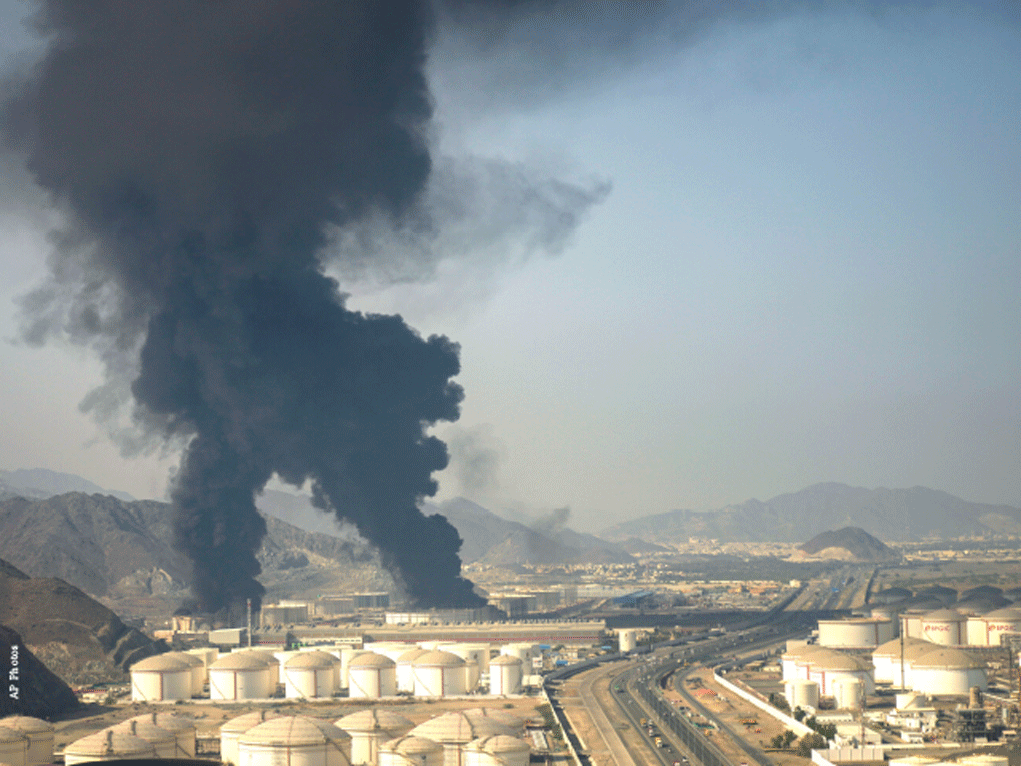

For weeks, the media’s negative spin on America’s war with Iran has echoed claims by Democratic congressmen and left-wing pundits that the U.S. military campaign is “illegal,” “reckless,” and “poorly planned.”
They warned that Washington’s attacks on Kharg Island, Iran’s “crown jewel” containing the regime’s key oil infrastructure, could spark global crises that could end Trump’s presidency.
Democrats have tried to thwart President Trump’s authority to continue the war through a War Powers resolution. Some have gone further, calling for an investigation into alleged U.S. “war crimes” after a girls’ school in Iran was bombed—though it remains unclear which side fired the missile and evidence suggests the school served as a human shield for the IRGC. [See Sidebar]
More recently, critics have claimed the Trump administration was totally blindsided by Tehran’s decision to close the Strait of Hormuz to global shipping.
“The Trump administration appears to have been unprepared for Iran to use the choke point of the strait as leverage,” a NY Times article huffed, pushing the “reckless, poor planning” theme.
But these and other media narratives seeking to undermine Americans’ support for the war and for President Trump’s policies are collapsing under the weight of the facts.
First, the United Nations last week overwhelmingly condemned Iran for violating international law by launching missiles at countries across the Persian Gulf—without any parallel effort to censure Washington for striking Iranian targets.
“UN Security Council Condemns Iran’s Retaliatory Strikes in the Middle East,” the Wall Street Journal reported. The sub-headline added, “In an overwhelming vote, the council backed a resolution condemning Iran.”
Not that the UN retains any moral authority for anyone familiar with its track record of epic corruption. But its silence regarding the U.S. attacks and allegations that they blew up a girls’ school—even from habitual hardline critics such as Russia and China—speaks volumes.
Against that backdrop, the Democrats’ posture on the war appears purely politically driven, as they and their media allies continue to insist Trump’s Iran campaign is “illegal” and violates international law.
Interestingly, U.N. watchers say the vote produced the largest coalition ever assembled around a U.N. Security Council resolution. Thirteen of the Council’s fifteen members supported the measure condemning Iran—while Russia and China merely abstained rather than opposing it—and a record 135 additional member states backed the resolution.
(The U.N. also managed to avoid condemning Israel during the session, which may itself qualify as a record.)
Holding the Strait Hostage: A Familiar Playbook
Concerning Iran’s threats to shut down the Strait of Hormuz, the regime attempted the same gambit when confronted by oil sanctions in 2019 during President Trump’s first term, only to back down in the face of Trump’s warnings of overwhelming retaliation.
In that incident, Iran sabotaged four tankers in the UAE, mined two freight ships in the Gulf of Oman, and drone-struck Saudi Aramco. But faced with Trump’s dire threats of reprisal, the regime buckled.
“Never, ever threaten the United States again, or you will suffer consequences the likes of which few throughout history have ever suffered,” Trump warned the ayatollahs in a 2019 online post.
In other words, the president was familiar with Tehran’s playbook and likely anticipated the ayatollahs’ present-day bluster. But the Times historical memory appears not to extend to 2019, as it continues pushing the narrative of an administration caught “unprepared.”
“Of course, we planned for it. For decades, Iran has threatened shipping in the Strait of Hormuz. This is always what they do: hold the Strait hostage,” Secretary of Defense Pete Hegseth told a reporter who asked him why the Pentagon had not planned for the strait being choked off to traffic, which will cause oil prices to spike.
“We planned for it. We recognize the pattern,” Hegseth told the reporter. “Iran has been exercising sheer desperation in the Strait of Hormuz. Ultimately, we want to resolve things sequentially, in the way that makes the most sense for what we want to achieve,” he said, without detailing specific plans.
Hegseth predicted that “soon and very soon, all of Iran’s defense companies will be destroyed.” He said that as of two days ago, every company that builds components of Iran’s ballistic missiles “has been functionally defeated.”
The mainstream media was even more critical of the latest attacks on Kharg Island, an essential hub of Iran’s oil industry, through whose pipelines flow 90 percent of the country’s oil exports, about 1.5 million barrels a day.
“Last night, U.S. forces executed a large-scale precision strike on Kharg Island, Iran,” read a statement by U.S. Central Command. “The strike destroyed naval mine storage facilities, missile storage bunkers, and multiple other military sites. U.S. forces successfully struck more than 90 Iranian military targets on Kharg Island, while preserving the oil infrastructure.”
Trump said in a post on Truth Social that the U.S. had “totally obliterated every military target in Iran’s crown jewel.”
A wave of alarmist headlines quickly followed the U.S. action, warning that the strikes, though limited to military infrastructure and deliberately avoiding Iran’s oil refineries, would wreck the global economy.
“Oil Market Set for Tumultuous Week as Kharg Attack Raises Stakes,” railed Bloomberg.
The New York Times echoed the same ominous note, warning that “any disruption” on Kharg Island could “jolt global energy markets.” The attacks, the Times noted, “appeared to be the first to target energy infrastructure since the U.S.-Israeli air war on Iran began last weekend.”
Trump Crosses Red Line
What the Times implied was that the strikes were unacceptably radical in that they crossed an invisible red line. For decades, a tacit understanding among all major players in the Middle East —including the US and Israel— has made oil infrastructure off-limits in military conflicts.
Not because anyone signed a treaty. Rather, all parties understood that hitting oil facilities was tantamount to wrecking the global economy: oil prices soar, stock markets plunge, and the attacking country gets vilified for causing worldwide economic devastation.
When Israel struck Iran in October 2024, for example, the Biden administration explicitly pressured Netanyahu to leave nuclear sites and oil facilities alone. Israel targeted Iranian air defenses, missile production facilities, and drone sites, significantly damaging Iran’s military capabilities. At Biden’s insistence, however, Israel avoided striking major oil infrastructure or key nuclear energy sites.
Even as Israel struck back at Iran for a missile attack, Biden insisted that Iran’s oil was unconditionally off limits. And so, the “gentleman’s agreement” held.
By striking the Tondgouyan refinery right outside of Tehran last week, Trump shattered that agreement. The move threw media pundits into a tailspin, igniting all kinds of dire predictions about how torpedoing the “don’t touch the oil” edict will affect the midterm elections.
But this was the media distorting the facts once again, or totally missing the point.
Tondgouyan was the IRGC’s key military fuel depot and ammunition dump. It was a refinery for domestic fuel. The strike did not affect Iran’s export facilities like Kharg Island. Hitting Tondgouyan crippled the IRGC’s ability to keep its trucks and war machinery running.
Trump was out to bankrupt the IRGC specifically, by collapsing its parallel economy. As noted in an earlier column, far from being just another Middle East army, the IRGC is an economic powerhouse that runs oil, banking, telecom, agriculture, real estate, transportation, shipping, and even Tehran’s international airport through its network of front groups.
The attack on the refinery was a precision strike on the IRGC’s lifeline, not reckless chaos. It did nothing to degrade Iran’s oil export capability, even though that is apparently what many outlets would like their readers to believe.
“For reasons of decency, I have chosen NOT to wipe out the oil Infrastructure on the Island,” President Trump posted online. He warned Iran’s leaders that he would immediately reconsider that decision if they interfered with ships transiting the Strait of Hormuz.
An attack on the oil infrastructure could strangle what remains of Tehran’s economy – including the government’s limited ability to pay its military.
A U.S. official, speaking on the condition of anonymity, told the WSJ that U.S. forces struck Kharg after seeing indications that Iran might soon reinforce the island with renewed defenses. The strikes, the official said, were designed to eliminate that possibility.
Trump Seeks International Support to Keep Hormuz Strait Open
President Trump told reporters following the strikes on Kharg Island that the United States would continue its campaign as long as necessary, noting that “we’re way ahead of schedule.” He also suggested the U.S. Navy would begin escorting ships through the Strait of Hormuz “very soon.”
In addition, Trump said over the weekend that he is talking to “about seven” countries—including China, whose ships importing Iranian oil continue to cross the Strait of Hormuz unhampered—about providing military support to keep the strait open to all.
“We strongly encourage other nations whose economies depend on the strait, far more than ours, we want them to come and help us keep it open and safe,” President Trump said. “We get less than one percent of oil from the Strait. Many of the Europeans get quite a bit.”
The countries Trump appealed to have yet to offer commitments, news reports say.
In the meantime, shipping traffic through the strait has been effectively halted, according to Dan Caine, chairman of the Joint Chiefs of Staff. He acknowledged during a press briefing that despite the severe degradation of its military capacity, “Iran still has the capability to harm friendly forces and commercial shipping.”
Pentagon Moving Marines, Warships to Middle East
Underscoring the gravity of the situation, the Pentagon announced it is moving additional Marines and warships to the Middle East. U.S. officials said that a Marine Corps air-ground task force will deploy on Navy vessels from Okinawa, Japan.
The task force, known as a Marine expeditionary unit, includes more than 2,200 Marines and is complemented by more than 2,000 additional Navy personnel and two other warships. The Marines are trained in amphibious landings, seizing islands, and launching rocket artillery at adversaries in a maritime environment, reported the Wall Street Journal.
“Iran’s military, and all others involved with this Terrorist Regime, would be wise to lay down their arms and save what’s left of their country,” Trump posted.
Retired four-star Army Gen. Jack Keane, in an appearance on Sunday Morning Futures, said the United States “could take control of Kharg Island at a time of our choosing, and we choose not to take that now.”
“Would we take it in the future? Those options are there for the president, likely towards the end of this conflict. Taking Kharg Island—either by occupying it or blockading it— would effectively put the Iranian regime in “checkmate,” given how heavily its economy depends on the island, Gen. Keane said.
“We would then own all of their major assets. That island is 50% of their budget, 60% of the revenue, 90% of the distribution points [for Iran’s oil].”
“The island has a loading capacity of about 7 million barrels per day, and roughly 90% of Iran’s crude oil exports pass through it, a Fox News report said. “Most of those exports are shipped to China and India, underscoring the island’s importance not only to Iran’s energy trade, but also to broader global oil markets.”
Endgame for The Revolutionary Guards?
Sources close to the IRGC say the regime realizes it is unable to defend the Island’s facilities and they are vulnerable to a takeover at any moment. Rumors have begun to circulate about IRGC soldiers defecting.
At the same time, Iranian Foreign Minister Abbas Araghchi continues his defiant posture, posting online on Monday that Iran was seeking neither “truce nor talks,” and calling claims to the contrary “delusional.”
In the meantime, the Trump administration has temporarily lifted sanctions on Russian oil shipments and taken other measures to stabilize the oil market, but prices continue to climb. Trump has said that gas prices would decrease when the conflict ends.
“Well, I think your gas prices, as soon as that’s over, are going to come tumbling down along with everything else,” the president predicted this week as he was boarding Air Force One. “I think you’re going to see a very big decrease in the price of gasoline, gas, anything having to do with energy, as soon as this has ended.”
***
Trump Called It 38 Years Ago
Life has a way of coming up with the strangest of ironies, and this one is hard to miss: Just as President Trump is being denounced by Democrats for supposedly “impulsive,” “ill-conceived” strikes on Kharg Island, a Guardian reporter resurfaced a 38-year-old interview showing that Trump had articulated the same approach decades ago.
The reporter asked then-investor Donald Trump in 1988 to describe his platform if he ever ran for president.
“Respect,” Trump said in a word. “We’re getting kicked around,” he explained. When asked for an example, Trump mentioned Iran. Not only that. He also mentioned a tiny, unknown plot of land in the Persian Gulf called Kharg Island.
“I’d be harsh on Iran,” Trump told the Guardian 38 years ago. “They’ve been beating us psychologically, making us look like a bunch of fools. One bullet shot at one of our men or ships, and I’d do a number on Kharg Island. I’d go in and take it. Iran can’t even beat Iraq, yet they push the United States around. It’d be good for the world to take them on.”
Nearly four decades later, what critics call impulsive sounds remarkably consistent with a course of action Trump laid out long before he ever set foot in the White House.
***
Why Is the New York Times Running Cover for Tehran?
The New York Times has relentlessly fixated on a single accidental strike on a girls’ school in Minab on February 28—the first day of the war—which killed more than a hundred people, most of them schoolchildren. In article after article, the paper has pointed the finger at the United States, even though the Pentagon’s investigation into the tragedy is still underway.
The images were heartbreaking and the wall-to-wall coverage—the Times ran a barrage of at least ten articles— prompted 120 Democrat lawmakers to write to War Secretary Hegseth, demanding that the bombing be “investigated as a possible war crime.”
This was even before the Department of Defense’s own investigation has concluded. Yet almost from the first hour, a deeper, more troubling question emerged: was this tragedy the result of a U.S. targeting error, or something far more calculated by the Iranian regime itself?
The school was not in some sleepy residential quarter. It sat inside the Sayyid al-Shuhada military complex, home to the Asif Brigade of the Islamic Revolutionary Guard Corps Navy. That unit operates coastal anti-ship missiles and fast-attack craft directly overlooking the Strait of Hormuz.
The Times betrays its duplicity by describing the school as “adjacent” to the IRGC Naval headquarters. Yet, according to satellite imagery, the school was actually inside the military compound.
Until 2013, it was part of the sprawling base, but even after a fence was built to separate the facility, online satellite photos show the school clearly remained inside the military complex. The Asif Brigade’s command buildings are still visible from the schoolyard.
Why was this school located in such a sensitive and perilous place? The Times never raises this question.
Even more troubling, Iran had ordered all in-person classes suspended nationwide after the U.S. strikes began. Yet somehow, at this particular school, attached to this particular IRGC base, the girls were still attending class.
In a war zone, keeping children in such a location looks remarkably like using human shields—yet the Times never questioned Iran’s role in keeping this school open, and in maintaining it inside a military complex to begin with.
Negligent Journalism? Or Something More Insidious
While vilifying the United States military for a strike the Times admits was accidental (but still a possible war crime!), the paper has largely ignored Iran’s repeated, deliberate targeting of civilians across the Persian Gulf: missiles on hotels, airports, civilian water plants, offices, cargo ships, and oil infrastructure in almost a dozen nations.
The U.S. Ambassador to the United Nations called it out: “Iran’s practice of targeting civilians and civilian infrastructure is reprehensible. Iran is indiscriminately attacking innocent families and civilians across eleven different countries.”
Yet the Times describes those attacks almost approvingly as “leverage.” Analysts quoted by the Times framed them as clever strategy—“spreading the pain,” “enlarging the battlefield,” “asymmetric endurance”—never labeling them terrorism or war crimes.
The contrast is stark. The Times’s coverage makes Iran’s deliberate terror appear as an unavoidable by-product of war, while America’s unintended blunder is presented as moral failure.
The paper’s reporting on the U.S.-Iran war is so laced with this double standard, it’s impossible to miss. Why is the NY Times so eager to cover for Tehran?