

Forty years ago this week, I lost my grandfather.
Many of you readers, and most of Klal Yisroel, might say the same thing, at least in a certain way.
In the years immediately following his passing, I cannot count the number of people, many not much older than I was, who told me how close they had been with Rav Yaakov Kamenetzky zt”l. They spoke about him with deep affection, often saying that he was like their own zaide. Hearing that actually made me feel a bit upset, if not a little jealous.
Perhaps I should not admit that publicly. But as a child, that feeling did not sit well with me. Despite the towering gaon that he was in every facet of Torah, so many people felt that he was their grandfather, their friend. And when they told me how close they had been with Rav Yaakov, they did not mean close in the sense of disciples wallowing in the dust of the feet of a sage. They meant something far more personal, close like a grandson to a grandfather.
Each person seemed to have a story. Sometimes it was a witty comment he had shared, sometimes it was advice that steadied them in a difficult moment. Sometimes it was a novel approach to answer a troubling dilemma, minhag or nusach that confused people. Sometimes it was the way he calmed a troubled heart, made peace between husband and wife, reconciled congregants with their rabbi, or restored harmony between members of a community and their shul.
There was something extraordinary about that ability. Despite the enormous stature he carried, he remained humble and self-effacing.
The myriad stories of his gentle demeanor and humility extended far beyond the confines of the Torah world. The accounts of him rolling a ball back and forth with a child in a doctor’s waiting room, or the story of the nuns from the convent near his home mourning the rabbi who always greeted them with a cheerful “Good morning” during his daily walks may be apocryphal — or they may be entirely true. But one thing is certain: People do not tell such stories about many others.
My favorite story was told to me by my dear brother Zvi. Several years after our zaide’s passing, he called Schechter’s Caribbean Hotel in Miami Beach, looking for someone who was vacationing there from Chicago.
After about fifteen rings, the hotel operator — an elderly Southern black woman who had worked there for three decades — politely informed my brother that the man was not in the room.
“Would you like to leave a message?” she asked.
“Sure,” Zvi replied. “Tell him Rabbi Kamenetzky called.”
There was a gasp on the other end of the line.
“Raabbi Kaamenetzky?” she drawled. “Did you say you were Raabbi Kaamenetzky?”
She knew the name. My brother responded simply, “Yes. Why do you ask?”
“Are you,” she continued, “by any chance related to the famous Rabbi Kamenetzky?”
There was silence in Chicago. My brother could not imagine that this woman had any idea who his grandfather, to whom thousands flocked for guidance, was.
Then she continued.
“You know, he passed away about ten years ago, at the end of the wintah?”
She definitely had the right person.
Still stunned, Zvi replied quietly, “Yes. I’m a grandson.”
“YOOOU ARE?” she exclaimed. “Well, I’m sure glad to talk to ya! ‘Cause your grandpa — he was a real good friend of mine!”
My brother pulled the receiver from his ear and stared at the mouthpiece.
“You’re saying Rabbi Kamenetzky was a good friend of yours?”
“Sure! Every mornin’, Rabbi Kaaamenetzky would come to this hotel to teach some sorta Bible class.” (It was Daf Yomi.) “Now my desk is about ten yards from the entrance. But every mornin’, he made sure to walk over my way, nod his head, and say good mornin’. And on his way out, he always stopped by my desk to say goodbye.
“Oh yes,” she concluded warmly, “he was a great rabbi. But he was an even greater man. A wonderful man. He was a real good friend of mine.”
It was that way with everyone.
And hearing simple Hungarian Yidden, people who may not have been versed in much more than Chumash and Rashi, claiming to be good friends of Rav Yaakov sometimes grated on me. It gridget. People were always talmidim of other gedolim, but he was called “ah gutteh friend.” It also filled me with regret that I had not spent another week, day, or even hour with him.
Being away from home since my bar mitzvah in out-of-town yeshivos certainly did not help cement a closer relationship. Even during the times when I was home, I later regretted the many missed opportunities to glean from the moments I could have spent with him.
Of course, his home was always open to me, and I spent Shabbosos and Yomim Tovim there as well. Their home also became one of my stop-off places when I was dating my wife. I remember once that a button had fallen off my suit and I was struggling to thread the needle. At about ninety years old, he took it from me, deftly threaded the needle, and lovingly chided me with a smile and the word “batlan.”
My future shver, Rav Yacov Lipschutz, was a close talmid of his. He very often turned to him as a guide during what, boruch Hashem, was a very successful shidduch process. My zaide’s home was always open to him, not only as a future mechutan, but as a talmid as well. As an alman, my shver would sometimes discuss the young men who were dating his daughters.
My zaide once asked him, “But what about the last young man your daughter met? They say he is a fine lamdan.”
“Indeed, he is,” my shver replied. “But he is flat.”
Rav Yaakov looked puzzled.
“You see, rosh yeshiva,” my shver continued, “it is like opening a bottle of seltzer and leaving it uncapped for a few days.” He paused. “The young man is missing the bubbles.”
Rav Yaakov listened quietly, then smiled. He walked into the kitchen and called his wife.
“Chana? Ich hub bubbles?”
I will never forget the smile that spread across both their faces.
His love for everyone sometimes made me feel like just another grandchild among the many others, related and unrelated, who were treated by him with the same love, sensitivity, and warmth.
Indeed, his house had an open border. People from every walk of life came in unhindered and uninhibited. He had no system of gabba’im, as has become customary in recent decades. His home was simply open to all.
He never took his phone off the hook, even when we were there. I would sometimes run to answer to shield him from annoying questions and to preserve some family time. I remember one Chol Hamoed, me running to get the phone. A boy was calling to ask if he could fix his bicycle chain that had fallen off on Chol Hamoed.
I was upset and asked him. “What’s the matter? Don’t you have a rabbi?”
The magical personality that made Rav Yaakov so beloved and sought after by Jews from every corner of the spectrum is something I have not seen replicated in the last half-century. Perhaps such universality would not even be possible today. Then again, we have lived for more than forty years without the embracing personality of Rav Yaakov, someone who possessed the rare ability to unite Jews from every corner of the world.
At times, I was also troubled that the tip of the iceberg of his brilliance, his innovative learning and astonishing bekius in every area of Torah, was often overshadowed by the stories of his sterling middos. It reminded me of what people said about the Chofetz Chaim: that his tzidkus overshadowed his extraordinary knowledge of Torah.
But his gentleness did not mean that he was, in any way, a mevater, someone willing to compromise on principle. When something truly pained him, he spoke firmly. As a grandson, I occasionally felt that side of him when he gave me mussar or corrected something I said.
The words of Chazal were always on his lips, even in family settings. One Chanukah, with family gathered around the table, he distributed dollars to the great-grandchildren. My three-year-old niece ran straight to give the dollar to her mother, my sister. Rav Yaakov quipped with his trademark wit, “V’hataf lamah bo’im? Litein s’char l’mevi’eihem — Why do the toddlers come? To give reward to those who bring them.”
I occasionally had the opportunity to learn with him, though he was often occupied with people bringing their tzaros. I remember once, when I was about fifteen and a bit cocky, he shared a pshat in a Gemara. Feeling confident, I challenged his interpretation by citing a Rav Boruch Ber.
My grandfather simply shrugged and said, “Ich bin shuldig far Rav Boruch Ber? Am I responsible for Rav Boruch Ber?” In other words, must every approach in learning follow the exact path of Rav Boruch Ber?
Years later, I heard Rav Shach say something similar during a shiur kloli in Ponovezh. After asking a strong question, he began, “Zugt Rav Chaim…,” and then stopped himself with a sigh: “Oy, Rav Chaim. Altz iz meyushav!” Once we invoke Rav Chaim, everything is already resolved.
Sometimes the things he corrected surprised me. He once saw my fingers intertwined in a certain position and gave me a small tap, not a potch, just a gentle correction, and told me not to hold them that way al pi sod. Later, someone actually showed me a Kabbalistic source that mentioned it.
His memory was astonishing. I once heard him mentally search for a source: “Not in Bavli… not Yerushalmi… not Medrash Rabbah… not Tanchuma…,” until he concluded that it appeared in the Zohar. For someone who once said that until old age he did not even know what it meant to forget, such recall was simply normal.
But old age eventually came. I remember once seeing him cry after he passed ninety. He was quoting a posuk in Divrei Hayomim and suddenly hesitated.
Then he said softly in Yiddish: “Shtelt zich fur az ich fargess ah posuk in Divrei Hayomim. Can you imagine? I forgot a posuk in Divrei Hayomim.”
His humility was just as striking. One Shabbos Shuvah, at the seudah, he turned to me and asked, “Vus zol ich zuggen di Yidden? What should I tell the people in shul?”
The man who could speak for an hour on mussar and halacha without hesitation was asking me for ideas.
When I became a chosson, my father-in-law assumed that my grandfather would be mesader kiddushin. But Rav Yaakov replied immediately, “No. Twenty-four years ago, at the bris, I was the sandek. We agreed then that the other zaide would be mesader kiddushin.”
Actually, he almost did not attend the wedding at all. When I told him the date, he checked his calendar and informed me that he already had an appointment with Rav Moshe Feinstein and Rav Ovadiah Yosef. To him, a commitment was a commitment. I could not accept that and contacted the offices of Chinuch Atzmai to make sure the meeting would not prevent my grandfather from attending.
At the wedding, three grandfathers were present, and the honors were shared. My mother’s father was mesader kiddushin. Rav Yaakov recited the sheva brachos. My wife’s grandfather received brocha achritah. At one point, the announcer referred to them collectively as the mesadrei kiddushin. Rav Yaakov immediately corrected him: “There is no such thing as mesadrei kiddushin. There never was, and there never will be. There is only one mesader kiddushin. If a question ever arises, he alone is responsible.”
Looking back, the world has certainly changed in the forty years since his passing, perhaps even more in the years since the stroke that limited the access he once gave people. A gadol of such stature who infused every conversation with warmth, wit, and wisdom is something we rarely see today. Access today often requires layers of protection and influence.
We are poorer for that loss.
As a grandson, I still feel it deeply.
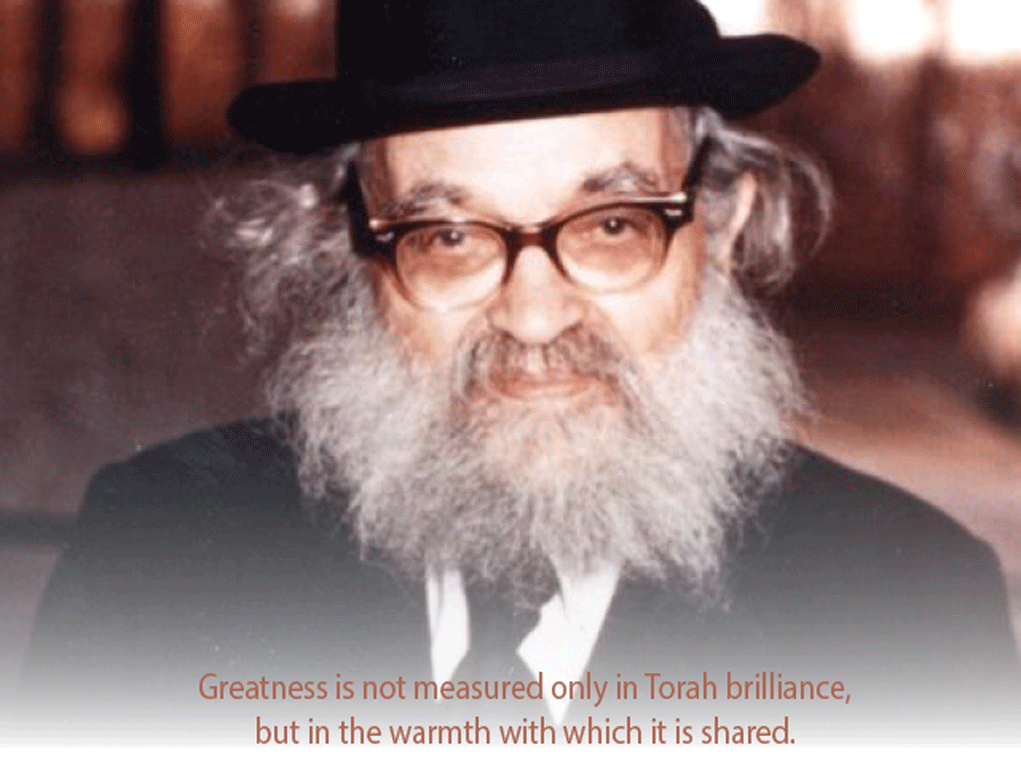
Rav Yaakov, zeicher tzaddik livrocha, was a living reminder that greatness is not measured only in Torah brilliance, but in the warmth with which it is shared. Even if I sometimes felt like just another grandson among so many, I will always miss the brilliant mind, the caring heart, and the home whose doors, like the heart and mind, were always open.
Just Remembering.