
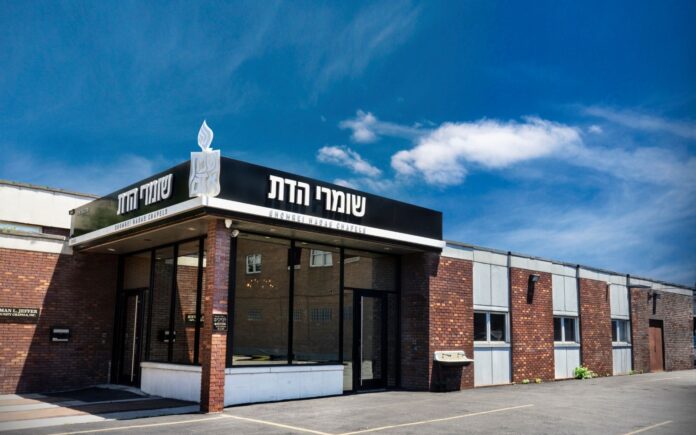

This article is written l’zaicher nishmas Tzalcha Bas R’ Moshe HaKohen, Mrs. Sally Hirsch, the author’s mother-in-law, whose levaya will be at Shmorei HaDas in Boro Park at 1:00 PM
NEW YORK (VINnews/Rabbi Yair Hoffman) – The Shulchan Aruch (Yoreh De’ah 401) rules that it is forbidden to deliver a hesped on Rosh Chodesh. The reason is that Rosh Chodesh is a partial Yom Tov status, when expressions of public mourning and lamentation are lessened.
There is another prohibition of eulogizing throughout the entire month of Nissan. This is because Nissan is the month of past redemption (from Mitzrayim) and destined for future Geulah. It is permeated with holiness and rejoicing.
The Scope: Days of Rosh Chodesh vs. the Month of Nissan
There are two separate applications of this prohibition:
Rosh Chodesh throughout the year: On Rosh Chodesh of any month, eulogies are prohibited. However, this is limited specifically to Rosh Chodesh itself and does not extend to the rest of that month.
The month of Nissan: During the month of Nissan, the prohibition applies to every day of the month — including regular weekdays (chol). The reason for this extension, as noted by the authorities, is that Nissan is distinguished from all other months by its singular holiness as the month of redemption.
Some Poskim distinguish between a hesped — formal lamentation designed to cause weeping and grief — and a divrei shevach, a praiseworthy eulogy or divrei Torah that honors the deceased without inducing grief.
The Taz makes the further point that a hesped is halachically more severe than Tziduk HaDin: Tziduk HaDin is an acceptance of Divine judgment and not lamentation per se, and therefore some opinions permit it even where hespedim are forbidden. But a full hesped — which aims to cause the listeners to cry — is entirely prohibited on the days in question.
The Exception for a Talmid Chacham — The Basic Rule
The Shulchan Aruch (Yoreh De’ah 401:5) carves out a fundamental exception: it is permitted to eulogize a Talmid Chacham on Rosh Chodesh — but only “bifanav,” meaning while the body is still present, i.e., before burial. The Taz (ibid.), Magen Avraham (ibid.), and Chochmas Adam (169:25) all affirm this ruling. The Gesher HaChaim (Chapter 20, Section 5) confirms it as well.
The rationale for this exception is that a hesped for a Talmid Chacham is not an act of personal grief that conflicts with the day’s joy — it is an act of Kavod HaTorah, honoring the Torah that the scholar embodied. As such, it does not fall under the general prohibition.
The Definition: Who Is a “Talmid Chacham” for This Purpose?
The Shulchan Aruch (Yoreh De’ah 401:5), based on the Tur in the name of the Maharitz Geios and Talmidei Rashi, defines a Talmid Chacham for this purpose as someone who is “asked about halacha in every area” — that is, a recognized halachic authority whom people consult on halachic matters across the full range of Torah law. This is an exacting standard: it is not sufficient to be a serious Torah scholar or even a distinguished learner. The scholar must function as a posek, a decisor of halacha, in a broad and comprehensive sense.
What About a Talmid Chochom’s Wife?
The Gemorah in Shavuos (30a and b) discusses the notion of Aishes Chaver k’Chaver – a Torah scholar’s wife is like a Torah scholar. There is a debate as to whether this is true even after the Torah scholar passed away. One should consult one’s own Rav as to how we rule.
The Strict View Regarding the Earlier Debate: The Magen Avraham and Mishnah Berurah
The most far-reaching ruling in this area comes from the Magen Avraham (Siman 547, Se’if Katan 8), who writes with striking directness: “It seems that today we no longer have a Talmid Chacham who knows halacha in every area.”
The significance of this ruling means that the exception carved out by the Shulchan Aruch is practically inapplicable in our times: since no individual meets the standard of knowing halacha in every area, there is no one for whose hesped the prohibition may be overridden. Every hesped — even for a great Torah sage — would fall under the general prohibition on Rosh Chodesh and during Nissan.
The Mishnah Berurah (Siman 547, Se’if Katan 26) codifies the ruling of the Magen Avraham as normative halacha. The Biur Halacha (Siman 547, s.v. “Shemutar”) reinforces this, writing explicitly: “We do not eulogize on Chol HaMoed even for a Talmid Chacham, as explained by the Poskim.” The Chayei Adam (118:7) and Yosef Da’as (401) adopt the same position.
It is important to note that the Magen Avraham’s ruling appears in the context of Chol HaMoed (Siman 547), where the prohibition on hespedim is generally stricter. The Mishnah Berurah extends this reasoning to Rosh Chodesh as well (Siman 547:26), treating the “no Talmid Chacham today” position as applicable across the relevant contexts.
Dissenting View: The Levush and the Eliyahu Rabbah
Against the Magen Avraham stands the Levush, who explicitly rules that even in our day we do have a Talmid Chacham for this purpose. The Eliyahu Rabbah (Siman 420, Se’if Katan 2) cites the Levush’s position as a significant dissenting opinion, noting that the Levush holds that the category of Talmid Chacham remains operative and applicable to qualified Torah scholars in every generation.
Additional Leniencies: The Pri Megadim and Eliyahu Rabbah
Even if one accepts the strict position of the Magen Avraham — that we no longer have a Talmid Chacham who “knows halacha in every area” — both the Pri Megadim and the Eliyahu Rabbah note additional grounds for leniency that may apply in specific circumstances:
The requirement that the hesped be “bifanav” — before burial, while the body is present — is itself a leniency granted by the Shulchan Aruch (Yoreh De’ah 401:5). The Pri Megadim (Siman 547, Mishbetzos Zahav 4) holds that this as an operative element of the ruling. Even under the Magen Avraham’s view, if the deceased was a scholar of any meaningful distinction and the hesped is delivered before burial with the body present, some opinions would be more lenient.
The Eliyahu Rabbah (Siman 420:2) records that the custom in cities such as Prague and other communities was to permit the hesped under certain conditions, relying on the combination of “bifanav” (body present) together with the scholar’s recognized status in his community. The Pri Megadim (Siman 420, Aleph Aleph 1) confirms this was the accepted custom of Prague and other cities.
The Nitei Gavriel (Aveilus, Siman 52, footnote 10) records that numerous Poskim hold that we do have a Talmid Chacham today for this purpose — a position supported by a broad range of authorities who reject the Magen Avraham’s limitation as overly restrictive.
Rav Ovadia Yosef and the Sephardic Ruling
Rav Ovadia Yosef in his Chazon Ovadia (Aveilos, Vol. 1, p. 288), rules categorically that we do have the halacha of Talmid Chacham for this purpose today.
Rav Ovadia held that genuine Torah sages — those who are broadly consulted on halachic matters — do exist in every generation and must receive a proper hesped even on Rosh Chodesh.
The Chazon Ovadia (Aveilos, Vol. 1, p. 282) also confirms the general prohibition of eulogies on Rosh Chodesh (consistent with all authorities), while at the same time carving out the Talmid Chacham exception.
Ashkenazic Practice: The Nitei Gavriel’s Summary
While the Mishnah Berurah’s strict position is widely cited in Ashkenazic halachic literature, the Nitei Gavriel (Aveilus, Siman 52, Se’if 10 and footnotes 10, 23) documents that many Ashkenazic authorities also hold that we do have a Talmid Chacham today for this purpose.
The Requirement of “Bifanav”
Even according to the permissive view — that we do have Talmidei Chachamim today — the hesped for a Talmid Chacham on Rosh Chodesh is only permitted “bifanav”: while the body is present and before burial. This qualification appears in the Shulchan Aruch (Yoreh De’ah 401:5) itself, confirmed by the Taz, Magen Avraham, and Chochmas Adam (169:25).
The Kol Bo, cited in the Rama (Yoreh De’ah 401:6) regarding Tziduk HaDin, extends this: even the saying of Tziduk HaDin follows the same rules as the hesped, and the same conditions apply.
The practical implication is clear: even for a Talmid Chacham, once burial has taken place, a formal hesped on Rosh Chodesh or during Nissan is no longer covered by the exception. The exception applies at the graveside or in the setting of the funeral itself, not to post-burial community gatherings held on prohibited days.
All this is for discussion purposes and each person should consult their own Rav or Posaik.
The author can be reached at [email protected]
This article is written l’zaicher nishmas Tzalcha Bas R’ Moshe HaKohen, Mrs. Sally Hirsch, the author’s mother-in-law, whose levaya will be at Shmorei HaDas 3803 14th Avenue in Boro Park at 1:00 PM