
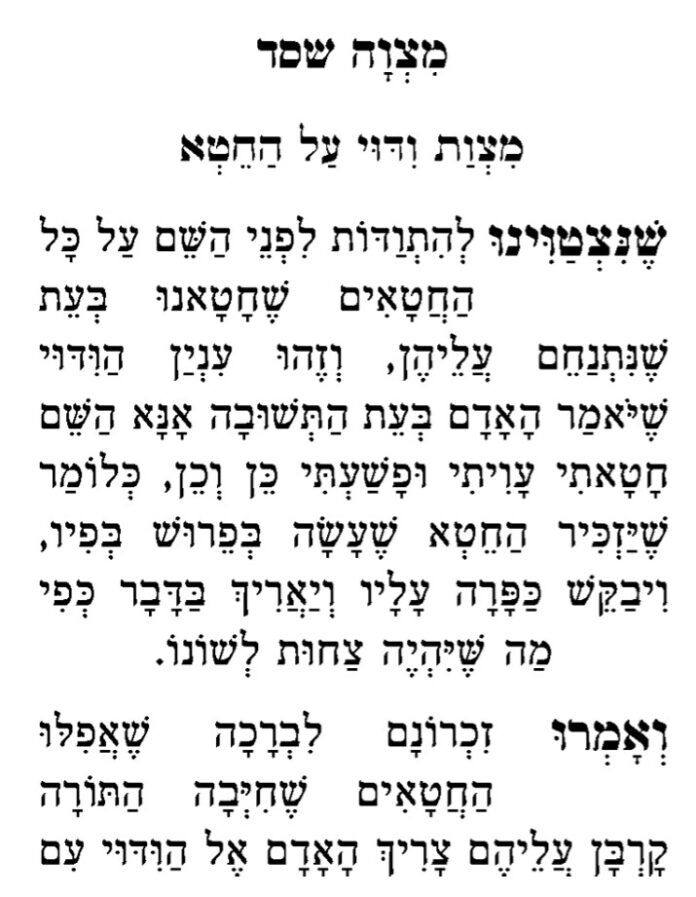

NEW YORK (VINnews/Rabbi Yair Hoffman) – There is a very important Mitzvah of Vidui, which is often neglected because of a number of factors. When visiting someone who is gravely ill, the halacha instructs the visitor to gently bring the conversation around to the vidui — and then to offer the patient a crucial reassurance: saying these words does not seal your fate. Many people have recited the vidui and walked out of that hospital room. The confession is not a death sentence. It is a lifeline.
And for the patient who can barely speak? Even a handful of words will do: “May my death be an atonement for all my sins.” That is enough. That whisper, though barely audible, carries the weight of a full confession.
There is one more thing the halacha asks of the dying: to seek forgiveness from anyone they have wronged. Because we do not only leave this world in relationship with Hashem — we leave it in relationship with each other.
The foundation of the mitzvah is gemilus chassadim that the ill person should be encouraged to confess. The goal is twofold: Firstly it is of great spiritual benefit for the sick person, and secondly it is an expression of closeness to Hashem at a moment of vulnerability.
One should encourage the choleh to say vidui while reassuring him — “rabbim shavu vichayu — many have said vidui and continued to live.”
The key components of Vidui are:
Acknowledgment of Torah and our Mesorah
The choleh affirms his or her faith in the Torah of Moshe Rabbeinu, that it was given at Har Sinai, transmitted through the Neviim and Chachamim, and also that he believes in the Zohar and Kabbalistic works as an authentic part of that transmission. He declares his belief that Hashem is One, that His Torah is truth, and that He alone is Melech al kol ha’aretz.
The choleh confesses his sins in thought, speech, and deed (machshavah, dibur, u’maaseh), asking for complete forgiveness and atonement. He specifically asks that his illness — or if it comes to it, his death — serve as a kapparah for all his transgressions.
Despite the gravity of the moment, the vidui includes a direct plea to Hashem as Rofeh kol basar to restore the person to complete health. He invokes Hashem as Rofei ha’cholim and asks that his recovery come speedily.
Tehillim are Incorporated into the Vidui
There are particular mizmorim to be recited. These include:
Mizmor LeDovid (Tehillim כ״ג) — “Hashem ro’i lo echsar”
L’Dovid — Hashem ori (Tehillim כ״ז)
Mizmor l’sodah (Tehillim ק׳)
Ana Hashem ki ani avdecha (Tehillim קט״ז)
There are also specific pesukim: “Tov lehodos laHashem” and the verse “Hodu laHashem ki tov ki l’olam chasdo” (Tehillim ק״ז).
The choleh fully accepts the din of Hashem, surrendering to whatever decree is issued, expressing complete bitachon.
He prays that if death does come, his neshamah should be bound in the tzror hachaim alongside the souls of Avraham, Yitzchak, and Yaakov, and the Shekhinah. He asks for a portion in the World to Come and in the resurrection.
The custom in Klal Yisrael is not to stand at the feet of the dying (raglov).
The custom of the tzaddikim is to donate tzedakah at the bedside and recite Tehillim (100, 91, 119 sections)
Much of the above was culled from Rav Nachum Yavrov zt”l’s sefer on Aveilus – Divrei Sofrim.
The author can be reached at [email protected]
This article was written l’zaicher Nishmas the author’s mother-in-law, Mrs. Sally Hirsch, Tzalcha Bas R’ Moshe HaKohain