
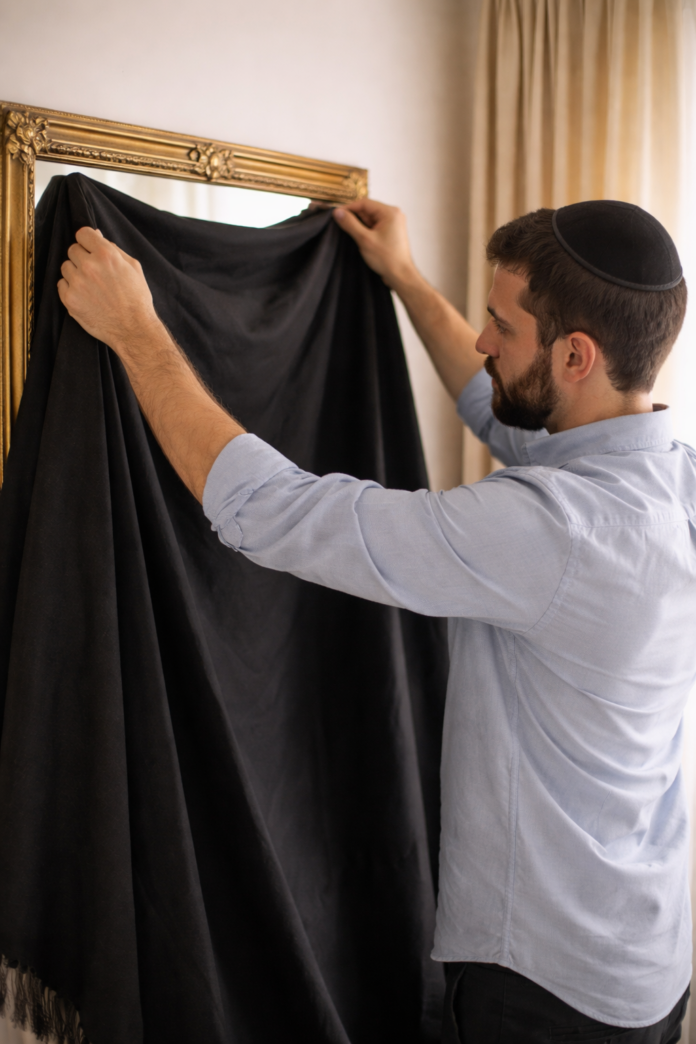

NEW YORK (VINnews/Rabbi Yair Hoffman) – When chas v’shalom a Jewish family loses a loved one and sits shivah — the seven-day mourning period — one of the first things people notice in the house is that all the mirrors are covered. Many visitors simply accept this as “this is what we do,” but few stop to ask: where does this come from, and do all the mirrors in the home have to be covered? We will see that it is likely thataccording to the last three reasons, all the mirrors should be covered, but consult your own Rav or Posaik.
As an introduction let’s note that clear, perfectly reflective glass mirrors were only invented in the late 1600s. Before that, mirrors were made of polished metal and gave only blurry images. It is therefore no surprise that no halachic source mentions covering mirrors during mourning until later. The earliest known Jewish discussion of this custom comes from the Chasam Sofer (1762–1839). He wrote about it in notes surrounding eulogies he delivered between 1832 and 1834.
Over the next century, several different explanations for this custom developed.
Reason One: Overturning the Divine Image — Parallel to Kefiyas HaMittah
The Chasam Sofer himself offered the first and perhaps most profound explanation. In the Talmud (Moed Katan 15b), Bar Kappara explains why mourners in Talmudic times were required to overturn their beds (kefiyas hamittah): the human being was created b’tzelem Elokim, in the image of Hashem. When a person dies, that Divine image has been “overturned” — knocked off balance. To express this reality, mourners overturned their beds. The Yerushalmi (Moed Katan 3:5) adds another dimension: the bed is overturned because it represents bringing new life into the world. When life ends, this symbol is turned upside down.
The Chasam Sofer explains that although we no longer overturn our beds today, mirrors serve as a perfect modern substitute. Why? Because a mirror captures the image — the tzelem — of the person looking into it. Since the Divine image in the deceased has been “overturned” by death, we turn the mirror around or cover it to represent this same idea. The mirror, which reflects the human form made in God’s image, is hidden — just as the beds were once overturned.
Reason Two: Mirrors Facilitate Intimacy — Like the Beds
The Chasam Sofer offers a second layer to his explanation, drawing on Rashi’s commentary to Shemos 38:8. When the Jewish women in Egypt donated their copper mirrors to build the Mishkan (Tabernacle), Rashi explains that these mirrors had historically been used by Jewish women in Egypt to strengthen their marriages during difficult times. Rashi praises these mirrors as deeply holy objects because of the role they played in Jewish family life and the continuation of the Jewish people.
Reason Three: Mirrors Are a Symbol of Vanity
Rav Moshe Sternbuch (Teshuvos v’Hanhagos, Yoreh Deah, siman 585) and Rav Soloveitchik both emphasize a third reason: mirrors are fundamentally an expression of vanity. We look into mirrors to check our appearance, fix our hair, and make ourselves look presentable. This kind of self-focused concern for outward appearance is entirely out of place in a house of mourning.
Reason Four: Not to Pray Facing a Mirror
Rav Menachem Pollack (Hungary/United States, 1890–1953), in his book of responsa Chelek Levi (Yoreh Deah, siman 132), provides the fourth reason —his reason is rooted in the laws of prayer.
It is customary to pray in the house of mourning during the shivah week, so that the mourner does not have to leave the house to attend synagogue. However, there is a well-established rule in Jewish law that one should not pray while facing a mirror, because it might look as though one is bowing down to one’s own image — which could give the appearance of idol worship. This concern was already raised in the 1500s by the Radbaz in his responsa (Part 4, siman 107).
Since mirrors are found throughout the house, and the whole house becomes a place of prayer during shivah, all mirrors need to be covered so that no one accidentally prays while facing one. This reason was adopted as the primary explanation by the great Sephardic authority Rav Ovadia Yosef (Yabiah Omer, Part 4, Yoreh Deah, siman 35:3).
Reason Five: The Zohar’s Warning About Mirrors and Evil Forces
The fifth reason comes from the world of Kabbalah — Jewish mysticism. The Zohar(Parshas Pekudei, 266a-266b) teaches that looking into mirrors too often is spiritually dangerous. The Zohar warns that excessive mirror-gazing leads to arrogance and can attract negative spiritual forces. This is because a mirror creates an image — an imitation of the human form — and such images can serve as vessels for impure spiritual energies.
The great 18th-century Torah giant Rav Yonasan Eibeschutz (1690–1764) developed this idea further in his Ya’aros Devash (Vol. 1, Derush 2, p. 36). He wrote that every picture or graven image carries with it an impure spiritual force (ruach ra’ah). People should be careful not to have such images in their homes unnecessarily. Most importantly, he warned that one must be especially careful not to look into mirrors without need, because spiritual forces can actually attach themselves to the reflection in a mirror and enter through it.
Building on the Zohar and Rav Eibeschutz, Rav Gershon Marber (Warsaw/Antwerp, 1872–1941) explains in his book on the laws of mourning, Darkhei HaChaim, that this concern is heightened during the shivah period. When a death has occurred in a home, negative spiritual forces are more present than usual. During shivah, these forces can more easily attach themselves to the reflections in mirrors, making it dangerous for the mourners and those who visit. Covering the mirrors protects everyone in the house.
This mystical reason is found as the sole explanation in Sefer Ta’amei HaMinhagim u’Mekorei HaDinim. It captures the intuition that a house of mourning is a spiritually heightened and delicate environment that requires special protection.
Reason Six: Protecting Mourners from Evil Spirits Drawn to the Home
The sixth reason is closely related to the fifth but focuses specifically on the mourners’ vulnerability. Rav Yosef Schwartz (Romania, 1875–1944), in his work Ginzei Yosef (p. 320; first published in the journal Vayelaket Yosef, Vol. 14, No. 11, Adar 1912), explains that evil forces (mazikim and ruchos ra’os) naturally gather in a home where a death has occurred. This is actually hinted at in the Talmud itself (Brachos 54b, see Rashi), which notes that mourners need special protection from harmful forces.
Rav Schwartz explains that in order to prevent these forces from being seen — or from making themselves known — through the reflective surface of a mirror, the mirrors are covered or turned to the wall. The mirror, as a reflective surface, is seen as a potential “window” through which negative spiritual presences might become visible or interact with those in the house. Covering the mirror closes that window.
The author can be reached at [email protected]
This article is dedicated l’ilui nishmas the author’s mother-in-law, Mrs. Sally Hirsch a”h – Tzalcha bas R’ Moshe HaKoen.