

By Rabbi Yair Hoffman
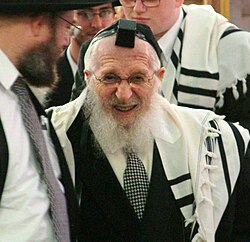
Rav Chaim Pinchas Scheinberg zt”l (1910–2012) was one of the Gedolei HaDor and one of the foremost American-born poskim and roshei yeshiva of the twentieth century. He spent the latter decades of his life leading Yeshivas Torah Ohr in Yerushalayim. Rav Scheinberg was student of Rav Shimon Shkop zt”l and the Mir Yeshiva in Europe, he bridged the worlds of American Orthodoxy and the developing Israeli yeshiva community, and his teshuvos and guidance were sought on some of the most sensitive halachic questions of his era. He lived to the age of 101, remaining active in Torah study and paskening shailos well into his final years.
The Rambam’s Ruling on Chometz
The Rambam rules (Hilchos Chometz uMatzah, Chapter 1) that if a person’s dough became Chometz, or if he purchased Chometz, he incurs lashes — because it is a prohibition that involves a maaseh, a physical action. Even though the prohibition itself consists of owning the Chometz, which is not technically an action, nonetheless, since it came about through an action — either baking or purchasing — it is classified as a prohibition that involves an action, and lashes are therefore administered.
The Rambam on Coveting
This ruling, however, raises a difficulty in light of the Rambam in Hilchos Gezeilah v’Aveidah (1:10). There the Rambam states that if a person pressured his friend to sell him an item, even enlisting numerous people to convince the seller, and even if he ultimately paid full price, he has violated Lo Sachmod — “Do not covet.” Nevertheless, he does not incur lashes, since no maaseh, no physical action, is involved.
The Raavad’s Objection
The Raavad attacks this ruling sharply, calling it most astonishing: what greater action could there be than the actual purchase of the item? He argues that the Rambam should instead have explained that lashes are not incurred because the violation is reversible — since the purchaser is obligated to return the item.
The Maggid Mishna’s Explanation
Rav Vidal Yomtov of Toulouse, Spain, the author of the Maggid Mishna, explains that the Raavad is operating according to his own position that Lo Sachmod applies only when the seller does not wish to sell. According to that view, the purchase itself is the sinful act, since the buyer in effect coerced the seller. The violation thus does involve a physical action — but since it can be undone, the buyer is obligated to return the item, just as one who steals must make restitution.
The Rambam, by contrast, holds that one violates Lo Sachmod even when the seller ultimately agrees to the sale, provided the buyer wore him down through excessive begging and pressure. According to this view, the buyer cannot be compelled to undo the transaction, so the Raavad’s reasoning is unavailable to the Rambam. The Rambam must therefore explain the absence of lashes differently — namely, that the core of the transgression is the pleading and maneuvering, none of which constitutes a physical action. The sale merely concludes and reveals that process. It is therefore properly classified as a prohibition without a maaseh.
The Apparent Contradiction
At this point, however, a contradiction arises from the other Rambam regarding Chometz on Pesach. We see there that any prohibition which comes about through a physical action incurs lashes — even if the prohibition itself contains no action. If so, the same logic should apply to Lo Sachmod: even if the essence of the sin is the excessive begging and effort, the prohibition is ultimately brought about through the physical act of purchasing. Why, then, is it treated as a prohibition without an action?
The Resolution
The distinction appears to be as follows. The prohibition of Lo Sachmod is the excessive begging itself. The actual purchase does not cause the prohibition — rather, it reveals that the begging was truly excessive. Without a completed sale, we would have no way of knowing whether his efforts crossed the line. The purchase thus serves as evidence of the violation, not as its cause. Since the prohibition is brought about without any action, and we require the purchase only to confirm that the line was crossed, it is properly classified as a prohibition without a physical action.
This stands in contrast to Bal Yeira’eh. There, the prohibition genuinely comes about through the action — without the act of purchasing or baking, the Chometz would never have come into his possession. The action is what makes the violation possible and present. Since the prohibition is directly caused by the action, it is classified as one that involves a maaseh, and lashes are therefore incurred.
This article is dedicated in honor of one of his ur-eineklach who, in a pinch, served as a Kashrus mashgiach at an event held by the author.
The translator can be reached at [email protected]