

By Rabbi Yair Hoffman
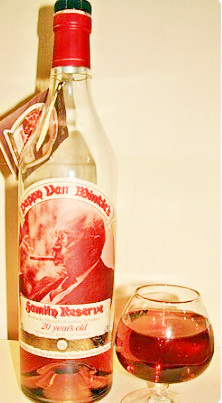
Pappy Van Winkle’s Family Reserve is the crown jewel of American bourbon, a product so coveted that aficionados line up for lotteries just for the chance to purchase a bottle. The secondary market for it ranges between $2300 to $3900 a bottle. Production has never exceeded a few thousand bottles per year.
But there is a question that few of those devotees have ever considered: Is Pappy Van Winkle kosher?
And beyond the question of kashrus there are at least three distinct halachic issues that must be addressed. This article examines them in turn.
A BRIEF BACKGROUND: WHAT IS PAPPY VAN WINKLE?
It was 1893, and a young man named Julian “Pappy” Van Winkle Sr. began working as a salesman for W.L. Weller & Sons in Louisville, Kentucky. He eventually became co-owner and in 1910 the two of them acquired the A. Ph. Stitzel Distillery, which had been operating since 1872.
Old Rip Van Winkle was introduced just before Prohibition, and the family managed to retain the rights to that label when the Stitzel-Weller distillery and its other brand names were sold off after 1972.
Julian Van Winkle Jr. reintroduced the brand using the old Stitzel-Weller stocks. After he passed away in 1981, his son Julian Van Winkle III carried on the legacy. Since 2002, the Van Winkle brands have been distilled and bottled by the Sazerac Company at its Buffalo Trace Distillery in Frankfort, Kentucky, as a joint venture with the Old Rip Van Winkle Distillery.
Buffalo Trace Distillery is owned by the Goldring family — a prominent Jewish family from New Orleans. This single fact, as we shall see, is the halachic key that unlocks a very serious question.
HALACHIC ISSUE #1: CHOMETZ SH’AVAR ALAV HAPESACH
The most pressing issue regarding Pappy Van Winkle — indeed, regarding virtually all bourbon produced at Buffalo Trace — is the question of chometz she’avar alav haPesach: chametz that was in the possession of a Jew over Passover.
Bourbon, by federal law passed by Congress in 1964, must be made from a grain mash of at least 51% corn — most distilleries use 65% to 75% corn. The rest is barley or wheat grain which is unquestionably chometz — fully leavened grain that is strictly forbidden on Passover and, under Rabbinic enactment, forbidden for benefit even after Passover if it was in Jewish ownership during Yom Tov.
The corn mash (with the grain) from which Pappy Van Winkle is distilled ages for many years — the flagship expressions are aged 15, 20, and 23 years — in charred new oak barrels, sitting in rickhouses at the Buffalo Trace Distillery. If the Goldring family, as Jewish owners of Buffalo Trace, did not sell this chametz before Pesach, then the resulting whiskey would be prohibited under Rabbinic law as chametz she’avar alav haPesach.
What does the CRC say? The Chicago Rabbinical Council — one of the most meticulous kashrus agencies in the world — has addressed this directly. According to their bourbon list, Pappy Van Winkle (Unflavored) is listed as “Not Recommended unless purchased before Pesach 2003/5763” — a ruling that underscores the seriousness of the problem.
The MK Canada (Montreal Kosher) similarly flags the Old Rip Van Winkle and Pappy Van Winkle lines as Not Recommended, placing them alongside Isaac Bowman, John J. Bowman, and Van Winkle Unflavored.
One might ask: Does Buffalo Trace not sell its chometz?
In fact, since 2020, Buffalo Trace, with the assistance of the CRC, does produce a certified Kosher Bourbon line. But the issue with Pappy Van Winkle specifically is more complex — those barrels have been aging for 15, 20, and 23 years, meaning the whiskey may have been in bottles was sitting in Jewish-owned warehouses through multiple Pesach observances many years ago, before any mechiras chometz arrangement was solidified for those particular barrels.
Are There Any Grounds for Leniency?
There is a position cited in the Mishnah Berurah (449:5) that in cases of safek — doubt — one may consume chametz she’avar alav haPesach. Additionally, some Poskim argue that when the Jewish owner is completely non-observant, the Rabbinic prohibition may not have been enacted with such an individual in mind, though both the Mishnah Berurah (OC 347:7) and the Vilna Gaon (YD 151:7) reject this view.
Rav Moshe Feinstein zt”l (Igros Moshe YD Vol. I #72) does allow reliance on this minority position but only in conjunction with another mitigating halachic factor — and even then, this is a shev v’al taaseh posture. It is certainly not the grounds for l’chatchilah consumption.
The snifin approach — combining multiple weak heterim to create a composite leniency — is a possibility discussed in the poskim, but its application here is debated and most leading authorities would not endorse it for this purpose.
HALACHIC ISSUE #2: AGING IN WINE CASKS
There is a second potential concern with certain expressions of aged whiskey: aging in wine casks. While bourbon, by federal law, must be aged in brand-new charred oak barrels and therefore cannot be aged in sherry, port, or other wine casks — this restriction applies specifically to the whiskey that carries the legal designation “bourbon.”
However, Pappy Van Winkle has released specialty expressions and some of the broader Van Winkle line has, on occasion, included finishes or special bottlings. Any whiskey finished in wine casks raises the separate issue of yayin nesach — libation wine — or at minimum the issue of wine that was handled by non-Jews in a way that could render it forbidden.
Also, experts in the field once told this author that some producers circumvent that law because they feel that the wine casks do make things a bit tastier.
Most Poskim would hold that for the standard Pappy Van Winkle expressions, since standard bourbon law requires new charred oak barrels, the yayin nesach concern from wine casks does not apply to the core line. One must, however, be cautious with any limited-edition or finished expressions, and should consult one’s posek before consuming such products.
HALACHIC ISSUE #3: NO BLESSING ON STOLEN GOODS
The third halachic issue is perhaps the most philosophically striking, and it applies not only to Pappy Van Winkle but to any item that was obtained through questionable means.
Now, why on earth would this pertain to Pappy Van Winkle?
The answer is a direct repercussion of the opening paragraph. The bottle is so fantastically rare that a black market has grown up around it. Bottles are stolen from warehouses, diverted from legitimate distribution channels, and sold at astronomical markups.
In 2013, a stunning theft was discovered at Buffalo Trace’s neighboring Wild Turkey and other distilleries — over 200 bottles of Pappy Van Winkle were stolen from the Buffalo Trace rickhouse itself in what became a celebrated police investigation.
The Mishnah Berurah (OC 196) rules explicitly that one may not recite a berachah on stolen goods — neither the opening berachah nor Birchas Hamazon. The principle is encapsulated in the verse (Tehillim 10:3), “Botzea beirach ni’atz Hashem” — one who blesses on what was seized thereby blasphemes Hashem.
The Mishnah Berurah writes: “If one stole wheat, ground it, and baked it, some say that even though he acquired it through shinui [a halachic acquisition through transformation] and it is technically his property — but he is obligated to pay for it — nevertheless it is forbidden to recite a blessing on it, whether an opening blessing or Birchas Hamazon, since anything involving the Name of Hashem is more severe and he is always in the category of one who blasphemes. Others say that since he acquired it, he may recite a blessing.” The Magen Avraham rules that at minimum, if he consumed a satiating amount, he should recite Birchas Hamazon because it is a Torah obligation.
The halachic reality: if a person obtains Pappy Van Winkle through illegitimate channels — from a reseller who obtained it improperly, or through any form of fraud or diversion — not only may there be issues of geneivah and gezeilah involved, but one cannot recite a berachah over the whiskey either.
The pleasure of sipping the world’s most coveted bourbon would be accompanied by the profound spiritual problem of a berachah l’vatalah — or worse, a berachah that constitutes a form of nivul peh before Hashem.
This is not a far-fetched scenario. Given the notorious scarcity of Pappy Van Winkle, many bottles that circulate are of doubtful provenance. The consumer should be very careful to know the chain of custody.
CONCLUSION: THE UNOBTANIUM QUESTION
So where does this leave us? Pappy Van Winkle is, in the memorable phrase of the Wall Street Journal, “liquified, barrel-aged unobtanium” — something essentially impossible to obtain. On a purely mundane level, that is true. But on a halachic level, the difficulty of obtaining it properly is even more profound:
- Chometz she’avar alav haPesach: The older expressions of Pappy Van Winkle, having aged in the Jewish-owned Buffalo Trace Distillery through multiple Passover seasons before any mechiyas chometz protocol was in place, are classified by the CRC and MK Canada as Not Recommended.
- Wine cask finishing: Core expressions are likely clear of this issue due to bourbon’s legal requirement for new oak barrels, but specialty finished expressions require individual inquiry.
- No berachah on stolen goods: Given the notorious black market around Pappy Van Winkle, any bottle of doubtful provenance presents a serious problem regarding birchas hanehenin.
In this author’s view, the halachic community has been far too casual about bourbon generally — an issue that has been raised in various forums over the years. We are, in many respects, still living in the 1950s when it comes to alcohol, relying on the WCBIIA principle (“What could be in it already?”). The answer, as we have seen, is: quite a lot.
There are, b’chasdei Hashem, certified kosher bourbons available. Buffalo Trace itself now produces a kosher line under CRC supervision. For those who wish to enjoy fine bourbon without halachic complications, those options exist.
As for Pappy Van Winkle: it may be the bourbon that everyone wants and no one can get. For the Torah-observant consumer, the halachic barriers may render it even more unobtainable than the lottery-driven scarcity that frustrates everyone else.
The author can be reached at [email protected]