
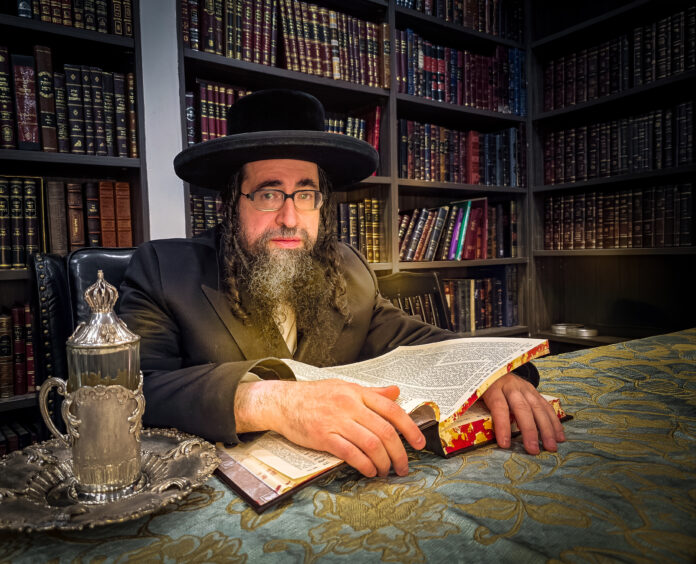

People don’t fail because they’re not smart. People fail because they never stick with one thing long enough to succeed.”
It’s the kind of line you expect from a business podcast or self-help guru, not from a rebbishe-looking, chasidishe Yid speaking in thickly accented English. Yet that is precisely who delivers it in a clip that recently went viral.
The speaker is Rav Shulem Landau, rosh yeshivah and rosh kollel of Mosdos Rivnitz. He leads close to 100 bachurim in his yeshivah and more than 200 yungeleit learning across three kollelim in Williamsburg. A marbitz Torah for decades, Rav Shulem has shaped thousands of talmidim who have passed through his mosdos.
The clip, though, is far from a one-off. Lately, it’s nearly impossible to scroll through WhatsApp without encountering one of Rav Shulem’s status videos, each offering a tightly delivered piece of practical wisdom in plainspoken English. His videos routinely rack up millions of views, along with thousands of likes, shares and comments.
And therein lies the paradox: a chasidishe rebbe delivering mussar to the masses on social media.
I needed to find out who the rav behind the quotes really is and what exactly he’s doing there.
On this rainy evening, his beis midrash on Ellery Street is easy to miss, tucked discreetly into the middle of a row of identical townhouses. There is no sign, just a narrow doorway that gives little indication of the reach of the man inside.
When I step into the building, I’m immediately struck by an unexpected sight: a group of Sephardic balebatim filing out of Rav Shulem’s office. Some are dressed in tailored suits, others more casually; a few sport slicked-back hair. It’s not the crowd one expects to encounter in a Williamsburg shul, and certainly not in a chasidishe beis midrash.
“Please give the Rav a few minutes,” Rav Shulem’s gabbai, Shraga Moshe Kalmanowitz, tells me.
While waiting, I ask Kalmanowitz what he can tell me about the phenomenon that has drawn so much attention.
“It’s a lot more interesting than most people realize,” he says. “The Rav’s audience on these platforms is incredibly diverse—every kind of Jew you can imagine, and even non-Jews.”
He scrolls through his phone and shows me a sampling of comments beneath Rav Shulem’s videos. One stands out. “The rabbi is spitting fiery truths,” writes an African American pastor.
Kalmanowitz explains that the responses go far beyond public comments. “People message the Rav directly with real questions about life, faith, marriage and purpose. It’s impossible to keep up. We receive thousands of messages every single day.”
Rav Shulem Landau’s voice, it seems, is reaching far beyond Williamsburg.
A few minutes later, Kalmanowitz motions me forward and ushers me into Rav Shulem’s study.
Rav Shulem sits at the head of a long table, an old, well-worn Gemara open in front of him. He looks up, smiles warmly and gestures for me to take a seat directly beside him.
“So,” he asks in the same heavily accented English familiar from the viral clips, “what do you want to talk to me about?”
I assure him that Yiddish is my first language. He nods approvingly, and we switch immediately to mamme lushen, as he calls it.
“Growing up in Kiryas Yoel, I didn’t even know English,” he tells me. “I never attended English classes. I thought it was bittul Torah.” He pauses and then smiles at the memory. “My grandfather begged me to learn the language of the medinah. He said it was the only way a person could earn a parnasah, but I told him I was going to stay in learning my entire life. I was a foolish child.”
“Even though it came true?” I challenge him gently.
“Yes,” he replies without hesitation. “Even though it came true.” He taps the table lightly for emphasis. “Because knowing English is still useful. It would make it much easier for me to speak to people who don’t understand Yiddish.
“It was foolish for another reason as well,” he continues. “Staying in learning wasn’t the norm in my family. My father was a bus driver at the time, and money was very tight. Today, baruch Hashem, my father is a rav in Kiryas Yoel with his own shul. But for many years he worked to support himself. Still, he never stopped learning. He was never a rav by profession, but it was bashert for him to become one. My mother says that in the end she got a rav for a husband.”
Today, his father is known as the Zlotchover Rav. “He’s very matzliach,” Rav Shulem says. “He doesn’t seek kavod, so everyone loves him.”
Born in Eretz Yisrael, Rav Shulem’s father later came to Williamsburg, where he became a talmid of the Satmar Rebbe, Rav Yoel, zt”l. The family’s connection to Satmar ran even deeper: Rav Shulem’s grandfather had learned by the Rebbe in the original town of Satmar. After the war, the family lived for a time in Bnei Brak and then moved to Williamsburg in the 1970s, eventually settling in Kiryas Yoel.
“The reason my father chose the name Zlotchov,” Rav Shulem adds, “is that our family tradition is that we are einiklach of Rav Michel Zlotchover, ben achar ben.”
He smiles as he notes that the family has since become one of rabbanim. “I have a brother, Rav Moshe Landau, who is the Yampoler Rav. I have another brother, Rav Mordechai Leib, who has a shtiebel. And my children are already rabbanim as well. My brother Reb Yoeli is also b’etzem a rav, he just hasn’t gotten the job yet. But he’s getting there.”
“We’ll make him a rav in the article,” I joke. “He’ll discover it when he reads it.”
Despite serving as a rav and heading major mosdos, Rav Shulem’s parnasah does not come from his avodas hakodesh. “I have some partnerships, investments and other ventures,” he explains. “I was involved in business when I was younger.” Today, however, he is no longer involved in business day to day, leaving him the space to focus on what he sees as his real mission.
Beyond his shul, Rav Shulem also heads a yeshivah and kollel. “Our ultimate goal,” he says, “is to create something similar to what exists in the Litvishe world. There, bachurim and yungeleit often learn together in the same beis midrash, and the yungeleit create a powerful kol Torah. This has a real impact on the bachurim. Even if a bachur is going through a difficult period, he’s still immersed in a makom Torah and drawn into its atmosphere.”
To read more, subscribe to Ami

