

The Global Response
Barely a week after spurning President Trump’s appeals for support in opening the vital Strait of Hormuz, European leaders buckled, delivering a striking about-face and revealing the force of Trump’s leverage.
“22 Countries Signal Readiness to Help Secure Strait of Hormuz,” the Wall Street Journal reported.
The leaders of these countries have now signed a declaration condemning Iran’s attacks on neighboring countries “and pledging support to secure the Strait,” the article noted.
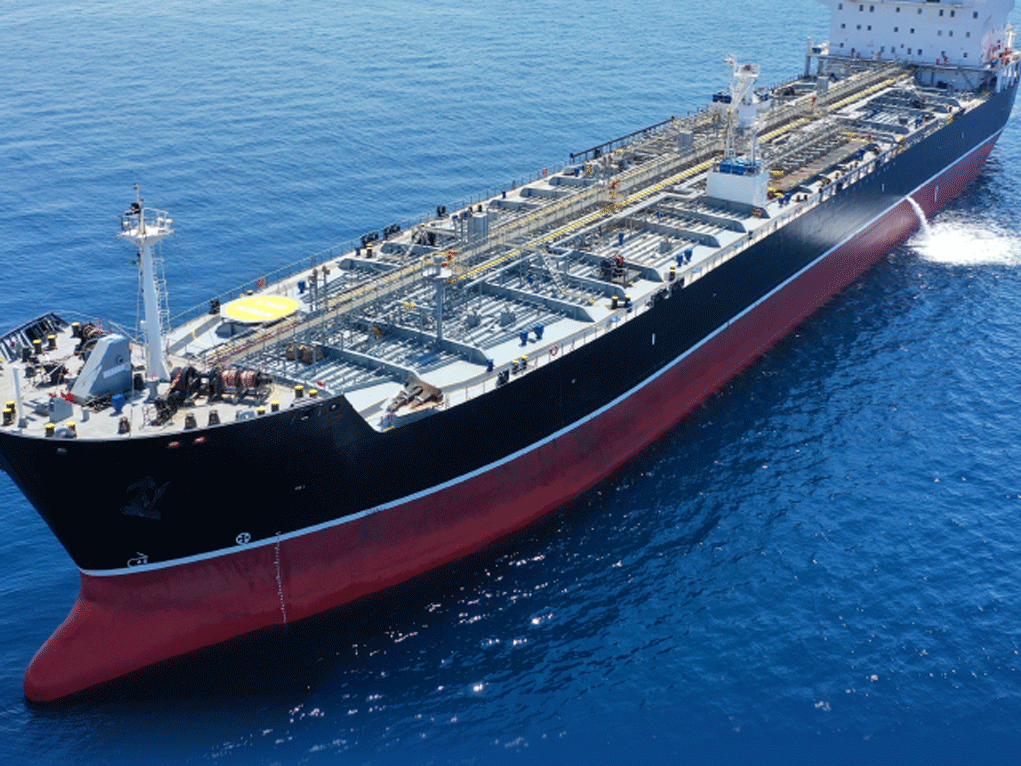
Tehran has effectively closed the Strait of Hormuz that connects the Persian Gulf to the rest of the world, while claiming safe passage for vessels from countries other than its enemies. Roughly one-fifth of the global oil supply passes through it, but attacks on ships have stopped nearly all tanker traffic.
The irony of world leaders flipping from pompous defiance to compliance in just a few days is striking. It might be one of the fastest reversals on record, leaving observers completely baffled. Europe’s initial response was supposedly based on a matter of principle: the war was “illegal” and of no concern to Europe. What happened to change that?
Germany, France, and Britain—America’s key allies within NATO—initially signaled that they owed the United States nothing.
“The war in the Middle East is not our war and we will not participate militarily,” proclaimed German Chancellor Merz on March 17. “France will never take part in operations to open or liberate the Strait of Hormuz,” French President Macron vowed that same week.
British PM Starmer announced he would not be drawn into “the wider war,” whose legality was “not clear.” Japan said it had “no plans” to send ships.
Defense News summed up the sweeping rebuffs in a catchy headline: “European Allies Tell Trump “Nein,” ‘Non” and “No.” The media celebrated with a barrage of approving articles, applauding Europe for finally “standing up to Trump.”
“This is Not Our War!” Europe Pushes Back Against Trump’s Demands (NY Times). “EU Leaders Balk at Joining Middle East Fight” (Bloomberg) “Europe Stands up to Donald Trump,” (Reuters) “European Leaders Rebuff Trump’s Call to Open Strait of Hormuz,” (Washington Post).
Trump: NATO is a One-Way Street
In the Oval Office the same day as the rebuffs from Europe flowed in, President Trump commented to reporters, “I always considered NATO, where we spend hundreds of billions of dollars per year protecting these same countries that won’t lift a finger for us, to be a one-way street. We will protect them, but they will do nothing for us, even in a time of need.”
“Without the U.S.A., NATO is a paper tiger, Trump railed online on Truth Social. “Now that the fight is militarily won, with very little danger for them, they complain about the high oil prices they are forced to pay. But they don’t want to help open the Strait of Hormuz, a simple military maneuver that is the single reason for the high prices.”
“The fact is that they need the oil going through the Strait, we do not,” Trump added, “I wonder what would happen if we let the countries that use it be responsible for the Strait? That would get some of our non-responsive ‘allies’ in gear, and fast!”
Speaking with reporters aboard Air Force One, Trump repeated his stance that countries that rely more heavily on oil shipments passing through the strait should contribute to securing it.
“I’m demanding that these countries come in and protect their own territory, because it’s the place from which they get their energy,” Trump said. “Why are we maintaining the Hormuz Strait when it’s really there for China and many other countries? Why aren’t they doing it?”
“We’re always there for NATO. We’re helping them with Ukraine,” he continued. “There’s an ocean between us. That war doesn’t affect us, but we’ve helped them. And it’ll be interesting to see which country would not help us with a very small endeavor.”
He warned that Europe’s refusal to help escort tankers through the Strait of Hormuz would be “very bad for the future of NATO,” linking NATO’s refusal on Hormuz to the question of whether Europe should continue its expectation of U.S. protection against Russia and defense of Ukraine.
America’s Energy Independence
“Thanks to President Trump’s ‘Drill, baby, drill’ policies, the United States is now a net energy exporter, producing 24.2 million barrels of oil per day, more than Saudi Arabia and Russia combined, writes attorney and author Jeff Childers. [Other sources place the number of barrels at 13-14 million.]
“Nearly zero American crude oil transits Hormuz. Seventy percent of the oil that does pass through the strait goes to Asia —China, India, Japan, and South Korea— and most of the rest goes to Europe,” the author attests.
“No American president has ever held the hand Trump holds now: A public refusal by every major NATO ally to assist the United States during an active military operation. By their public pronouncements, the same “allies” who refused to send minesweepers and escorts to Hormuz just handed the President the leverage to restructure NATO on his terms.”
With their dismissive “Nein,” “Non,” and “No,” European leaders have opened the door for Washington to condition U.S. participation in NATO on its own terms, the article notes—a scenario the Trump administration likely foresaw and can now potentially leverage.
Unsurprisingly, the gambit slipped past a media that, where Trump is concerned, has a habit of missing the bigger picture.
Feeding the Monster
“American service members and Israeli pilots are in harm’s way at this very moment, absorbing retaliatory strikes so that the free world does not have to live under the shadow of a nuclear-armed theocracy,” writes former U.S. ambassador to the EU Gordon Sondland in a Fox News op-ed.
“And what has Europe offered? The collective message from the continent was not solidarity but distance,” the writer continued. “If the transatlantic alliance cannot count on Europe for full-throated public support while Americans and Israelis bear the costs and the risks, then what, exactly, is the alliance for?”
Drawing on his own personal experience as a U.S ambassador, Sondland recalled his mission to urge U.S. allies in Europe to abandon the “toothless” Obama-led JCPOA and join America’s maximum-pressure campaign against Iran, during President Trump’s first term.
“What I encountered in Brussels was willful denial,” the author recounted, describing how European officials “performed extraordinary contortions” to avoid acknowledging what the intelligence made plain: Iran had already violated the deal and would continue to do so.
“At a moment when the democratic world should have been tightening the vise, Europe was engineering workarounds to do business with the mullahs, the writer said. “Iran took note and went on to systematically violate every uranium enrichment limit the JCPOA imposed, reaching 60% purity — a short step from weapons-grade material.”
Despite this, Europe refused to ditch JCPOA, and continued the charade. Instead of blocking Iran’s nuclear ambitions, it actually enabled them, convincing the mullahs that they were “unstoppable.”
Having fed and coddled the monster, Europe can only blame itself as it strikes back.
EU Leaders Have Second Thoughts
After some rethinking, Britain read the handwriting on the wall and signaled a change of heart. From denying the United States permission to use British military bases to launch attacks at Iran, PM Starmer executed a “180.”
Britain would now grant full permission, and not only for ‘defensive’ reasons as before. In addition, Starmer announced a British warship was on its way to the Strait, to escort oil tankers through the waterway.
Two days later, on Thursday, France signed a joint statement expressing “readiness to contribute to appropriate efforts to ensure safe passage through the Strait.” Germany and a score of other countries immediately followed suit.
What could have possibly transformed “not our war!” into a document with 22 signatures in 72 hours?
For one thing, a news report out of Washington last week sent alarm bells ringing in Europe: the United States is considering ‘winding down’ the Iran war—even with the Strait closed—as U.S. removes sanctions on 140 million barrels of Iranian oil [to stabilize oil prices],” wrote CNN. (This ominous report was based on one of Trump’s online “tweets” that are often in conflict with his actual actions on the ground.)
Nevertheless, the message to Europe—“You’re on your own”—sparked alarm. For context: Americans are paying around $3.80 a gallon at the pump. Germans and other Europeans are paying the equivalent of $7.85 a gallon.
Europe, suddenly confronted with much-needed oil shipments stranded in the Persian Gulf, grasped the stakes. While still uneasy with the war against Iran, its leaders had little desire to see it end before the Strait of Hormuz was reopened—a task they depend on the United States to carry out.
Shocker: Iran’s Missiles Can Reach Europe
An even more jarring wake-up call came a few days ago with Iran’s ballistic missile strikes at Diega Garcia—a joint US-British base in the Indian Ocean, 2,500 miles (4000 kilometers) from Tehran.
Obviously angered by the British allowing their bases to be used for Operation Epic Fury, the IRGC—who have grown stronger after Iran’s top leadership was wiped out—launched two intermediate-range ballistic missiles at Diego Garcia.
US forces reported that one misfired and the other was intercepted by a missile defense system. No damage was reported. But something critical took place. While the missiles missed the military base, they drove home the message: Iran’s reach extends much farther than anyone suspected was possible.
Iran’s leaders have long claimed to voluntarily cap their ballistic missiles at around 2,000 km, which would put Diego Garcia as well as vast portions of Europe safely out of reach. The problem for Europe is the 4000 kilometers to Diego Garcia is only the revealed range; the actual range of these missiles could be much farther.
A ballistic missile with an actual range of 4,500 km, if launched from western Iran, could theoretically strike most of Western Europe, reaching as far as southern England, analysts say.
“The move marked Iran’s first operational use of IRBMs,” the Wall Street Journal noted, “and a significant attempt to reach far beyond the Middle East.”
London is 2,700 miles from Tehran. Berlin is 2,500. Rome is 2,200. If the actual missile range is more like 5,000 km, then all of Europe lies within Tehran’s murderous reach. And Europe’s leaders know there is nothing their countries can do by themselves to deter an attack.
Suddenly, the war they once disdained and kept at arm’s distance looks different—not as an impulsive move by Trump or the product of pro-Israel lobbying, but as something far more thought out and crucial for Europe and the world.
NATO Secretary General Mark Rutte confirmed this on CBS’ Face the Nation, saying, “What we know for sure now is that the Iranians are very close to having that capability to hit European capitals. We can’t allow that.”
He asked for President Trump’s “understanding” for the hesitancy expressed by allied countries when asked to provide support to reopen the Strait of Hormuz, explaining that the U.S surprise attack on Iran blindsided them and they needed “a couple of weeks” to rally around plans to open the Strait of Hormuz.
He also noted that since last Thursday, 22 countries — some that are part of NATO and others that are not — have stepped forward to address security in the passageway. “We are now coming together to make sure that we can be able to secure the Strait,” Rutte told the CBS host.
“What do we need? When do we need it? And where do we need it? These three questions are now worked through to answer the president’s call, to make sure that we secure the free sailing through the Strait of Hormuz,” he said.
If Rutte is correct that Europe is finally “getting it,” then Iran’s attempted strike on Diego Garcia may have done what years of diplomacy could not—triggering a near revolution in European relations with Iran, rooted in “peace through strength.”
***
48-Hour Ultimatum Stretches Into 5-day Deadline
The Strait of Hormuz has emerged as a central front in the war with Iran, with U.S. and Israeli forces intensifying operations to restore freedom of navigation, while continuing to dismantle Iran’s remaining military arsenals and weapons production facilities.
“If the Strait is not fully opened within 48 hours, the United States will target Iran’s various power plants, starting with the biggest one,” President Trump vowed over the weekend.
The ultimatum sparked radical counter-threats from Tehran and, as the clock ticked down, a flurry of emergency talks between US envoy Steve Witkoff and Iranian Foreign Minister Araghchi.
The talks were described by the Trump administration as “productive” and possibly capable of leading to an end to hostilities, to the point that they achieved “a 5-day extension of the deadline,” the president said.
This statement was flatly contradicted by an IRGC spokesman who said “No talks are in progress—that is fake news.” Yet, Trump’s comment immediately (if temporarily) brought down oil prices and took the edge off market panic. The president now has Iran wondering what he’s actually up to and how they should respond.
If the U.S. is planning to go after Iran’s oil facilities, that could require preparations that involve a longer timetable than the 48-hour period in Trump’s initial ultimatum, commentators suggest. Another possibility is that Washington needs the time to put troops and weapons in place for another type of strike, such as seizing Kharg Island and finally securing the Strait.
“In a sense, Trump has conducted this war the same way he approaches most undertakings,” writes Commentary Magazine editor Abe Greenwald. “He likes to keep his audience guessing and ensure that no one expects the next massive surprise. In high-stakes combat, this approach has proved to be an asset—at least when paired with the outstanding capabilities of the U.S. and Israeli armed forces.”
‘Whatever you find him saying one day, Iranian weapons and regime figures get blown up the next,” the author notes. “That’s the only predictable pattern we have to go on.”
***
The Most Critical Global Threat Since World War II
Harvard Law School Professor Alan Dershowitz, speaking on Newsmax’s “Sunday Agenda,” noted that the conflict with Iran represents the most critical global threat since World War II, and warned that failure to act could result in mass destruction.
“This is the most important war since 1939, since Nazi Germany,” Dershowitz said. “If Iran is allowed to develop nuclear bombs, it will do what Hitler did, and there will be millions and millions of deaths.”
Dershowitz also pointed to the reach of Iran’s weapons as a growing concern. “We now know that its rockets can reach Europe, and ultimately, the United States,” he said. “So, this is the most important war we have fought since the Second World War, and every decent person ought to join it.”
He added that the United States should present a united front, and that the Democrats ought to support the war. But they’re not, he said, “because they’re putting partisanship before national security.”
Dershowitz invoked a historical comparison involving President Donald Trump, suggesting that forceful early action at historical junctures could have altered past events.
“Had President Trump been in charge in 1935, 1936, I think the Holocaust could have been prevented,” he said. “We’re preventing another Holocaust, a nuclear holocaust that Iran would clearly inflict not only on Israel, but on Europe.”
Dershowitz rejected claims that Israel was responsible for past and current U.S. military decisions in the Middle East, and warned that “extremist elements” within the Republican Party pose a broader threat.
“The Republican Party has to disassociate itself from its fascist neo-Nazi wing, which is growing within the Republican Party, particularly among young people,” he said. “It’s a real threat to America, to democracy, to American Jews, to Israel, and to American values.”