
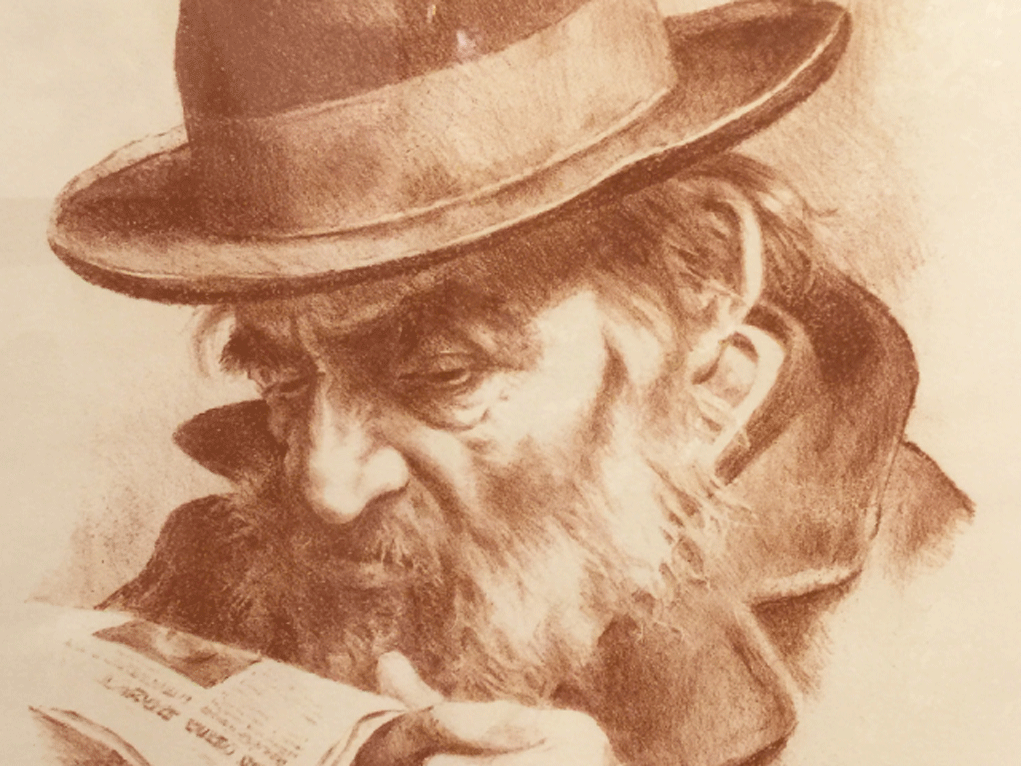

The Yahrtzeit of Rav Shlomo Wolbe
Pesach is the holiday of miracles and the source of the emunah that we carry with us throughout the year and throughout our lives. Chol Hamoed Pesach is an excellent opportunity for Torah learning, as I try to take advantage of the numerous shiurim offered in various venues in Eretz Yisroel. But there is another poignant aspect of Chol Hamoed Pesach for me: I can never forget the year 5765/2005, when we bade farewell to the mashgiach Rav Shlomo Wolbe precisely at this time. The same feelings of tragic loss are stirred within me every year on the night of bedikas chometz, when I remember the tragic car accident that took the lives of Rav Shimshon Dovid Pincus, his wife Chaya Mindel, and their daughter Miriam in the year 2001, at that time. I will never forget that experience; I spent an entire day at Soroka Hospital and then at the funerals in Ofakim and Yerushalayim. On every yahrtzeit, I visit the kever on Har Hamenuchos together with the family—and 25 years have now passed since that tragic day! I wasn’t acquainted with Rav Shimshon Pincus as well as I knew Rav Wolbe; however, his son Rav Eliyohu Yitzchok has always been like a brother to me.
On the day Rav Wolbe passed away, I was at Shaare Zedek hospital together with his wife, Rebbetzin Rivka Wolbe (the daughter of Rav Avrohom Grodzinsky, mashgiach of the Yeshiva of Slabodka), and his son-in-law, Rav Schwartzmann. We knew that Rav Wolbe’s hours were numbered; his kidneys hadn’t been working for several days, and the doctors had told us that there was no natural way for a person to survive without kidneys. But the advance warning wasn’t nearly sufficient to prepare us for the moment when the doctor emerged from the room and told us that the yetzias neshomah had begun. That was an unbearable moment that I will never forget. It was Rebbetzin Wolbe who served as the pillar of strength at that time, dispensing instructions on what to do next.
As I’ve mentioned in the past, the Yaakovson and Wolbe families had already been connected for three generations. My grandfather, Rav Binyomin Zev Yaakovson (the right-hand man of Rav Yaakov Rosenheim, one of the leaders of Keren HaTorah and the Vaad Hatzolah) became the rov of the Machzikei Hadas community of Copenhagen, Denmark, after the war and fled with his kehillah to Sweden on that famous Rosh Hashanah when the Jews of Copenhagen were saved from the approaching Nazi army. Rav Wolbe was a young man who was living in Sweden at the time and later partnered with my grandfather to open a school that accepted 100 girls, after thousands of Jewish survivors of the Holocaust made their way to Sweden directly from the death camps. All of the girls in the school came from religious homes and had clung to their faith in Hashem and their loyalty to the Jewish people. Half of them later emigrated to America, while the other half accompanied by grandfather to Eretz Yisroel. My grandfather maintained contact with “his girls” in America as well and made a point of attending their simchos and other events that they organized. The story of Lidingo is a piece of Jewish history that hasn’t received enough attention and appreciation over the years. Many girls who did not join the students in the school were lost to the Jewish people forever, including some who hailed from prominent families.
One of the girls in Lidingo was my mother. Another girl, who was somewhat older, was Rivkale Grodzinsky. The shidduch between Rav Shlomo and Rebbetzin Rivka Wolbe was made in Lidingo, and they married in Eretz Yisroel several years later. Rav Wolbe went on to open the yeshiva in Beer Yaakov, where he served as the mashgiach and recruited my father to hold a position as a maggid shiur. My father later took over for Rav Moshe Shmuel Shapiro as rov of the community of Beer Yaakov, after Rav Moshe Shmuel decided that he could not simultaneously hold the positions of rov and rosh yeshiva. Many years later, Rav Wolbe moved to Yerushalayim. After my marriage, I became his neighbor; we lived in the same building for about 30 years, until the time of his passing. In short, I essentially spent my entire life in the shadow of Rav Wolbe and his rebbetzin, whom I knew as “Doda Rivka.” I don’t want to boast, but I assisted Rav Wolbe on dozens of occasions with all sorts of things, including during the period of his illness. And that is why I feel the same emotional pang every year on Chol Hamoed Pesach.
On that note, I would like to share two stories concerning Rav Wolbe with you.
“The Malach”
Shortly after Rav Wolbe’s passing, I had a conversation with two women who had been students in the Lidingo school. Both were over the age of 75 at the time, twenty years ago. One of those women was my mother, and the other was a Belzer chossid named Rebbetzin Rechnitzer, whose husband was a posek in the Belz community. When I wrote about this conversation at the time, I identified them in the published article only with their initials. Now that they have both been deceased for many years, I can use their names.
“What did my grandfather, Rav Binyomin Zev, and Rav Wolbe mean to you in Lidingo?” I asked them.
“They gave us a sense of family; they were like fathers to us,” my mother said. “Shabbos in Lidingo reminded us of all the Shabbosos we had in our own homes, with all the mitzvos we experienced there.”
The other woman added, “We both lost something very, very great…. He created our Yiddishkeit. We owe our Jewishness to your grandfather and to Rav Wolbe. We were like lost sheep…. Even I, who came from a chassidish home, did not know what would become of me after the Holocaust.”
“What was Rav Wolbe’s role?” I asked them.
“Merely looking at him was enough to strengthen our yiras Shomayim,” Rebbetzin Rechnitzer said. “He was a great man even at the time. All of us, all the girls in Lidingo, used to gather together in that small room to listen to him.”
“He gave shiurim on Tehillim,” my mother added. “He was a spiritual figure. He was able to use Tehillim as a basis for discussing anything, as we sat in a circle and listened.”
“I know that you used to call him ‘the malach,’” I said.
“That’s right,” my mother replied. “In Lidingo, that is what we called him.”
“Tzvika, you are writing for a newspaper, aren’t you?” my mother’s friend admonished me. “You can’t write such words in a newspaper. You can write that we were filled with yiras Shomayim when we looked at him, and that we cannot describe how much we owe to him and to your grandfather.
“Did you maintain contact with him after coming to Eretz Yisroel?” I asked.
“Absolutely,” my mother said. “He and Doda Rivka felt a strong sense of responsibility toward us. We often sought his advice.”
“Yes,” her friend concurred. “Morah Rivka used to visit us every time he came to the yeshiva in Gush Shmonim for Shabbos, which he continued doing until recently. We, the remaining Lidingo girls, used to meet every year on the yahrtzeit of your grandmother, Rebbetzin Baila Yaakovson, and listen to a shiur. Last year, the kinnus was held in my house, but Rav Wolbe no longer had the strength to attend. Only his wife came to the event. These two great men, Rav Binyomin Zev and Rav Shlomo, were the ones who revived us—the long-suffering girls who yearned for the release of death, for whom the fire of life had dimmed and whose smiles had faded. Your grandfather knew how to open our hearts,” she added.
Why Did Rav Wolbe Insist on Davening Mincha Gedolah?
On Tisha b’Av 5764/2004, Rav Wolbe delivered a shmuess in the Mir yeshiva, and I drove him to the yeshiva. When he concluded his shmuess, I approached his seat to inform him that I was still there and available to take him home, and he looked surprised. “Did you stay here for the shmuess as well?” he exclaimed.
As we headed toward the car, a yungerman approached Rav Wolbe and asked how to strengthen his emunah. “By davening,” Rav Wolbe replied. One minute later, a different yungerman approached him and asked how to improve his davening. “Think about every word, and remember that you are standing before Hashem,” Rav Wolbe replied. “Envision yourself before Him.”
On that subject, the following story is a true incident that I experienced, although I have heard quite a few speakers repeat it, each of them adding many details that never actually took place: The staff of the Yeshiva of Givat Shaul, which Rav Wolbe founded, asked him to join the yeshiva for Mincha during the summer zman, but he demurred. “I prefer to daven Mincha Gedolah,” he said. The rabbeim tried to persuade him to change his mind, pointing out that if he arrived for the later Mincha and remained in the yeshiva until Maariv, it would create an opportunity for the bochurim to meet with him personally between the two minyanim. “Nevertheless, I prefer to daven Mincha Gedolah,” Rav Wolbe insisted.
“Perhaps the rov can come for Mincha in the late afternoon and simply not daven with the yeshiva,” they suggested.
“Chas veshalom,” Rav Wolbe replied. “I cannot be in the yeshiva without observing the sedorim of the yeshiva.”
Thus, Rav Wolbe refused to wait until the end of the day for Mincha, and he also refused to be present in the yeshiva without davening along with them. One day, I decided that I needed to solve the mystery of his behavior: Why, in fact, was he unwilling to daven Mincha late in the afternoon? When I questioned him about it, Rav Wolbe seemed to feel obligated to explain himself to me, out of hakaras hatov for the fact that I often drove him from his home to the yeshiva.
“I am not capable of waiting from the morning until the evening to speak to Hashem,” he said frankly. And if I remember correctly, he may have added, “How can someone wait from 7:00 in the morning until 7:00 at night without speaking to Hashem?”
With that, I wish you all a Pesach kosher v’someiach.
Pesach Brings Out the Beauty of Am Yisroel
Here in Israel, the entire country shut down for Yom Tov, government offices are closed and banks maintain a half-day schedule on Pesach, even when there is no war. Of course, there are also shiurim and yeshivas bein hazemanim programs, which have become ubiquitous. As I write this, I wonder how these programs will be impacted by the temporary prohibition on large gatherings due to the war.
This year, incidentally, there are some left-wing agitators who have grown outraged by the fact that certain grocery stores cover chometz items with plastic before Pesach. They cannot tolerate the sight of chometz being made inaccessible to consumers on Pesach. Rav Uri Zohar once told me, any display of kedusha tends to provoke the eirev rav among us.
From my standpoint, there is something else that is extraordinary about this season: It is a time when the Jewish people’s grandeur is revealed. It is astounding to see how people observe the laws of Pesach with painstaking care, toiling to purge every last trace of chometz from their homes, to obtain matzos of the highest halachic quality, and so forth. This is also the holiday when we become aware of an entire world of chessed operating in our communities, including massive distributions of food and other provisions to the needy. I am always amazed by the many neighborhoods where communities organize group purchases of various goods for Pesach, using their joint purchasing power to negotiate cheaper prices. These arrangements are often handled by yungeleit who spend the entire year in the bais medrash but turn out to be shrewd businessmen as well, capable of soliciting bargains and organizing massive ventures—although they confine their business exploits to bein hazemanim.
Will Pesach Bring Netanyahu Freedom from Criminal Charges?
You may find this difficult to believe, but the Israeli media and liberal elites are focused on something that they seem to find even more important than the war and the oil crisis. And no, it isn’t that they are worried about baking matzos or purchasing wine for the upcoming Yom Tov. Instead, their attention is occupied by a decision due to be made by Amichai Eliyahu, a minister in the Israeli government in Itamar Ben-Gvir’s party and a grandson of Rav Mordechai Eliyahu, former chief rabbi of Israel. And what is the subject of this all-important decision that dwarfs even the war against Iran? You may have guessed it: It is the question of whether the government should accede to Prime Minister Netanyahu’s request for a pardon.
You are surely already aware that our president, Yitzchok Herzog, is holding a veritable ticking time bomb in his hands. Netanyahu has already submitted an official request for a pardon, and Herzog is under enormous pressure from President Trump to accede to that request. Trump used some strong words that daunted the Israeli president, and Herzog responded weakly that Israel is an independent democratic state with its own internal processes, and we must allow those processes to take place.
The first official step was for the request for a pardon to be reviewed by the Pardons Department of the Justice Ministry. Two weeks ago, the department released its professional opinion, and there was a fierce dispute between Bibi’s supporters and his detractors over what, exactly, the decision said. The anti-Netanyahu camp claimed that the department had found that Netanyahu’s request isn’t a standard request for a pardon and therefore cannot be reviewed at all. The reason it isn’t a standard request is that Netanyahu hasn’t been convicted, nor has he even admitted to any of the crimes with which he was charged. They also claimed that the professional opinion states explicitly that there are legal difficulties involved in accepting the request. Netanyahu’s supporters, however, insist that there is a precedent for issuing a pardon in this situation—namely, the 300 Bus affair, in which then-President Chaim Herzog pardoned the heads of the Shin Bet after they were accused of murdering a terrorist. In that case as well, a preemptive pardon was issued, before the defendants were tried or convicted. As for the legal difficulties cited by the opposing camp, the prime minister’s supporters pointed out that the professional opinion states only that the difficulties exist, but not that it is impossible to issue a pardon.
Once the Pardons Department has issued its opinion, the next step is for the minister of justice to make his own recommendation to the president. This time, however, the minister of justice, Yariv Levin, passed this hot potato to Minister Amichai Eliyahu instead of handling himself. Levin considers himself in a potential conflict of interest on this subject; he is a friend of Netanyahu and a member of his party, and his own opinion regarding the pardon is already well-known. To date, Levin has transferred all legal issues that he couldn’t personally address to Minister Eliyahu, and this occasion was no exception.
It would be easy enough to guess Minister Eliyahu’s opinion on the subject, but there isn’t even a need to guess. As soon as he received the professional opinion from the Pardons Department, Amichai Eliyahu unleased a torrent of scathing criticism against Attorney General Gali Baharav-Miara for her handling of the issue. (Of course, Baharav-Miara has been vehemently opposed to pardoning the prime minister.) He then added, “I have begun a series of in-depth consultations with the relevant authorities in order to formulate my final position, before I relay my recommendation to the president.”
Minister Chikli Against the Wife of the Mayor of New York
There are many more things that I could report to you. As you know, the State of Israel creates news stories at a dizzying pace. One hot topic is the recent recommendation issued by Amichai Chikli, the Minister of Diaspora Affairs and Combating Antisemitism, to bar New York Mayor Zohran Mamdani’s wife, Rama Duwaji, from entering Israel in light of her support for terrorism. Duwaji expressed solidarity with Hamas after the Simchas Torah massacre, and she has since described American soldiers as “imperialists.” I don’t know if Duwaji actually has any intention of visiting Israel, and I cannot be certain if Chikli’s decision was the correct move, but I felt obligated to share the information with you.
Meanwhile, a mind-boggling recent incident has demonstrated once again that the ministers in the government lack any real power. There is an investigator in the police force named Rinat Saban, who is due for a promotion on account of the amount of time she has spent in the service. (In the military and the police force, officers are promoted every few years even without showing any special abilities or qualities. The more worthy officers simply receive their promotions earlier.) However, Minister Ben-Gvir decided to block her promotion, claiming that she is a failed officer and that her file contains negative reviews. The political left promptly accused him of denying her a promotion for political reasons—namely, that she was one of the investigators on the Netanyahu case. Last week, the Supreme Court ruled that Ben-Gvir is required to grant Saban the promotion she desires. Ben-Gvir was aghast. “This is my authority; I am supposed to be the one making the determination. How can they obligate me?” he demanded.
We will have to wait and see how this story ends.
A Plethora of Memorial Days
As everyone anticipated, the draft law will not be passed before Pesach. We hope that it passes after Pesach. (See my interview with MK Uri Maklev this week on that subject.) For the chareidi community, the law is desperately needed to put an end to the ongoing persecution of bnei Torah. However, the war with Iran has brought almost all parliamentary proceedings to a halt; the Knesset is in a state of hysteria, and the committees are mainly busy with the state budget as they strive to ensure that it will be passed before Pesach. The Knesset speaker is barely permitting the committees to discuss any ordinary topics.
Amid all this commotion and confusion, however, one aspect of the Knesset’s work is continuing: The members of the Knesset are still placing new bills on the Knesset table, even though it is very unclear if any of those bills will ever be brought to a vote. And if the latest bills are any indication, it seems that introducing a law in the Knesset is one way to set a trend. For instance, after Avi Maoz submitted his conversion law, Meir Porush introduced a bill of his own on the subject. But unlike Maoz, whose bill states that the Chief Rabbinate will be empowered to determine whether a conversion is valid, Porush adopted a formula that was first attempted 30 years ago, which states that a convert will be recognized as a Jew only if he converted “in accordance with halacha.” This language was rejected by legal experts in the previous generation, who warned that the Supreme Court might rule that even a Reform conversion is considered “in accordance with halacha,” which would make it pointless to pass this bill.
Meanwhile, Maoz’s Kosel Law, which accords the chief rabbis the ultimate authority over the Kosel Hamaaravi, recently passed its preliminary reading in the Knesset. This law, which is a copy of a law that has been repeatedly introduced by MK Michoel Malchieli since the 20th Knesset, was assigned this week to the Constitution Committee to be prepared for its first reading. That seems to be good news, since the committee is headed by Simcha Rothman.
Meanwhile, other types of laws seem to be developing into trends as well. Israel already has laws on the books calling for days of remembrance for Rav Kook, Rav Ovadiah Yosef, and Rav Mordechai Eliyahu. Two more bills, which were placed on the Knesset table, call for days of remembrance for Rav Meir Mazuz and the previous Sanz-Klausenberg Rebbe, respectively. And the Knesset has begun reaching even further back in history, as MK Eliyohu Revivo (Likud) recently introduced a new bill calling for a day dedicated to the legacy of Rav Nachman of Breslov.
Defense Minister Admits: No Minyan in Prison
Even though I could easily write an entire article detailing the events of the winter assembly in the Knesset, I will limit myself to one more comment about it. Last week, just before the winter session ended, two important subjects were raised in the Knesset: the chareidi young man imprisoned for draft evasion who was not permitted to hear the reading of Parshas Zachor, and the arson attack on a shul in Ramle. The latter issue was raised by MK Ariel Bosso, who was born in Ramle and is a nephew of the city’s chief rabbi. (Bosso is also a grandson of the Baba Chaki, Rav Yitzchok Abuchatzeirah, the brother of the Baba Sali; the Baba Chaki served as the rov of both Ramle and Lod for many years.) The former topic, meanwhile, was raised by Yoav Ben-Tzur.
“This is a historic time for the State of Israel,” Ben-Tzur declared in the Knesset. “It is a time when the Jewish people are fighting with courage, with wisdom, and with boldness against the head of the Iranian octopus. The miracles that we are witnessing are astounding the leaders of the world when they see the Divine protection accorded to us, the children of the Jewish people. At the meetings held to prepare for the war against Iran, concerns were expressed about the possibility of them firing at us on a level we have never seen before. Preparations were made for destruction on a level that would best not be described in detail, chas v’sholom. Thanks to Hashem’s mercy, this did not happen, and we all daven that it will not happen. Along with the great miracles, we are all pained and grief-stricken over those who were murdered; may Hashem avenge their blood….
“Unfortunately, specifically during these days, when we are fighting against Amalek, a young man who was held in a military prison was prevented from hearing the reading of Parshas Zachor, which is a mitzvah in the Torah that is obligatory for every Jew. I am pained by this incident not because of my affiliation with a specific sector, but rather because I am a Jew who takes pride in his country, the land of his birth. The words ‘remember what Amalek did to you’ belong to all of us, not just to the chareidim. That is the motto we must adopt today, so that we can combat the Amalek who is attempting to destroy and obliterate us. Specifically for that reason, this is an outrage, especially in the wake of the previous incident when a young man was not permitted to wear tefillin. It makes no difference why he was detained in the military prison, where the authorities are required to abide by the laws of the religion, which they have flouted time and again. I think that it is important to pay attention to these things…. People are being arrested for the great crime of learning Torah in the State of Israel. My friends, members of the Knesset, the Torah of Israel has no connection to politics. The entire Torah was given to all of us at Har Sinai. No one asked us whom we vote for, with which camp we associate ourselves, or what ethnicity we came from. There was only one question: Are you Jewish, and if so, do you accept the Torah? Today, I call out here, after thousands of years have elapsed since the Torah was given: Yes, we are Jews. Yes, we believe in the Torah of Moshe. Above all, we are united as brothers. That is why our pain is much greater when we witness things such as this, things that would have horrified us if they happened in another country. We would surely have protested loudly if that happened. Why was it so hard to permit this to him? This is a sign of callous insensitivity.”
Minister May Golan delivered the defense minister’s response on his behalf. The minister of defense wrote in his response, “The army gives every religious or chareidi soldier the opportunity to observe mitzvos. However, for security reasons, it is not possible to permit davening with a minyan in the segregated wing, although individual prayer is permitted. For that purpose, prisoners in the wing were provided with a Chumash, in accordance with their request.”
That response is shameful!
Minister Eliyahu on a Pardon
As I mentioned, Attorney General Gali Baharav-Miara is staunchly opposed to the pardon. For one thing, Netanyahu submitted his request without admitting to a crime or expressing remorse, and his trial hasn’t ended yet. All of these factors, she insists, make it difficult to conduct a routine review of the request. Moreover, she argues that Netanyahu should not receive preferential treatment, especially in light of the criticism that he has directed against the prosecution throughout his trial.
Amichai Eliyahu pointed out that the judges in Netanyahu’s trial recommended arbitration or an out-of-court settlement, and they also advised the prosecution to remove some of the charges (especially the charge of bribery), but Baharav-Miara ordered the prosecutors to refuse. Eliyahu feels that the attorney general has been highly unreasonable. He also pointed out that she has worked extremely rapidly to advance the charges against Netanyahu, whereas she is as slow as molasses in dealing with any other subject. The minister added, “Contrary to the attorney general’s briefings [i.e., the statements she leaked to close associates in the press] that indicate that there is nothing to discuss about granting a pardon, the opinions of professionals have established that we are indeed dealing with a completely proper and legitimate request for a pardon, which must be handled by the president of the state.”
This week, Amichai Eliyahu announced that he had completed his review of the subject and that he plans to relay his recommendation to the president. No one has any doubt as to what he will recommend, but everyone is waiting with bated breath to see how President Herzog will respond.
At the beginning of this week, a leaked report from the president’s office indicated that he plans to promote his own suggestion, which he hopes will be a respectable way to bow out of the conflict: evaluating the possibility of criminal mediation. In other words, Herzog does not intend to reject the possibility of a pardon out of hand; however, he hopes to concurrently pursue some sort of dialogue. If the mediation leads to an agreement, it will be possible to proceed from there. If there is no progress, then he will be able to resume the process of considering a pardon.
In short, Herzog hopes that the trial will end with some sort of arrangement that will receive the agreement of both Prime Minister Netanyahu and the prosecution and judges. That, however, is highly unlikely, although if such an agreement were reached, it would be a veritable lifeline for Herzog. The president’s office is remaining mum on the issue for the time being, issuing the fairly noncommittal public statement that Herzog will review all information brought to him independently, in accordance with proper protocol and based on his own discretion. But everyone knows that when Minister Eliyahu’s recommendation lands on his desk, the president will be in a serious quandary.