
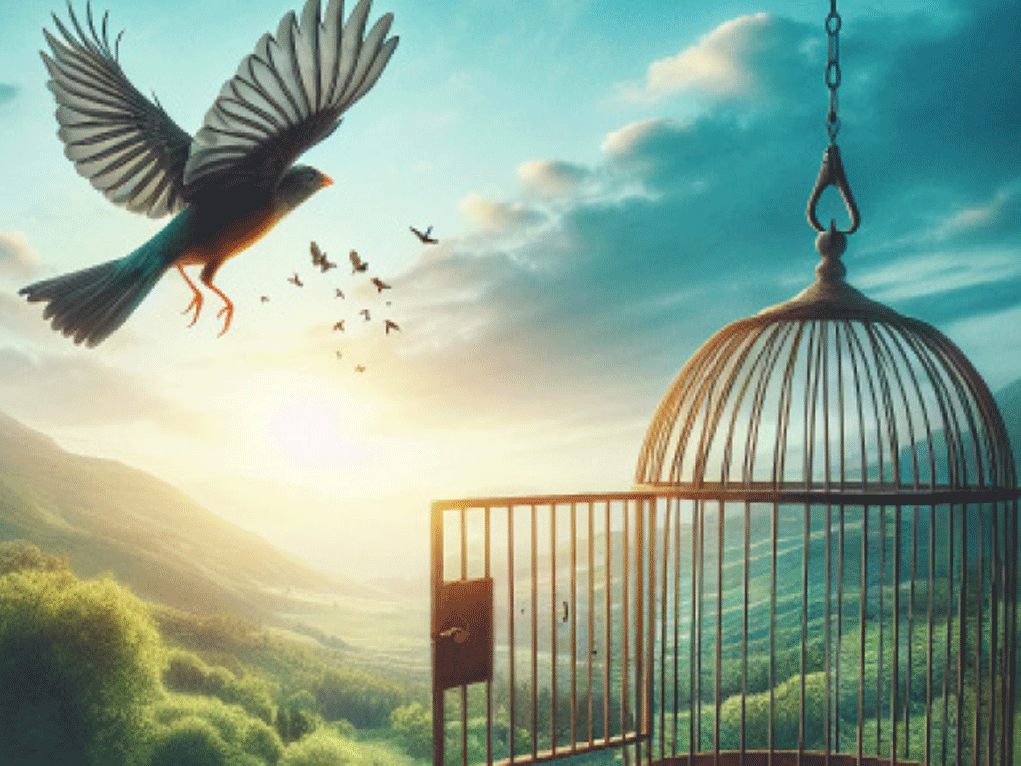

The Pesach Seder is a cherished time. With all the hustle and bustle of cleaning and preparing behind us, not to mention the sweat and tears, we sit around the Seder table like kings and queens, celebrating Hashem’s miraculous salvation. We recount the story, eat the matzah and marror, and listen to an endless flow of divrei Torah from adults and children.
Every detail of the Seder and the Haggadah is rich with depth and meaning, and on this night, more than on all other nights, we take the time to delve into every aspect and bring it to life. Yet, precisely because of this richness, we must remember that the Seder has a central message that must not get lost in the sea of insights. It’s a message we must absorb ourselves, and one we are obligated to convey to our children: V’higadita l’vincha.
We sit at the Seder to recount and relive the experience of yetzias Mitzrayim: the enslavement, the great nissim Hashem performed, and His choosing us to be His nation. We remember how our temporary sojourn turned into inescapable slavery and the terrible bitterness of our suffering. We recall how we cried out to Hashem, and He answered. We recount the supernatural punishments and plagues He visited on our tormentors, and the wonders through which He redeemed us, leading us towards the momentous revelation at Har Sinai and ultimately to the Bais Hamikdosh.
As the Haggadah says, “Kol hamarbeh lisaper harei zeh meshubach — the more we expound on the story and all that it means, the more praiseworthy it is.” But even as we explore the details, we must not lose sight of the central point.
The Seder is more than an annual commemoration of the past. It lays the foundations of our emunah and bitachon. The Ramban, in Parshas Bo, explains that the purpose of the great miracles of Yetzias Mitzrayim was not just to redeem us physically, but to establish the foundations of our emunah for all generations.
The open miracles we experienced and witnessed shattered the illusion that the world runs on its own. They demonstrated that Hashem creates the world, knows every detail, and actively guides events. Moshe Rabbeinu’s warnings to Paroh revealed that Hashem communicates directly to His nevi’im, revealing to them His will and His wisdom. These are the foundations of Torah and emunah, the source of our strength as we face our own personal Mitzrayim and our own inner Paroh.
Since such open miracles do not occur in every generation, the Ramban explains, Hashem gave us mitzvos that serve as enduring reminders. They ensure that the memory of those nissim never fades and we never lose sight of the truth they reveal. Pesach is first among them, but tefillin, mezuzah, Shema, and others also serve to keep these great nissim in the forefront of our minds.
The truth revealed by the great public miracles also reveals the truth in our personal experiences: our daily lives are shaped only by Hashem’s hand; His hidden, personal miracles direct everything we experience and every challenge we face. In the words of the Ramban, seeing Hashem’s hand in everything that happens to us is “the foundation of the entire Torah, for a person has no portion in the Torah of Moshe Rabbeinu unless he believes that everything that happens to us is a miracle, not a result of nature or ‘the way of the world.’”
The Seder, then, is not simply an act of remembrance. It is an act of construction. Each year we rebuild the foundations of our perception, training ourselves and our children to see beyond the surface of events and to live with clarity, with emunah in Hashem, and bitachon that He will provide for all our needs. It leads us, in other words, to true freedom.
Chazal teach us that the word chorus, “engraved,” describing the words on the luchos, can also be read as cheirus, freedom. True freedom, they explain, comes only from Torah.
At first glance, this seems paradoxical. The Torah includes many mitzvos lo saaseh, which restrict us. Yet, they actually free us, enabling us to live in alignment with who we truly are. They don’t confine us; they define us.
Freedom is not the absence of restriction. It can’t be. Removing all bounds is not liberation, it’s total destruction. Existence requires definition, and definition is, by definition, limitation. Those limitations that reflect our true nature are not imprisonment; they are true freedom.
I lived this reality myself. Behind bars, in a place called prison, I felt truly free. Not by removing boundaries, but by embracing boundaries of Torah, halacha, hiddur mitzvah, the boundaries that define me as a Yid.
To find freedom, therefore, it’s critical to know who and what you are. Consider the midaber, the human being. To be a mentch, a civilized person, is to embrace numerous restrictions on your behavior. If someone “frees” himself from these restrictions, he’s not considered a freer person — he’s abandoned his identity as a person and is instead derided as an animal.
An animal itself is not belittled for acting this way, but to be an animal, a nefesh chayah, carries its own limitations. For example, animals each have their natural habitat or ecosystem in which they thrive. An obvious example is a fish, which is “constrained” to water. To free them from this “limiting environment” is to kill them.
A plant is a tzome’ach. It needs to grow. Give it soil, water, and sunlight, and it will flourish, but it needs to stay rooted to one place. Free it from that constraint, uproot it and move it around, and it dies.
A Yid is a neshomah, a nefesh Elokis. Our connection to Hashem is who we are. Torah and mitzvos are part of that connection. Fulfilling them, even the ones that constrain us, is our true freedom. Not only do Torah and mitzvos express our true nature, but they connect us to Hashem, who is truly without limit and limitation.
Paroh’s slavery wasn’t just the hard labor — he prevented us from going to Har Sinai and receiving the Torah. Yetzias Mitzrayim was not just the escape from the taskmaster’s whip; it was the ability to go stand at Har Sinai.
That’s what’s really on the table at the Seder. Focused on the message of the night, we can set aside the illusion of the natural order and “the powers that be” and embrace the miracles and salvations, in our history and in our daily lives, that are granted to us by the only “Power that Is.” We can recognize and affirm our own true nature and our commitment to Torah and mitzvos. We can use the night, with all of its mitzvos and minhagim, to restore and strengthen our clarity, our foundations, and, as a result, our true freedom.