
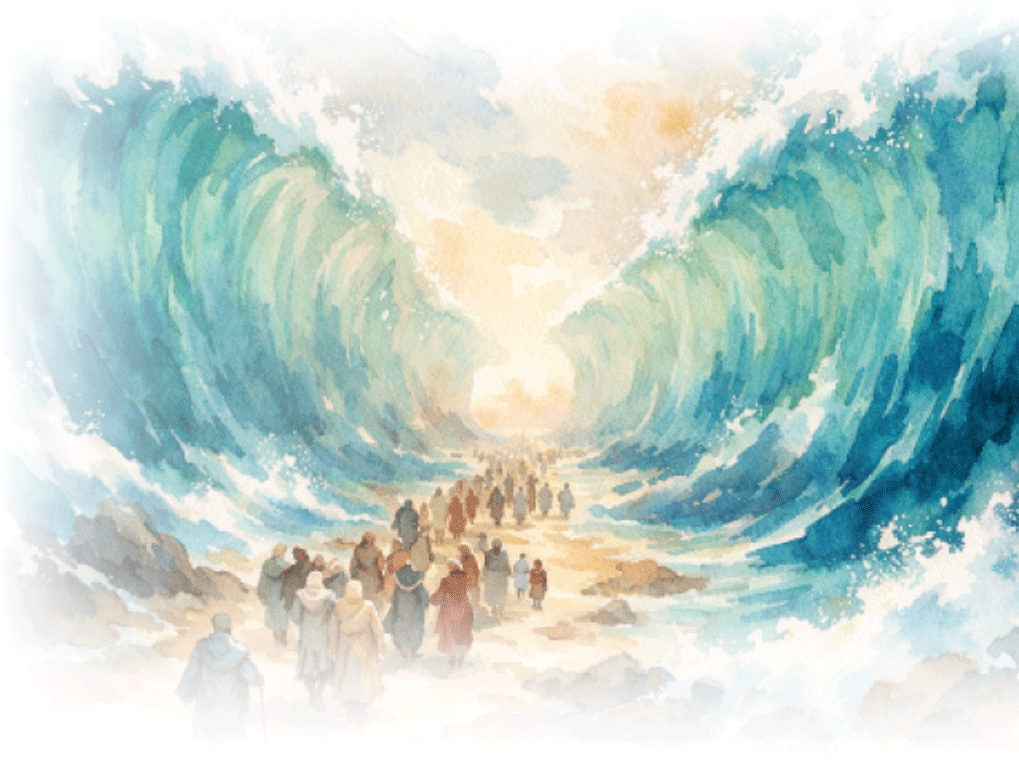

The culmination of Pesach and indeed Yetzias Mitzrayim was Krias Yam Suf. This was clearly one of the greatest miracles in human history and has become a part of our legacy, davening and emunah. But something equally important happened then that also has a daily impact upon our lives and the hashkafah by which we live.
My rebbi, Rav Yitzchok Hutner (Maamorei Pachad Yitzchok, 69:9, page 249), notes that the Shirah is the first time that Knesses Yisroel speaks of itself in the first person. The words are “zeh Keili ve’anveihu — This is my G-d and I will build Him a sanctuary; the G-d of my father and I will exalt Him” (Shemos 15:2). This is the first moment of Klal Yisroel’s self-awareness. When a child is born, it has no such awareness of a self. At this crucial moment, Klal Yisroel declares coronation of the Ribono Shel Olam, for without that, it cannot continue to exist.
So now we know. Beyond the exodus, beyond Mattan Torah, it seems that we received our identity as a nation at Krias Yam Suf. Why, indeed, not when, as the Haggadah tells us, “We became a nation there [in Egypt]”? Why not at Har Sinai, when we were told what to do and what to avoid? We are the nation of the Torah. Shouldn’t that be the moment when we discovered our identity?
Rav Hutner answers that all other nissim were temporary. They lasted as long as they were needed, and then the world returned to its original state of creation, which is the ostensibly natural not supernatural world. However, when Hashem split the Yam Suf, the waters would have remained suspended in midair if not for His declaration that “the water will go back upon Egypt, upon its chariots and upon its horseman” (Shemos 14:26). As Rav Hutner expressed it elsewhere (ibid. 33:15, page 135), “If when we went down to Mitzrayim, the future family of Klal Yisroel that would go toward the End of Days was created, its form and final birth happened at Krias Yam Suf.”
But we have not yet fully understood why this was the pivotal moment when we realized who we were, why we were created, and what our purpose is in the world. Rav Hutner gives a comprehensive and profound answer, which is beyond the scope of this article, but I would like to suggest a simpler approach to this important query, which is actually based upon Rav Hutner’s words elsewhere.
First of all, Rav Hutner (Pachad Yitzchok, Pesach 40:7) quotes the Mechilta (Shemos 14:21) that all the waters in the world split at the same time as the Yam Suf. He explains that this seemingly unnecessary part of the miracle “happened because, in fact, the neis of Krias Yam Suf affected the entire realm of water and earth.” In other words, this miracle was not limited to the nation’s need to be rescued from the Egyptians. It represented a new manifestation of Hashem’s power and control over every facet of the universe. This itself is an answer to Rav Hutner’s question earlier. Once we understand that the world was created for Klal Yisroel, the final part of Yetzias Mitzrayim must be felt all over the earth so that we would realize that from this point on, “everything is because of Klal Yisroel” (see Vayikra Rabbah 36:4).
To continue our study of the Pachad Yitzchok’s view of Krias Yam Suf, Rav Hutner (Maamorei Pachad Yitzchok , Pesach 96:2, page 344) quotes the Yerushalmi (Arvei Pesachim, halacha 6) that “the reason that Klal Yisroel didn’t sing shirah until the seventh day of Pesach is that the culmination of geulah (redemption) did not occur until then. He elaborates on this statement of Chazal in several maamorim (ibid. 33:15, 41:6), where he derives the relationship between the finality of geulah and shirah from a posuk in Tehillim (13:6), which we recite every day at the end of Hodu. Dovid Hamelech says, “But as for me, I trust in your kindness; my heart will exult in your salvation. I will sing to Hashem, for He has dealt kindly with me.” Rav Hutner concludes, following the Vilna Gaon (commentary in the siddur on Hodu), that even if one totally believes in Hashem and has absolute bitachon that He will rescue us, shirah is not recited or sung until the redemption has actually taken place. This is also quoted by the Emek Brocha, who heard it from the Brisker Rov in the name of his father, Rav Chaim Soloveitchik (see also Rav Nissan Kaplan, Shalmei Nissan, Brachos, page 185:18).
We can conclude from the Vilna Gaon, Rav Chaim and now Rav Hutner that Klal Yisroel was able to burst into a song that has become eternal because they had experienced the miraculous completion of the process of Yetzias Mitzrayim. Only after witnessing the “Egyptians dead on the seashore” were they able to collectively and individually sing our beloved Az Yoshir.
We can now understand why we discovered our identity and voice at Krias Yam Suf. As we learned from Rav Chaim Brisker, even when one has total trust in Hashem, it is impossible to sing shirah on an incomplete event. In the case of Yetzias Mitzrayim, this was the complete annihilation of the Egyptian army. Perhaps there are analogies to the current war in Iran. We cannot be sure, but we can hope that the Yad Hashem will once again become manifest and clear enough for us to sing. This, as Rav Hutner suggests, might also be the reason why the waters would have remained standing if not for an express command from Hashem. Since this was a pivotal final moment releasing us from the threat of Mitzrayim, the miracle had to include a sense of culmination and permanence. This also explains the universal aspect of Krias Yam Suf being both visible and effective throughout the world.
Many other aspects of Krias Yam Suf now fall into place as well. The Mateh Moshe (Hilchos Pesach) quotes Rabbeinu Bachya (Parshas Va’eira), who says that Krias Yam Suf is included in the four aspects of geulah. In fact, the splitting of the sea corresponds to the kos shel brocha of Birkas Hamazon. Halachically, there is a fascinating disagreement amongst the poskim (Hilchos Krias Shma) if one can fulfill his obligation to mention Yetzias Mitzrayim by reciting the Shirah. The Mogein Avrohom is certain that one can, but Rav Akiva Eiger citing his son-in-law, the Chasam Sofer, is unsure (see Brachos 13b). In any case, it is clear that Yetzias Mitzrayim was officially over after the Shirah. This might also explain why it marks the culmination of Pesukei Dezimra, the passages that praise Hashem for many things. It also explains why the Mishnah Berurah (51) assures us that “one should recite the Shirah joyously and imagine that he, too, has crossed the sea that day. Whoever follows this regimen will surely have his sins forgiven.”
Finally, the Maharal (Gevuros Hashem, chapter 39) tells us that “when Klal Yisroel accepted the royalty of Hashem at Krias Yam Suf, we gained our new form through the singing of the Shirah. The Vilna Gaon (Aderes Eliyahu to Devorim 33:8), too, teaches that “at Krias Yam Suf, we acquired the ability to serve Hashem properly (nishlam kinyan avodah).” Thus, we see that Krias Yam Suf, on many levels, represents the ultimate perfection of the Jewish body and soul so that we can truly be avdei and ovdei Hashem.
Just to complete the picture, let us note that the Shelah Hakadosh and Meshech Chochmah (both on Parshas Beshalach) stress the culmination aspect of Krias Yam Suf and the Shirah. They both understand those magical moments at the end of Yetzias Mitzrayim as a time of self-discovery. We know that the Ramchal (Derech Hashem) stresses that each Yom Tov brings a renewal and ability to reenact what happened on that day. The seventh day of Pesach is therefore a unique time to look deeply inside of ourselves and discover new paths to greatness and how we can help bring the geulah.
May Hashem accept our efforts and bring the long-awaited and much-needed geulah sheleimah bemeheirah veyomeinu. Amein.
A chag kosher vesomeiach to all.