

Divorce, Trauma, and the Communal Obligation to Protect Our Children
By Rabbi Yair Hoffman
A Crisis Hiding in Plain Sight
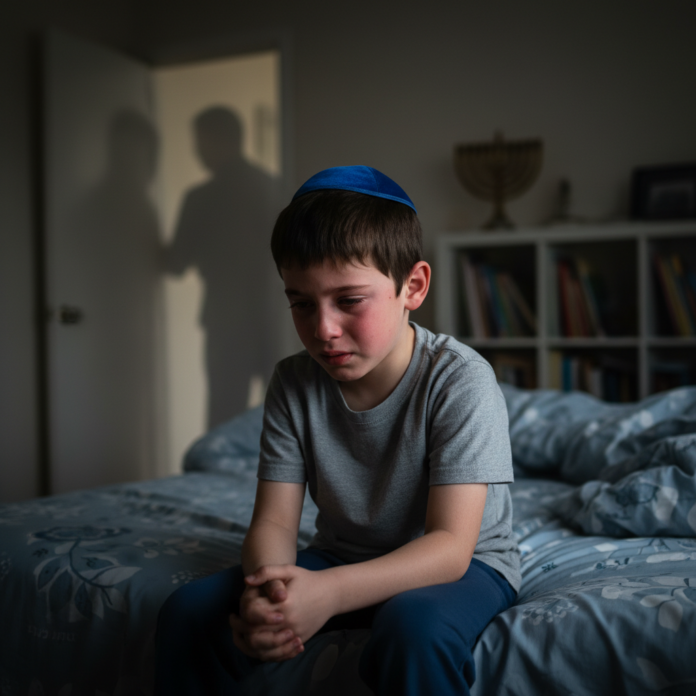
There is a serious devastation unfolding in many Orthodox homes across America. It is happeningin bedrooms where children lie awake listening to arguments they cannot understand, at Shabbos tables where one seat is suddenly empty, and in school hallways where a child has learned to tell two different versions of the same week depending on which parent is asking.
We are a community that speaks openly about our blessings. Our divorce rate — approximately 10%, according to research by Dr. Yitzchak Schechter, a clinical psychologist based in Monsey — is a fraction of the nearly 50% rate in the general American population. This is cause for real gratitude.
But gratitude does not excuse us from confronting what the data also shows. The July 2025 Nishma Research survey — the most comprehensive study of Orthodox Jewish family life ever conducted, drawing on more than 1,700 respondents including 350 divorcees — reveals that when Orthodox marriages do end, they often end badly. And the people who pay the heaviest price are the ones with the least power to do anything about it: the children.
What the Numbers Tell
Approximately 80% of divorced Orthodox respondents had children under 18 at the time of their divorce. The average Charedi marriage ends after 11 years; Modern Orthodox, after 16. These are not young couples who separated before children arrived. These are families mid-stream — with school-age children fully present and fully absorbing everything around them.
The leading cause of divorce in both communities is untreated or undisclosed mental health conditions and personality disorders — cited by 40% of Modern Orthodox respondents and 51% of Charedim. Emotional and verbal abuse, dishonesty, and addiction were also major factors, with 22% of Charedi respondents naming addiction specifically.
More alarming than the divorce rate itself is how these divorces unfold. Dr. Schechter found that 57% of Orthodox divorces were highly contentious. The Nishma survey corroborates it: 47% of respondents described their divorce as hostile, versus only 28% who called it friendly. The factors driving this are unique to our world — the complexity of the get process, the intense interdependence of Orthodox family systems, and the reality that competing advice from rabbis, mentors, and family members simultaneously pulls each party in different directions.
The result is a prolonged conflict that burns for months and years — with children inside it the entire time.
What Research Knows
For decades, our community’s discussion of divorce and children was largely impressionistic. Today, we have something more. A 2024 systematic review catalogued the documented effects on children caught in parental conflict: behavioral problems, academic decline, social withdrawal, anxiety, depression, and in serious cases, suicidal ideation. Divorce is now formally classified as an Adverse Childhood Experience — a category of early trauma shown to produce measurable increases in long-term mental health risk. A 2022 study found that children from high-conflict divorces may develop post-traumatic stress symptoms indistinguishable from those produced by other forms of childhood trauma.
Research also documents a striking gender-specific effect: boys whose parents separate show a significant drop in time devoted to learning and reading, and a doubling of unstructured screen time. For a community in which Torah learning is a core value and screen exposure a recognized threat, this finding is a communal emergency.
The Malbim explains that the Torah compares itself to the pupil of the eye because it is irreplaceable once damaged. The same is true of a child’s formative years. The window during which a child forms his foundational sense of security and identity does not remain open indefinitely.
Perhaps the most sobering Nishma finding is this: 24% of divorced respondents had themselves experienced childhood trauma. The researchers explicitly called for intervention before marriage — because the data shows a direct line from one generation’s unhealed pain to the next generation’s fractured home. The children inside today’s contentious divorces are at elevated statistical risk of becoming tomorrow’s divorcing parents.
Parental Alienation: When a Child Becomes a Weapon
Among all the harms of a contentious divorce, one stands out for its particular cruelty: the deliberate effort by one parent to turn the child against the other. It takes many forms. A parent who uses visitation as leverage, leaving a child waiting at the door to punish the ex-spouse. A parent who interrogates the child after every visit — “Did anything bad happen? Are you sure?” — planting anxiety where none existed. A parent who files accusations of abuse not because they believe them but because they understand that such allegations are the most effective legal weapon available. A parent who turns every birthday and graduation into a competition for loyalty.
Parents who do these things often believe they are acting protectively. They are wrong. What they are teaching their child is that love is conditional, that adults cannot be trusted, and that the appropriate response to pain is retaliation. These lessons last. The clinical research is unambiguous: chronic parental conflict produces chronic emotional dysregulation in children. They do not grow accustomed to it. They are harmed by it, repeatedly, and carry those wounds into adulthood.
“Do not open your mouth for evil, to act with deceit” — Tehillim 17:3
A parent who manipulates a child — even with the sincere conviction that they are protecting them — is committing an act of deceit against the most defenseless person in the household. The child has no frame of reference beyond what that parent tells them. What the parent calls reality – becomes their reality.
The Get and the Children
No honest accounting of Orthodox divorce can omit the get. A 2025 survey by Chochmat Nashim of nearly 400 women across 11 countries found that at least 30% experienced get refusal. One-third reported being pressured to surrender financial rights or custody arrangements in order to receive it. On average, 40% waited more than a year; 16% waited more than three years.
These numbers represent years during which children are living inside an unresolved crisis — years in which no parent has the emotional bandwidth to focus on their children, in which sustained hostility poisons every interaction, and in which a child’s need for stability is perpetually deferred. The harm compounds with every passing month.
This is a call to every participant in the get process — dayanim, rabbanim, attorneys, and family members — to weigh the welfare of the children as actively as they weigh anything else before them.
Six Obligations
In an article published some 15 years ago, David Mandel delineated 6 obligations. These are obligations — drawn from the data, from the clinical literature, and from the values our community already hold.
- Premarital preparation must address mental health. The Nishma data has given us a diagnosis: the single greatest driver of divorce in our community is untreated mental health conditions. Chassan and kallah classes must evolve to include meaningful education about narcissism, control issues, emotional regulation and relational skills. Rabbis who serve as mesadrei kiddushin should consider making documented participation in such programs a condition of officiating.
- Mentorship in the first year of marriage. The first year is when habits of communication and conflict resolution are established — for better or worse. A model of pairing young couples with experienced married mentors has shown measurable success in several chasidic communities. It deserves adoption across all of Orthodoxy, with equal attention to young women as to young men.
- Mandatory child-centered counseling for divorcing parents. When minor children are present, both parents must participate in counseling focused exclusively on the children’s welfare — not the adults’ grievances, not legal positioning, but one question: what do our children need right now? This requirement should come from rabbanim and batei din. The state of Florida already mandates pre-divorce parenting education by law. Our community should not need the state to tell us what our own values already demand.
- Therapeutic support for the children themselves. Children of divorce need their own therapist — someone whose client is the child, not the parents, not the marriage, not the legal case. A skilled clinician who understands Orthodox life can give a frightened child space to process what is happening, help re-establish structure in a chaotic period, and serve as a bridge to the rebbeim and teachers observing the effects in the classroom. Community rabbis and principals should maintain updated referral lists.
- The extended family must step back wisely. Grandparents and extended family members who become enmeshed in the conflict — providing financial ammunition, amplifying grievances, coaching on legal strategy — can inadvertently extend the very war they hope to end. The most important thing a grandparent can say to their divorcing child is: I am here for you. And this fight must not be at the expense of your children.
- The financial cost of divorce must come down. Divorce in our community frequently costs tens of thousands of dollars. That financial devastation transfers directly to children in the form of housing instability, school changes, and lost opportunities. Greater use of mediation, faster beis din resolution, and communal funds for families who cannot afford adequate representation are all part of the answer. A community that has built elaborate support systems for education and basic needs must extend that infrastructure to protect children from the collateral financial damage of their parents’ divorce.
The Assignment Before Us
The 2025 Nishma survey found that 76% of divorced respondents said it was good that they divorced. Their lives improved. The decision to leave a broken marriage — when the marriage is truly broken — can be the right one. We should not pretend otherwise.
But the same survey found deep ambivalence about whether the children were better off. That ambivalence is not a side note. It is the assignment.
The children of these divorces did not make the decisions that led to them. They did not choose the conflict, the instability, or the pain. They are owed something by the adults in their lives — not the preservation of a failed marriage at any cost, but the sustained, self-sacrificing commitment to place their wellbeing ahead of every adult grievance. Every time. Without exception.
The Sfas Emes taught that loving Hashem with all your heart means loving even the parts of your heart that are in pain, even the parts that feel wronged. A parent who truly internalizes this — who loves something greater than their own hurt — is capable of choosing their children over their grievances.
That choice is what protects a child. That choice is what our community must demand.
The author can be reached at [email protected].
This article was inspired by “Divorce: It’s Not About You, It’s About the Children” by David Mandel, published in Hakirah (Vol. 10, 2010). The six recommendations draw from Mr. Mandel’s original framework.