
 Vos Iz Neias
The Korban Pesach: What It Was, What It Means, and Could We Do It Again, Today?
NEW YORK (VINnews/Rabbi Yair Hoffman) – Imagine this: a group of Jews walks up to Har HaBayis, and offers the Korban Oesach— just like we did 1956 years ago. No Beis HaMikdash. And it is performed in the open air, on the holiest piece of real estate on earth.
Sounds impossible, right? Maybe not entirely.
But before we get to whether it could happen today, let’s understand what the Korban Pesach actually was all about.
The Korban Pesach was never a solo act. Every family — or collection of families and friends — had to form a group called a chavurah before the Korban could be brought. Anyone living within a three-day walk of Yerushalayim was required to join one. You could not just show up and eat. If you were not registered as a member of a chavurah in advance, you got nothing.
The lamb or itself had to meet strict standards. It had to be male, less than one year old, and completely free of any physical blemish. And the group had to be sized carefully: everyone had to eat at least a kezayis — an olive-sized portion — of the meat, and the entire animal had to be consumed.
Too many people in the group and there wouldn’t be enough to go around. Too few, and they might not finish it. Every chavurah also had to include at least one adult Jewish male, but women were fully obligated in this mitzvah — a notable exception to the general rule that women are exempt from time-bound commandments.
The reason?
Women were equally part of the miracle of the Exodus, and they share equally in the obligation to commemorate it. The same principle applies to the four cups of wine, matzah, and maror on Seder night.
The Most Intense Afternoon of the Year
On the afternoon of Erev Pesach — the day before Passover — Yerushalayim became the most intense place on earth.
First, the daily afternoon Tamid offering was brought. Then the incense was burned on the golden altar. Then the Menorah lamps were trimmed and lit. Only after all of that did the Korban Pesach begin.
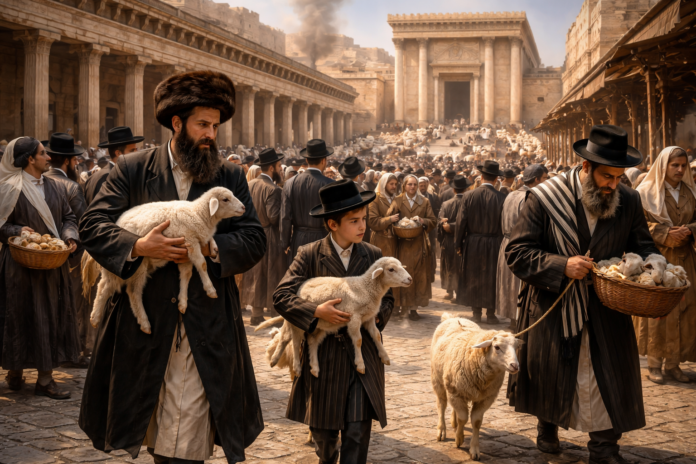
Representatives of each chavurah brought their animals to the Temple. They filed into the great courtyard — the Azarah — which housed both the altar and the Heichal, the inner sanctuary where only Kohanim could enter. When the courtyard filled up, the massive gates of the Temple were locked shut. The shechting began.
Here is something surprising: any Jew — not just a Kohain — was permitted to shechita the Korban Pesach. The only requirements were proper intention. The shechitaer had to have in mind that this was specifically a Korban Pesach, and that it was being offered for the consumption of that particular chavurah. If either of those intentions was missing, the entire korban was invalid.
The procedure ran in three shifts. Each shift required at least thirty people. Once the first group finished shechting their animals, ten people would leave and ten new ones would enter — keeping the count at thirty — and the process would continue until everyone had brought their offering.
While all of this was happening, the Leviim sang. They chanted Hallel — Psalms 113 through 118 — continuously, accompanied by musical instruments played by the kohanim and Leviim. Every time a new cycle of Hallel began, the Kohanim blew the shofar: a tekiyah, a teruah, and another tekiyah. The singing continued as long as the shechita continued. When the shechita paused, the music stopped.
Meanwhile, the Kohanim were performing their own critical role. As each animal was shechted, a kohen would catch the blood in a special gold or silver basin called a bozich. The basin had a rounded bottom — by design — so the blood wouldn’t pool and coagulate before it reached the altar.
The kohanim would pass the basin hand to hand down a line, and the last kohen in the chain would pour it in a single motion against the base of the altar. Then the basin was passed back up the line to be used again for the next animal.
The Science of Roasting
After the shechita, the fatty portions of the animal — called eimurim — were removed from the abdomen, salted, and brought by a kohen to be burned on the altar. Then the representative of the chavurah took the rest of the animal home, along with the hide.
What happened next was governed by laws that were more precise than most people realize. The Korban Pesach had to be roasted over an open flame — tzli eish. Not boiled or steamed or cooked in a pot, not even a dry one. And if any part of the animal rested against a metal surface that conducted heat rather than being directly kissed by the flame, that portion was considered cooked rather than roasted — and was problematic.
This is why the spit had to be made of pomegranate branch rather than metal. The animal was skewered from mouth to tail, with its legs dangling freely, so that the open fire could reach every part of it equally. Only one animal per spit was allowed. The entire animal had to be roasted whole — not cut up. The Torah’s insistence on tzli eish was complete.
The Korban Pesach was eaten at the very end of the Pesach Seder, together with matzah and maror. Hillel famously ate his in a sandwich — wrapping the matzah around the maror together with the meat, a practice we still commemorate today with Hillel’s sandwich at our Sdarim.
The Torah obligation to eat maror only exists when it is eaten together with the Korban Pesach. Today, without the Korban Pesach, eating maror is only a rabbinic requirement — a mitzvah derabbanan. The same Seder that feels so complete to us today is, from a halachic standpoint, missing its centerpiece.
The rules governing the eating were strict. The meat could only be consumed within the boundaries of Yerushalayim — not outside the city. It had to be eaten inside a house or an enclosed area where the chavurah had gathered together. If even a piece of meat was carried outside after the meal had begun, it was rendered invalid — even if brought back in. No bone with meat on it could be broken, whether during roasting or eating. Also, it could only be eaten on the first floor. So those who invested in a second floor apartment or above – well maybe it wasn’t such a tzipisa liyeshuah type of investment.
If multiple chavuros were eating in the same house, a partition — a mechitzah — had to be placed between them. They turned away from each other while eating. They could not share from each other’s lamb, even if one group had plenty left and the other was running short. Each chavurah was its own sealed unit, bound together by its shared animal and its shared obligation.
One final rule: no one was allowed to fall asleep mid-meal. If you dozed off and woke up, you were done — you couldn’t continue eating. And nothing — absolutely nothing — was eaten after the Korban Pesach. It was the last taste of the night, lingering on the palate until morning. Today, the afikomen — that last piece of matzah we eat at the end of the Seder — is a direct memory of this. We eat it last, we don’t eat anything afterward, and it is meant to leave us with that same sense of sacred finality.
A Rabbi With a Plan
In the year 1257, a famous rabbi named Rav Yechiel of Paris — one of the greatest Torah scholars in all of medieval Europe — apparently made plans to travel to Yerushalayim and actually bring the Korban Pesach. This was nearly 1,200 years after the Temple’s destruction.
We know about this story because of another Rav, Rabbi Ashtori HaParchi, author of the Kaftor VaFerach, heard it firsthand from a Rabbi Baruch in Yerushalayim. Rabbi Ashtori was so intrigued that he launched into a long halachic discussion of whether such a thing was even permitted. Did Rabbi Yechiel actually go through with it? We don’t exactly know.
There’s also a fascinating Gemorah (Pesachim 74a) in which Rabban Gamliel instructs his servant Tevi to roast a Paschal lamb. The question is — which Rabban Gamliel? There were two: a grandfather who lived while the Mikdash still stood, and his grandson who lived after its destruction. Rabbi Yaakov Emden, one of the great 18th-century authorities, argued it was the grandson — meaning the Korban Pesach may actually have been offered after the Temple was already gone.
So Why Not Just Do It?
There are a number of obstacles.
Obstacle #1: Everyone Is Ritually Impure
Halacha requires that anyone bringing or eating a sacrifice be tahor- ritually pure. The problem is that purification from the most serious form of impurity requires the ashes of a red heifer — a parah adumah — and that hasn’t been around in nearly two thousand years. Every Jew alive today is considered impure in this technical sense.
Does this mean that the case is closed? Not so fast. Halacha contains a remarkable built-in exception: when a sacrifice must be brought on a specific day, it may be offered even by people who are tamei – impure (Talmud, Yoma 50a; Rambam, Hilchos Bias HaMikdash 4:9–10). The logic is that you cannot simply cancel a time-sensitive Mitzvah because of a widespread technical obstacle. This exception covers the daily Korbanos, the Mussaf sacrifices — and the Korban Pesach.
Obstacle #2: Where’s the Money Coming From?
Most of the special Temple offerings are Korbanei Tzibbur – communal sacrifices — they were funded by a national tax called the machatzis hashekel, the half-shekel collected from every Jew. Today there’s no functioning system to collect that tax, which means those communal offerings technically can’t be properly funded (Sheilas Yaavitz 1:89; Chasam Sofer, Yoreh Deah 236).
But the Korban Pesach was never a communal offering. It was brought by individuals and small groups — each chavurah paying for its own lamb. This removes yet another major roadblock.
Still, obstacles do remain. Nobody knows with absolute certainty exactly where on Har HaBayis the altar stood. The Kohanim who perform the service need to wear their bigdei Kehunah – the specific, carefully crafted vestments — without it, the entire service is invalid. Determining who qualifies as a kohen with enough certainty to perform Temple service is itself deeply complicated. And the red heifer problem remains: even though impurity doesn’t block the Korban Pesach in theory, proper purification is simply not available.
The Rabbi Who Said We Must Do It
In the 1800s, a German Rav named Rav Tzvi Hirsch Kalisher went further than anyone before him. He wrote an entire sefer — Derishas Tzion — arguing not just that we are allowed to bring the Korban Pesach today, but that we are actually mechuyav to do so – obligated to. He pointed out that the Torah explicitly states: if someone is capable of bringing the Korban Pesach and fails to do so, he incurs karais — spiritual excision, one of the most severe punishments in all of halachah (Bamidbar 9:13). Rav Kalisher took that deadly seriously.
His position was explosive. But for most of the past two thousand years, the debate was purely theoretical — Har HaBayis was always controlled by non-Jewish rulers. As the Chasam Sofer noted in a famous letter to his father-in-law Rabbi Akiva Eiger (Yoreh Deah 236), the site was covered by a mosque held sacred by Muslim rulers who would not allow a non-Muslim to set foot there, let alone build an altar and shecht a lamb or goat.
1967 Changes Everything
Then came June 1967. In six days, the Israeli army captured Yerushalayim and Har HaBayis. My mother aleha haShalom cried when she heard the words said on the radio as it happened, “Har HaBayis b’yadeiniu! Har HaBayis B’yadeinu!” For the first time in nearly two thousand years, Jews had control — at least nominally — over the holiest site in Judaism.
Suddenly this wasn’t a theoretical debate anymore. The halachic world erupted. Was there now an obligation to bring the Korban Pesach? The arguments flew fast and furious.
In the end, the consensus among leading Poskim was that the remaining obstacles — not knowing the altar’s exact location, unresolved questions about Bigdei Kehuna and who qualifies as a kohen, and the very real political situation on the ground — made actually offering the sacrifice impossible for now.
Har HaBayis, while under Israeli sovereignty, is administered day-to-day by the Islamic Waqf, and any attempt to bring a Korban there would be politically explosive in every sense of the word.
Some groups in Israel have nonetheless refused to simply wait. In recent years, activists have raised lambs specifically designated as potential Passover offerings. They have crafted Bigdei Kehuna according to ancient spec, and have rehearsed the service. They do it every year, insisting that when the moment comes, they will not be caught unprepared.
What We Have Now — And What We’re Missing
Every year, as we reach the end of the Seder and call out l’shanah haba’ah b’Yerushalayim — “next year in Yerushalayim” — we are yearning for what the Seder was designed to be.
The Torah obligation of maror only existed because of the Korban Pesach. The afikomen exists because the taste of the sacrifice was supposed to be the last thing we experienced.
The Korban Pesach is unique in all of halachah. Of all the Korbanos, it alone has managed to clear — at least in theory — some of the biggest halachic hurdles standing between us and its revival. It doesn’t require communal funding. It can be brought in a state of ritual impurity. There is a long halachic tradition arguing it can be offered even without a standing Beis HaMikdash.
Whether it could actually be done today — given all the obstacles that remain — is another question. The procedures, the laws, the chavurah, the roasting, the taste of the meat on the palate at midnight — all of it waits, preserved in halachah like a treasure in a vault, ready for the day when it will live again.
May that day come speedily in our times.
The author may be reached at [email protected]