
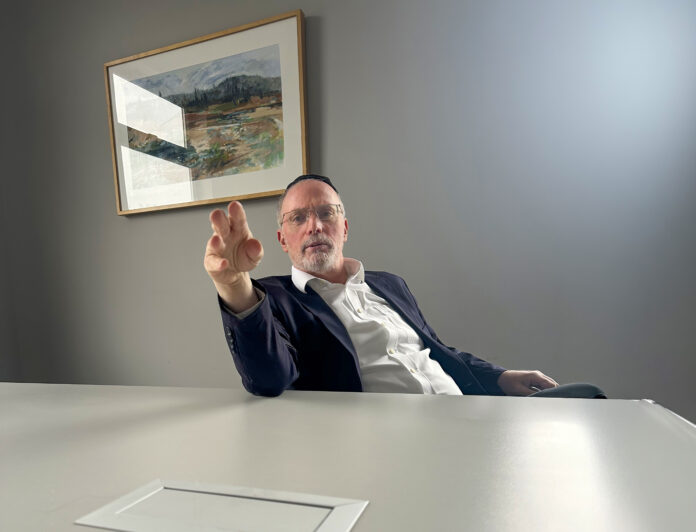

From 1995 to 2021, Rabbi Aaron Kotler served as the CEO of Lakewood’s Beis Medrash Govoha. Since his departure from that position, he has largely stayed out of the public eye. Yet he continues to follow in his father’s footsteps, teaching and spreading Torah to distant communities.
In this conversation, he reflects on his remarkable upbringing and the enduring legacy he continues to shape.
You grew up in a home of greatness, and for many years you were involved in your father’s work. Your father was the embodiment of Yissachar and Zevulun, serving as both the rosh yeshivah and the fundraiser. You assumed the role of fundraising, while your brother Rav Malkiel became the rosh yeshivah.
Yes. My father did both. And while he carried the yeshivah, he also carried klal Yisrael. They used to joke that Rav Aharon Kotler’s koach in psak was obscured by his lomdus, and Rav Moshe Feinstein’s lomdus was obscured by his psak. My father’s brilliance in learning was obscured by his askanus in taking care of the klal. But he was also a nonstop fountain of Torah and a unique gadol hador.
My mother also did many things. Her desk was the go-to address for Bikur Cholim, Tomchei Shabbos and shidduchim. Even bachurim would come to the house on a regular basis to say hello and get some ice cream. Her tiny desk had a massive Rolodex of doctors’ names, and she also kept a file of index cards with notations on things she was doing, such as finding jobs for people, helping those who needed extra money and solving problems.
Our house was always full of strangers. There were nine of us kids sharing four bedrooms, and our cousins, the Schwartzmans, lived with us as well, so altogether there were around 15 children in the house.
One of the sweetest interviews I ever did was with your mother, a”h. When I was a bachur, she redt a shidduch for me. When I interviewed her years later, I told her, “I don’t know if I ever thanked the Rebbetzin for redting that shidduch, but I just want the Rebbetzin to know that nothing came of it.” She replied with a chuckle, “Oib gornisht hot geshehn iz avada gut—If nothing happened, then it was surely for the best.” She had such a down-to-earth quality.
She did. I once came to her and saw that she was smiling, so I asked her why. She said, “I made three shidduchim this week, and one of them was very difficult.” The difficult shidduch had involved a divorced woman who got engaged to a divorced man. The woman had divorced her first husband because he didn’t have a job and didn’t feel responsible for taking care of the household. She said to my mother, “I’ll listen to any shidduchim the Rebbetzin suggests, but he has to have a job.”
My mother then told me who the man was. I said, “But he doesn’t have a job!” She said, “You’re right, so here’s what I did. I redt the shidduch and told him, ‘You’d better not tell her that you don’t have a job. We’ll take care of it when the time comes.’” They went out, and once my mother saw that things were serious, she called one of the yeshivah’s balebatim and said, “I made this amazing shidduch between two people who had been divorced, and I even got him a job!” The balebos said, “Really? Where?” “By you,” she told him. She was a real doer in that sense.
She was an amazing person. She was as sharp as a whip.
She was smart like anything and could see right through you. I once brought one of the most insightful, intuitive people I knew to her, and he told me afterward that he felt as if she had looked right through him. She saw his soul.
She said things exactly as she saw them, and her candor could sometimes catch you off guard.
She was also always happy, with a good laugh and a candy in her hand. What people don’t know about her is that she was also highly educated. She went to the Augusta Victoria Gymnasium in her hometown of Memel, which was a German school. She grew up speaking English and German. I have her grades from school.
In fact, min hashamayim, the reason why she was able to get her visa out of Russia and escape to Japan was that she went to the Japanese Embassy in Moscow. There were a lot of refugees trying to get in, but they weren’t admitting anyone. She didn’t know this at the time, but I have copies of the cables.
Japanese Foreign Minister Matsuoka had ordered Ambassador Tatekawa to stop giving visas to Jews. This was after Sugihara. If you wanted to get out after 1940, there were no more Sugihara visas. But the same kneitch that Sugihara and Jan Zwartendijk were mechadesh—that Curacao officially said “no visa required”—meant that you could still go to Japan and get a two-week transit visa saying that you were going to Curacao.
The way it originally worked was that Zwartendijk, the Dutch consul in Kovno, would stamp the passport “No Entry Visa Required for Curacao,” which was true, but Curacao wouldn’t take them in. Technically, there was no visa required, but if you showed up there, they weren’t going to let you in. Once the Dutch consul stamped your passport, you could then go to Sugihara, the Japanese consul, and he would give you a two-week transit visa as if you were heading to Japan on your way to Curacao. Of course, he knew that these people were going to stay in Japan.
After Sugihara had to stop giving out those visas, the refugees who still wanted to get out of the country, including my mother, decided to go to the Japanese Embassy in Moscow, and the ambassador there started giving out visas. In the meantime, he was getting cables ordering him to cease and desist: “We don’t want them. If any Jew needs to be helped, he can go to Vladivostok—on the other side of Russia—because the consul there has a limited number of visas available for refugees.” That was actually a joke, because you couldn’t get to Vladivostok without an entry visa for Japan. Stalin wasn’t going to let anyone cross Russia without that.
The embassy in Moscow was closed and wasn’t letting anyone in, but my mother was young and well-kempt, and speaking in English she said to the guards, “I have an appointment with the ambassador.” They saw a foreign woman speaking in English, so they let her in. She knocked on the door, and the ambassador’s aide opened it. She said again in English, “I have an appointment with the ambassador.” He saw a well-dressed woman speaking in English, so he called the ambassador. When the ambassador walked in, she said, “I need a visa.” He didn’t give her a visa, but he did give her a transit certificate that was valid for two weeks. The visas were also valid for two weeks, so he was pulling a diplomatic shtick on his bosses. He gave transit certificates to a number of people, but he was forced to stop a few days later.
To read more, subscribe to Ami

