
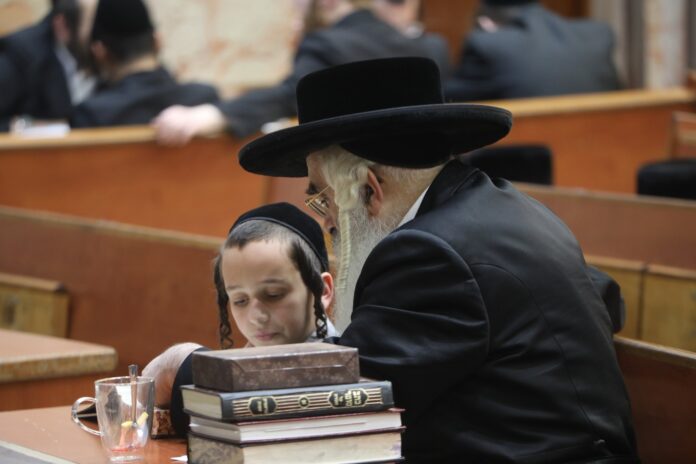

Hidden behind the plain, functional facade of the Dushinsky yeshivah building on Rechov Shmuel Hanavi is its beis midrash—a beautiful edifice that is home to a warm and welcoming chasidus. In many ways, that is a reflection of the Dushinsky Rebbe himself. Known for his extreme simplicity and humility, Rav Yosef Tzvi Dushinsky’s modest exterior belies his remarkable spiritual depth.
I first encountered the Rebbe at the airport when I was flying to Eretz Yisrael. Traveling without a gabbai, the Rebbe sat near the gate of our flight, learning quietly and speaking graciously with whoever approached him. At the time, I was too shy to step forward, a missed opportunity I have regretted ever since.
Among the many stories attesting to the Rebbe’s unique pashtus is the following, representative of his essence:
A few years ago, a picture circulated of the Rebbe carrying a case of water to a stranger’s apartment. On his way to be menachem an avel in a certain building, the Rebbe saw a Yid struggling to carry cases of water up the stairs. The Rebbe immediately took one of the cases and carried it up to the man’s apartment on the second floor.
When I ask one of the Rebbe’s chasidim for the gabbai’s number so I can make an appointment with the Rebbe, he looks at me askance. “Call the gabbai? Why? Ask the Rebbe himself.”
As I stand in a short line in the Dushinsky beis midrash after Shacharis waiting to speak with the Rebbe, I’m rethinking my decision to listen to his advice.
Although the Rebbe does not appear to be rushing any of his visitors, the line moves quickly. Then the Rebbe spots me—the only one in the room not wearing traditional Yerushalmi chasidic garb.
“Shulem Aleichem,” the Rebbe greets me with a warm smile. After a minute of small talk, the Rebbe asks how he can help me, and I tell him why I came.
“Aren’t there others more important you can speak to?” he asks in his typical self-deprecating manner.
“I have spoken to some of them, but everybody wants to hear from the Rebbe,” I reply.
To my relief, the Rebbe smiles again. He asks how long I will be in town. “Until the end of the week,” I tell him. He contemplates for a moment.
“This is a very busy week,” he admits. “We experienced a tragedy in the chasidus, and I have to travel to raise money to support a new almanah and many children. On Thursday, we have a hachnasas sefer Torah. It will be difficult, but we can try either early afternoon before the hachnasas sefer Torah or immediately after.”
The Rebbe gives me a warm brachah and instructs me to reach out to a gabbai regarding his schedule on Thursday afternoon. If nothing opens up then, he says, I should come to the hachnasas sefer Torah on Thursday night. I am deeply moved by his kindness and warmth to a complete stranger.
* * *
Thursday morning, I call the gabbai, who informs me that the Rebbe is still busy fundraising for the newly bereaved family and will not be available this afternoon. “Maybe after the hachnasas sefer Torah,” the gabbai says.
My flight is scheduled for that night. Though the departure time is quite late, I have no idea when the hachnasas sefer Torah will conclude; it’s probable that I will not be able to wait long enough to speak with the Rebbe. But when I voice my concern to the gabbai, he laughs and tells me with certainty, “It’s going to end at eight o’clock.” I’m somewhat skeptical but decide to try.
One thing I’ve learned is the reason why the Rebbe is not available in the morning: it’s because of his intense learning schedule. He deviates from it only for especially important matters. During the hachnasas sefer Torah, I schmooze with one of the talmidim learning in the yeshivah. He tells me about the Rebbe’s seder hayom.
“Every morning before davening, he has a chavrusashaft with two older bachurim who have already left the yeshivah and entered the working world. They come at six to learn with him. After davening, he has another chavrusashaft with another few bachurim who can use chizzuk. The Rebbe is a mohel, and he performs brissim almost every day.
“Because he became so much in demand and didn’t want to disturb his sedarim, he only performs a bris if the people are willing to have it in his beis midrash.
“It’s not about kavod,” the talmid tells me. “He doesn’t accept kibbudim unless all the grandfathers have already served as sandak.”
After that, he learns with Rav Meir Eliyahu Goldstein, who comes every morning to learn with the Rebbe. According to those I spoke to, that chavrusashaft is chok v’lo yaavor; the Rebbe rarely if ever misses it.
“Rav Goldstein is a rosh kollel by us,” the talmid says, “and they lock themselves in their room to learn together.
“In the afternoon, the Rebbe gives two shiurim. An earlier one is for shiur daled, and one after Minchah, for shiur hei. Both shiurim are older bachurim.
“After that, he says an entire yom of Tehillim, which he started during COVID for cholei Yisrael. After that he learns with Rav Yosef Tzvi Klein for an hour, and then he has hours for kabbalas kahal.
“On Thursday, instead of kabbalas kahal he gives a shiur to shiur gimmel. On Friday, he gives a shiur to balebatim in the sefer Panim Yafos.
“He always reminds the hanhalas hayeshivah that the yeshivah runs from Sunday morning until Friday afternoon. The Rebbe instituted his own project on Friday afternoons. Every one of us bachurim writes on a paper what hours he learns on Fridays and Shabbosim, which we then hand in to the Rebbe.
“Before Kabbalas Shabbos, the Rebbe joins us at the learning seder and gives a shiur on Sidduro Shel Shabbos to all the bachurim. He started this when he first became rebbe.
“On Shabbos morning, the Rebbe once again joins us for a seder before Shacharis, and this repeats itself on Motzaei Shabbos and in the summer after Minchah. This is so important because the Rebbe always tells us that if you go for a day or two without learning, then it’s as if you’re starting the zman anew. There must be continuity.”
* * *
The hachnasas sefer Torah is a beautiful, simple and very not rebbishe affair. The Rebbe is standing near his seat watching the dancing. Suddenly the music stops, the chasidim dance the new sefer Torah to the aron kodesh, and the event concludes with Tehillim and Maariv. After Maariv, the Rebbe notices me standing in line. He nods his head, indicating that I should follow him, and leaves to his room adjacent to the beis midrash.
As soon as I reach the door, a gabbai —one I have not met before—informs me that the Rebbe has an appointment now. I inform him that I believe I have an appointment with the Rebbe now, as arranged by a different gabbai. He says he has to ask the Rebbe.
He returns with the message that the Rebbe will see me now—on the condition that I do not take any pictures while in his office. The Rebbe is aware that there are many pictures of him available to the public, but he doesn’t enjoy being photographed.
“You will have to wait, though, because the Rebbe has a chavrusa now, a Yid named Gross who sells pasta to grocery stores. He was recently one of the eidim at a chuppah, where he joked to the Rebbe that since he is an eid, he has to do teshuvah in order to be a kosher one. The Rebbe told him that the Be’er Mayim Chaim in the previous week’s parshah actually discusses this, and he instructed him to come learn it with him after the hachnasas sefer Torah.”
The gabbai remarks that it’s unusual for the Rebbe to say in which sefer he saw a particular shtikel Torah. “In order to avoid being seen as a talmid chacham, the Rebbe hesitates to answer when people ask in learning, aside from talmidim. And when he does answer, he phrases it, ‘I once saw somewhere; I’m not sure exactly where.’ Then he will complete the entire shtikel without missing a beat.”
To read more, subscribe to Ami

