
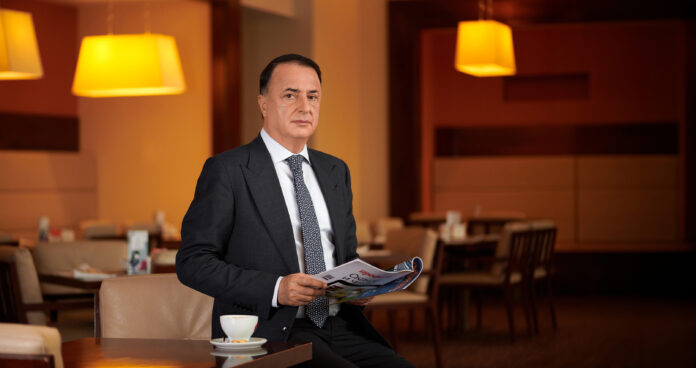

Lev Leviev is one of the most prominent yet most private figures in the Jewish world. Renowned as a diamond magnate and major philanthropist supporting a wide range of causes, his personal story and that of how he built his empire remained largely untold—until now.
I recently had the rare privilege of sitting with Mr. Leviev for nearly two hours for an interview. The conversation was easygoing and relaxed, not what I expected from the man who took on De Beers. While he clearly possesses a sharp and unconventional business mind, the phrase he returned to again and again was “Avinu Shebashamayim,” consistently attributing all his success to Hashem.
As a young boy growing up behind the Iron Curtain in Tashkent, Lev learned Gemara with Rashi and Tosafos, completing several masechtos. While he was still a teenager, Lev’s family settled in Bnei Brak, where he led a simple and grounded life, and yes, attended tishen.
A devoted chasid of the Lubavitcher Rebbe, Leviev shared several career-defining moments with the Rebbe, including the one that set everything in motion.
He has no plans of slowing down. For Leviev, business today is a means to an end: funding the many mosdos he has built and continues to support. These include worldwide institutions for the Jewish community, kollelim for older men, yeshivos, girls’ schools and more.
We discussed the future of the diamond industry, his approach to supporting mosdos and the business lessons he has learned along the way.
Wishing you a chag kasher v’samei’ach. Enjoy!
—Nesanel
I was born in Tashkent, Uzbekistan, in 1956, the fifth of eight children. I have four older sisters. We were always a strictly Orthodox family, not only going back to my great-grandparents’ generation, but a continuous lineage of Jews who always kept the faith. The major turning point was in 1906, exactly 120 years ago, when a Chabad shliach named Rav Eliezerov arrived in Samarkand, where my father and grandfather were born, and opened a cheder with 15 children. Among them was my grandfather. Rav Eliezerov strengthened Yiddishkeit in his students.
“My grandfather had been orphaned of his mother, and his father, my great-grandfather Yitzchok, had to support the family during those difficult times. As soon as the Communists came to power, they closed all the religious schools. They left one shul where only the elderly were allowed to daven. But the Yidden continued to keep Shabbos, as everyone was frum. The Jewish quarter became a kind of ghetto for the few thousand Yidden who lived there.
“Over the years, the children began to leave the ghetto, go to the city and study at universities, becoming doctors and scientists. They were afraid to do mitzvos in public, as it was forbidden. Everything was closed down, and in 1920, Rav Eliezerov had to flee Russia because the borders were going to close.
“He left his students, among them Rav Chizkiyahu Kaykov, who studied in Lubavitch. Rabbi Kaykov and my grandfather were chavrusos. They did all the activism together.
“The flame of Yiddishkeit went underground. The Yidden kept all the mitzvos in secret until they were informed upon and arrested. Many were sentenced to death for their religious activities; others were exiled to Siberia and sentenced to work in the uranium mines. In 1953, when Stalin died, these exiles, including my grandfather, were granted amnesty and released. Baruch Hashem, everyone returned healthy and safe from the frozen wasteland.
“Meanwhile, my father and his brothers had fled from Samarkand to Tashkent because the authorities wanted to arrest my grandfather’s children as well. They changed a letter in their last name so they wouldn’t be caught. We are Leviim; originally, my last name was Levi HaLevi. In the Soviet Union they always added an ‘ev’ at the end of the last name, turning Levi to Leviev.
“Our religious activities continued in Tashkent. From the age of five I had a rebbi, a Chabad chasid who operated in secret. He would come every day to teach me in hiding in the basement. Every day brought challenges; we always had to hide who we were—not only from the non-Jews but even from other Yidden who knew nothing about Yiddishkeit. For them, Lenin was god. Shabbos was especially challenging. We couldn’t be mechallel Shabbos, but missing school triggered inquiries, which would lead to a KGB investigation and prison time for my father. Most weeks, we simply took the risk and stayed home.
“When I was 12, I decided I would no longer attend school. Between the danger of missing classes on Shabbos and my refusal to remove my hat—a school requirement—the situation had become untenable. I went to study in an underground yeshivah in Samarkand.
“I lived in a house with ten other bachurim and our teacher. At the time, we thought that was the entire yeshivah. Only later did we discover that there was a network of many such houses, each with a teacher and each operating quietly.
“Back in Tashkent, though, they began to question my absence. When my father was threatened with arrest, I was smuggled back home in the middle of the night. Amazingly, while there were very few frum children in town, there were farbrengens all the time. We would be careful to come one by one and not to leave together as a group. We’d close the door, drink l’chaim, discuss words of Torah and dance. This was all under heavy prohibitions and a real threat of death. We’d get together on Yomim Tovim and special days. We lived in a kind of clique of our own: our family, my father’s brothers and a few Chabad chasidim. We had no beards or peyos because it was forbidden.
“My father was the manager of a department store. He also had a side business selling imported clothing. He made a good living.
“Finally, in 1971, we moved to Eretz Yisrael, baruch Hashem. For a long time, we were denied permission to emigrate, and my father had to pay a lot of money for our permits. When we finally made it out, we settled in Bnei Brak. Every Friday afternoon, everything shut down for Shabbos. It was beautiful. We used to go to the tishen of many rebbes, such as Lelov, Vizhnitz and others. There were a few rebbes, special tzaddikim, who came from Russia.
“I was 15 when we came to Eretz Yisrael, so I didn’t help my father with the business, but I had already received the best business lesson of my life when I was 12. I was always buying and selling on the market; we’d have to run when the police were spotted. I was making money, and my father received some sporty suits that were popular at the time. I told him I wanted a suit, which was worth 12 rubles. He asked me, ‘Do you have the money? These aren’t free. Pay and you’ll get it.’
“I was so offended that I cried. At the time, I thought my father was being stingy and didn’t love me. I’m ready to be moser nefesh for him, and he wants me to pay him for a suit? He’s not embarrassed to take money from his son? Baruch Hashem, that gave me the right perspective: to not rely on anyone except Avinu Shebashamayim. From that day on, I said, with Hashem’s help, I would not accept any more money from my father. Not that he ever gave me much before then.
“It was the most important lesson in life. Many parents spoil their children by giving them money and all the latest things. In our house, that concept didn’t exist. There was food at home? You got new clothes once a year before Pesach? Make do with what you have. That was the motto of our house. It was a strict and tough upbringing, but it was very loving.
To read more, subscribe to Ami

