

By Rabbi Yair Hoffman
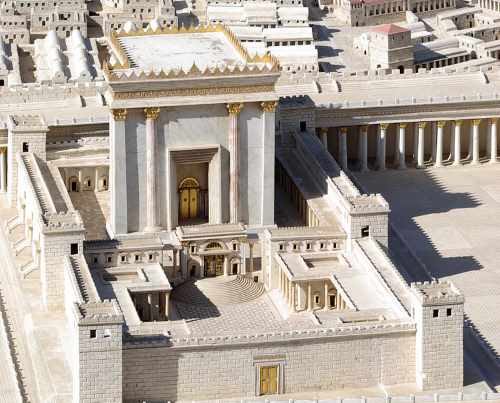
It is some 1975 years ago. We standing in Yerushalayim on the fourteenth of Nissan. The noise around us is thick with the bleating of hundreds of thousands of lambs. The smoke of the Mizbeiach curls heavenward. The Levi’im are chanting Hallel — not once, not twice, but three full times, as wave after wave of Klal Yisroel enter through the gates of the holiest structure ever built on earth. This was the Beis HaMikdash on Erev Pesach.
Three Groups, Three Cycles
The Mishnah in Pesachim (5:5) describes an extraordinary logistical choreography. The entire Jewish nation — hundreds of thousands of people — could not enter the Azarah simultaneously. And so the Chachamim instituted a system of three groups (kitos). The first group would enter, fill the Azarah to capacity, and the doors of the Azarah would be locked behind them. Then, as the Levi’im sang the Hallel, each man shechted his Korban Pesach. When the first group finished, they departed, and the second group — those waiting patiently outside the gates — would surge forward. Then the third.
If the Hallel was completed before a group finished, it was begun again. If the third group was small, they might hear Hallel only once. The Gemara records that the third group was nicknamed the kita atzlanin — the lazy group — because they delayed coming. Yet even they were bound by the same sacred obligation.
The Northern Gates: Where the Action Was
The Korban Pesach had to be offered on the northern side of the Azarah (Zevachim 5:8). This meant that most of us entered primarily through the northern gates of the Azaras Nashim and the Azarah itself.
The Beis HaMikdash’s outer courtyard — the Ezras Yisrael and the Ezras Nashim — were accessed through multiple gates. The Mishnah in Middos (2:3) describes the gates of the Ezras Nashim, and it is here that we can reconstruct the breathtaking human drama of Erev Pesach.
The Women’s Gate and the Chamber of the Exile
Entering through the second gate from the left is a long line unlike the others. These are women — but not women who have come merely to observe. These are women obligated to bring the Korban Pesach on their own: widows, divorcées, and unmarried women who have no husband in whose household they could eat the Korban. They enter through what is known as the Sha’ar HaNashim — the Women’s Gate (Middos 2:3).
Above this gate, perched over the teeming masses of people below, is the Lishkas HaGolah — the Chamber of the Exile. The Rambam in Hilchos Beis HaBechira (5:16) identifies this chamber as the place where water was stored — specifically, the great cistern whose water was used throughout the Beis HaMikdash. The name itself evokes the deepest currents of Jewish history. It was filled, according to tradition, by the returning exiles of Bavel — the remnant of Klal Yisrael who came back from Galus to rebuild the Beis HaMikdash under Ezra and Nechemiah. Every drop of water that sustained the Avodah carried within it the memory of golus – exile and return.
That these women — widows and women alone — would pass under the shadow of this chamber is itself a symbol. They, too, are in a kind of personal galus. And yet here they stand, fully obligated, fully participants in the greatest national mitzvah of the year.
The Gate of the Offering: The Heart of Erev Pesach
The third gate from the left is the Sha’ar HaKorban — the Gate of the Offering. It is aptly named. Through this gate pours the heart of Erev Pesach: the ba’alei batim, the heads of household, each leading or carrying his lamb.
They are headed into the Azarah itself — the inner sanctum — where the Korban Pesach and the Korban Chagiga will be offered. The Mishnah (Pesachim 5:6) describes how each man would hand his animal to the kohen, who would slaughter it, catch the blood in a mizrak (a sacred vessel), and pass it hand-to-hand in a chain of kohanim stretching all the way to the Mizbeiach, where it would be dashed against the base.
Above this gate rose one of the most striking structures of the entire Beis HaMikdash: the Beis HaMoked — the great domed Chamber of the Hearth. The Mishnah in Midos (1:6) and the tractate Tamid describe it extensively. It was the sleeping quarters of the kohanim who had completed their service. It was heated by an eternal fire. Four large chambers opened off its central hall. One of them contained the great fire from which the Mizbeiach fire was replenished every morning. The dome above the gate — massive, permanent, authoritative — reminded every person passing below: the Avodah never stops.
The Gate of Jeconiah: History Written in Stone
On the northwest side stands the most historically charged gate of all: the Sha’ar Yechanyah — the Gate of Jeconiah. Its name alone is a wound in the national memory.
Yechanyah — Yehoyachin, king of Yehudah — was led through this gate into Babylonian captivity. The Talmud Yerushalmi (Sanhedrin 10:2) and other sources preserve the tradition that the entire royal house of David passed through this gate when they were exiled by Nevuchadnetzar. Jewish kings had ascended through this gate; now a Jewish king descended through it into seventy years of exile. When the people passed through it on their way to bring the Korban Pesach — the quintessential symbol of geulah — they walked through the doorway of our deepest national tragedy, on their way to national celebration.
Above the Gate of Jeconiah stood the Beis HaНitzotz — the Chamber of the Spark. The Rambam and the Mishnah (Middos 1:1) describe it as the place where the fire for the Beis HaMoked hearth was perpetually maintained. Stone-cutters would chip sparks here; the fire would be kept alive through the night. The Levi’im who guarded the Beis HaMikdash during the night watched from this chamber, ensuring that the sacred flame never died.
The Leviim Guards and the Closing of the Gates
As the sun began its descent on the afternoon of the fourteenth of Nissan, a dramatic moment arrived. The Leviim Temple guards — who had been stationed at each gate throughout the day — would begin closing the great wooden doors.
The Mishnah in Tamid describes the enormous, iron-reinforced doors of the Beis HaMikdash, doors so heavy and so precisely balanced on their hinges that their opening and closing could be heard as far away as Yericho — three days’ journey. Once those doors closed, the group inside would complete its Avodah before they reopened.
And outside the gates? More people waited. These were the members of the second and third groups — the kita shniya and the kita shlishis. They stood in the courtyards, with their lambs, hearing the Hallel echoing from inside, waiting for the doors to open again. The Gemara in Pesachim (64b) gives us a window into the sound of that moment: hundreds of thousands of voices, Levi’im and Yisraelim alike, singing b’tzeis Yisrael miMitzrayim — “When Israel went out of Egypt” — as the blood of the lambs flowed and Kla Yisroel relived its founding moment.
Numbers That Stagger the Imagination
How many people passed through those gates? The Gemara in Pesachim (64b) records that King Agrippas once asked the kohanim to count the korbanos brought on one Erev Pesach. They counted the kidneys — one kidney per animal — and arrived at a figure of 1,200,000 pairs of kidneys. This suggests that over a million Korban Pesachs were offered on a single afternoon.
The logistics required were mind-bending. The blood had to be caught, passed, and thrown at the Mizbeiach. The fat (eimurim) had to be separated and burned on the altar. The bodies of the animals were hung on hooks along the walls and on iron rods carried on the shoulders of pairs of men, skinned right there in the Azarah, and then carried home to be roasted whole for the Seder. All of this happened — repeatedly, three times over — in the space of a single afternoon.
What It Meant to Walk Through Those Gates
For the average individual— the farmer from the Galil, the craftsman from Chevron, the merchant from the coast — arriving at the gates of the Beis HaMikdash on Erev Pesach was the defining experience of the Jewish year. The Rambam writes in Hilchos Chagiga (1:8) that the mitzvah of aliyah l’regel carried with it a special spiritual charge — the obligation to see and be seen, to stand in the presence of the Shechinah, to feel the weight of belonging to Klal Yisroel.
Walking through the Gate of the Offering, under the dome of the Beis HaMoked. Passing beneath the Chamber of the Exile, we hear perhaps an older man whisper the story of how returning exiles built that cistern with their own hands. Moving through the Gate of Jeconiah and remembering that a Jewish king once walked out through this very arch in chains — and that you, by being here, were the living proof that the chains had been broken.
And then, finally, into the Azarah itself. The smell of the Ketores drifting from within the Heichal. The kohanim in their white bigdei kehunah moving with practiced efficiency. The Levi’im on the duchan, voices rising in Hallel. And in your arms — a lamb. Your lamb. The animal that would carry the memory of that first night in yetzias Mitzrayim, when our ancestors painted blood on the mezuzos (side posts) of their doorways and waited for the Malach HaMaves to pass.
This was the Beis HaMikdash on Erev Pesach. May we see it rebuilt, speedily and in our days.
The author can be reached at [email protected]