
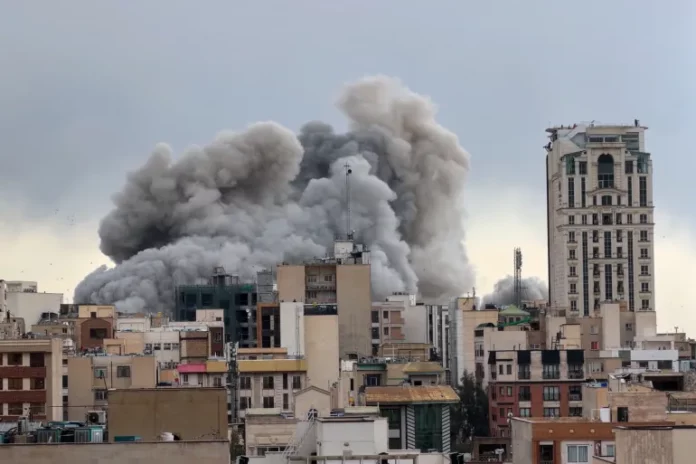

JERUSALEM (VINnews) — During the course of the first day of Pesach, the IDF deepened its strike against the Iranian regime’s military production industries and attacked approximately 15 weapons manufacturing sites, including a central complex of Iran’s Ministry of Defense. This complex housed infrastructure for the production and development of advanced missiles intended to target fighter jets and unmanned aerial vehicles.
In addition, air defense systems, launch sites, and facilities for the production and storage of ballistic missiles and anti-aircraft missiles were targeted. These completed strikes are part of a broader phase aimed at intensifying damage to the core systems and foundations of the Iranian terrorist regime.
As part of the strike wave, the Israeli Air Force, guided by Military Intelligence, also targeted a ground forces base of the Islamic Revolutionary Guard Corps (IRGC), which serves as a central unit of the regime’s forces.
Throughout Operation “Roaring Lion”, the IDF has systematically struck hundreds of command centers of the Iranian regime across Iran, rendering them inoperable.
In recent days, the IDF identified that the Iranian regime began relocating its command centers into mobile units, with commanders operating from them. During the strike wave, the IDF targeted one such mobile headquarters while senior commanders were inside.
Alongside these targets, a ballistic missile storage site belonging to a missile unit in the Tabriz region was also attacked, as part of the ongoing effort to degrade the regime’s missile capabilities.
Additionally, on Wednesday night, the Israeli Air Force, guided by Military Intelligence, struck central IRGC headquarters in Tehran, which were used to manage budgets for security bodies and fund terrorist activities worldwide.
For years, the IRGC has used large budgets and funds allocated through these headquarters for two main efforts:
1. Funding and strengthening Iran’s armed forces – producing thousands of ballistic missiles and weapons that pose a threat to the citizens of Israel and the world, at the expense of civilian infrastructure development. These budgets also supported internal security forces and the Basij, which killed thousands of civilians during protests against the regime.
2. Funding the Iranian regime’s proxies across the Middle East – the IRGC and its Quds Force transferred vast sums to their proxies. Over the years, the regime has sent tens of billions of dollars to terrorist organizations such as Hezbollah, Hamas, and the Houthi regime, responsible for deadly attacks against Israel and globally.
During the holiday, the IDF also struck more than 50 targets belonging to Iran’s ballistic missile array. In the past 24 hours, the Air Force completed approximately 20 strike sorties in central and western Iran, hitting over 50 ballistic missile launch and storage sites using more than 140 munitions.
In newly released footage, an Israeli Air Force F-35i “Adir” fighter jet identified a ballistic missile launcher at a storage site. Immediately after detection, the launcher was struck, thwarting planned ballistic missile attacks against Israel.
So far, the Air Force has carried out hundreds of strikes against the Iranian regime’s missile array and air defense systems, aiming to degrade its capabilities and reduce missile fire toward Israel as much as possible.
Lebanon Front:
On Wednesday night, the IDF struck two currency exchange sites in Beirut that served as major funding sources for Hezbollah’s terrorist activities. The sites are “Boa Chance,” owned by Hassan Ibrahim, and “Trade Point International,” owned by Mohammad Nour al-Din.
Hezbollah’s systematic use of currency exchange offices was exposed about a year ago by the IDF and serves as a central channel for funding and money laundering from the Iranian regime. These exchanges knowingly transfer funds to the organization and play a direct role in financing terrorism and strengthening its economic power.
The exchanges were targeted after the IDF identified that they continued transferring funds to Hezbollah, which were used for terrorist activities against IDF forces and Israeli civilians.
In the past 24 hours, the Air Force also struck dozens of headquarters, weapons depots, launch sites, and anti-tank missile positions. Additionally, the Navy conducted a precise strike on a Hezbollah weapons warehouse in southern Lebanon.
As part of ground operations, forces from the 91st Division identified a Hezbollah terrorist cell and quickly closed the loop, striking and eliminating the operatives. The forces also destroyed dozens of terrorist infrastructures, including observation posts and anti-tank missile launch positions.
The 36th Division continues to operate in southern Lebanon, deepening operational achievements. Forces quickly neutralized three armed terrorists on motorcycles who posed a threat. In the past 24 hours, forces eliminated approximately 10 terrorists and destroyed dozens of terrorist infrastructures in the area.
Forces from the 146th Division destroyed more than 180 terrorist infrastructures, including anti-tank launch positions, observation posts, underground facilities, and weapons depots.
Troops from the 401st Brigade and the Nahal Brigade, under the 162nd Division, located large quantities of weapons, including anti-tank missiles, Kalashnikov rifles, ammunition, and grenades.
Additionally, this morning (Thursday), Nahal reconnaissance unit fighters eliminated a Hezbollah terrorist in close-quarters combat during a targeted ground operation in southern Lebanon.
Following the encounter, forces searched the area and located additional weapons, including firearms, vests, grenades, and other military equipment. Two soldiers were lightly wounded during the operation and evacuated for medical treatment; their families have been notified.