
 Vos Iz Neias
Senior IDF Officer Says Israel’s Goal Is Demilitarizing South Lebanon, Not Disarming Hezbollah
JERUSALEM (VINnews) — Israel does not define the disarmament of Hezbollah as a central objective of its current offensive, according to a report by Maariv military reporter Avi Ashkenazi.
“Such a move would require conquering all of Lebanon and clearing the entire Lebanese territory, and even then we wouldn’t reach the final outcome. We must be modest in the war objectives we set for ourselves. At the same time, we will not accept anything less than demilitarizing the area south of the Litani River, as agreed before the fighting,” said a senior IDF officer, who revealed that the IDF will destroy the first line of villages along the northern border and prevent the resettlement of Shiite residents in the area adjacent to the border.
The IDF will establish a security zone several kilometers deep from the border, similar to the “yellow security line” created in Gaza. These remarks were made this morning during a briefing by a senior IDF official on the fighting in Lebanon. According to him, the IDF has advanced to the line of villages and is expected in the coming days to complete the capture of the second and third village lines.
The senior officer outlined the planned security concept for Lebanon, which is expected to be presented for government approval soon. At the core of the IDF plan is a significant security zone. “This is not a return to the old security zone,” he said, “but a different model—dynamic, mobile, without deep reliance on fixed outposts.” According to him, the outposts that will be established will be positioned slightly behind within the security zone and will control deeper territory, while ongoing operations will be conducted dynamically by IDF forces.
According to the official, the IDF is operating according to plan and is expected within the coming week to complete Phase C, whose goal is to remove the direct threat to northern Israeli communities—primarily anti-tank missile threats and infiltration raids. The plan includes advancing to dominant terrain, creating a depth of approximately 8 km while seizing high ground for observation and fire control, with the aim of removing the threat.
Division 146, operating in the western sector and strengthening the coastal line, has advanced significantly and created a security zone that expands operational freedom toward the Tyre Valley. In the central-western sector, Division 162 has advanced toward northern high ground, while in the east, Division 91—responsible for defending the contact line above Metula and Bint Jbeil—has crossed the ridge in the Rab a-Tlattin area. The IDF says that forces now control all key terrain in the central sector, the entire second village line, and in some areas also parts of the third line, after pushing the enemy beyond these lines.
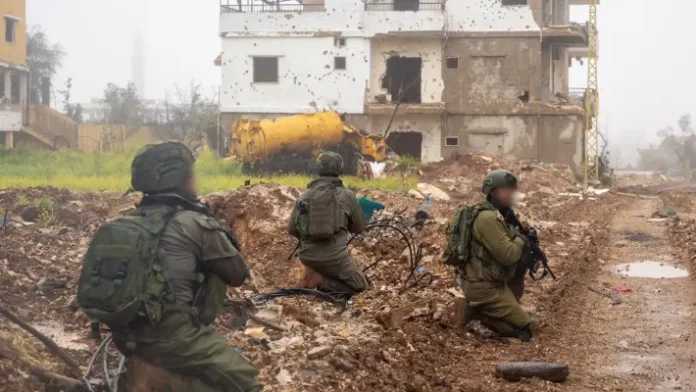
At the same time, two defensive divisions are primarily focused on the first line of villages—capturing and clearing them. “Some villages were heavily damaged in ‘Northern Arrows,’ so in some there isn’t much infrastructure left, but in others militants returned and rebuilt infrastructure, and we found quite a lot of weapons there,” the senior officer said. According to him, the advance was carried out gradually to allow concentration of force and effective protection for each division.
The officer detailed the current deployment and plans for the coming days:
Western sector: strengthening the coastline and deepening control toward the Tyre Valley
Central sector: capturing dominant terrain and advancing north
Eastern sector: Division 91 defends the Ramim Ridge and Metula–Khiam line, while Division 36 operates further forward
He noted that forces are currently stabilizing the forward defensive line, based on terrain control but not yet relying on permanent positions.
Meanwhile, two divisions are continuing to clear the first village line, capturing villages where residents have returned alongside terrorist presence, locating and destroying terrorist infrastructure and weapons. Extensive activity is also underway in open areas where hidden infrastructure has been found, some predating the “Northern Arrows” operation and some introduced over the past year.
According to the senior officer, the establishment of the security zone, including flattening the first line of villages and removing their population, is being carried out under legal authorization. Alongside operational activity, a structured process is taking place with the political leadership and legal advisors regarding destruction:
“We present the political echelon with an organized process, including mapping and documentation of terrorist infrastructure within villages. When villages effectively become terrorist infrastructure, this allows us, legally, to define them as such.”
He added that there is ongoing coordination with legal advisors, with evidence presented showing that infrastructure inside villages is used by the enemy. Based on this, approvals are granted to demolish buildings and infrastructure. He noted that some second-line villages may be treated similarly: “We see in certain villages infrastructure that enables the enemy to threaten our civilians and serve as a launchpad for attacks. In such cases—those villages must be destroyed.”
The senior officer emphasized that the main effort remains directed against Iran: “This is the factor that can weaken Hezbollah most significantly.”
According to him, most of the damage to Hezbollah is being carried out north of the Litani River, combining significant firepower:
- Targeted killings of senior commanders, including the southern front commander
- Strikes on economic infrastructure—banks and fuel stations used by the organization
- Continued attacks on Iranian elements and divisions established in Lebanon
He also addressed the ongoing challenge of indirect fire (rockets and mortars) toward Israel’s home front, noting that intensive efforts are being made to reduce it. “We understand the difficulty faced by residents in the north. There are still threats and challenges, but the goal is clear: to remove the threat.”
In the short term, as long as fighting with Iran continues, Israel is focused on forward defense. Later, a broader offensive effort in Lebanon may be considered. According to the officer, Hezbollah fears being cut off from Iran, while Lebanon fears continued fighting after a ceasefire with Iran.
He stated that about 1,000 Hezbollah operatives have been killed so far and that the organization has changed its methods—shifting from concentrated rocket fire to a dispersed system. “This makes threats harder to detect but also reduces the scale of barrages,” he said. Most fire is now directed at IDF forces rather than civilian areas.
He added that cooperation with the Air Force is “exceptional,” but noted that weather conditions remain a major challenge, alongside the complexity of fighting in mountainous and built-up terrain.
The IDF also released footage today from the interrogation of a terrorist from Hezbollah’s Radwan Force. During targeted ground operations in southern Lebanon, IDF forces captured armed militants from the unit who had planned to fire an anti-tank missile at IDF troops. They were transferred for questioning by Unit 504.
The interrogation revealed declining morale among operatives in southern Lebanon, despite continued efforts by Hezbollah to carry out attacks. According to the detainee:
“Morale is on the floor. No one has the strength to go out and fight anymore. I just came out of a year and a half of war. Whoever comes from home comes against their will: you can’t tell Hezbollah you don’t want to come. It’s all bombardments—you never know when a bomb will fall on you.”
It was also stated in the interrogation that Hezbollah went to war under the auspices of the Iranian regime: “Hezbollah went out to avenge Sayyid Ali Khamenei,” reinforcing the claim of close alignment between Hezbollah and Iran.