
 Matzav
Artemis II Astronauts Travel Farther From Earth Than Any Humans In History, Breaking Apollo 13 Record Set More Than 50 Years Ago
Astronauts aboard NASA’s Artemis II mission reached a historic milestone Monday, venturing farther from Earth than any humans before them and surpassing a record that had stood since the Apollo era.
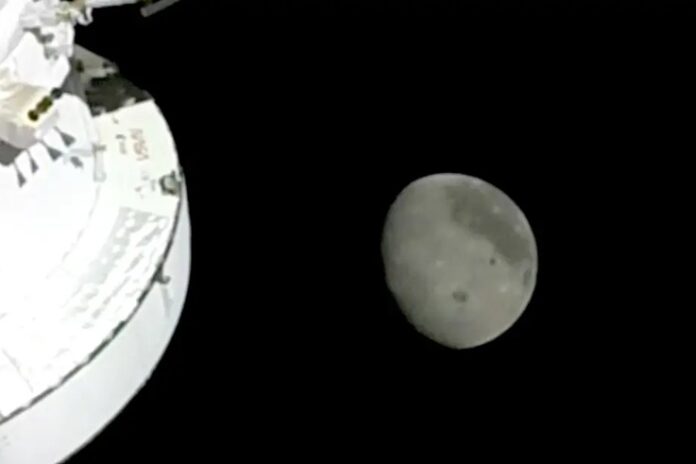
The four-member crew exceeded the previous distance benchmark of 248,655 miles — set by Apollo 13 — at approximately 1:56 p.m. Eastern Time, pushing slightly beyond it to 248,656 miles as their spacecraft sped past the moon at nearly 2,000 miles per hour.
The moment came almost exactly 56 years after Apollo 13 established the original record on April 14, 1970. That mission achieved the milestone under emergency conditions, as astronauts used the moon’s gravitational pull to swing their damaged spacecraft back toward Earth following an onboard explosion.
The Artemis II crew, however, continues to extend that distance, moving progressively farther from Earth until the spacecraft begins its return trajectory later in the evening.
Mission projections indicate the astronauts will ultimately reach a peak distance of approximately 252,757 miles before turning back toward Earth.
Following that point, the Orion capsule will begin its journey home, with splashdown expected in the Pacific Ocean around Friday evening at approximately 8 p.m. Eastern Time.
The record-setting distance will be achieved shortly after the spacecraft makes its closest pass to the moon, coming within roughly 4,000 miles of the lunar surface.
This milestone will also occur during a temporary communications blackout, expected to last about 40 minutes, when the moon blocks direct signals between the spacecraft and Earth.
Contact with mission control is anticipated to resume around 7:25 p.m. once the spacecraft emerges from behind the moon.
During this period, the crew will focus on documenting and studying the lunar surface, including regions of the moon’s far side that have never been fully observed by humans.
Although astronauts on earlier missions — beginning with Apollo 8 — did glimpse parts of the far side, large portions remained obscured due to mission timing and lighting conditions.
Apollo crews typically orbited the moon while sunlight illuminated landing areas on the near side, leaving much of the far side in shadow as they passed over it.
In contrast, Artemis II’s trajectory allows for full illumination of the far side, enabling the crew to view it in its entirety, with the moon appearing roughly the size of a basketball held at arm’s length through the spacecraft windows.
The lunar flyby began at approximately 2:45 p.m. and is expected to continue until around 9:20 p.m., provided operations proceed as planned.
To illustrate the scale of the journey, mission officials noted that if Earth were the size of a soccer ball, the moon would resemble a tennis ball positioned about 30 feet away.
Like Apollo 13 before it, Artemis II is relying on gravitational forces to return home. After circling the moon, the spacecraft will use the momentum gained from its trajectory to head back toward Earth, requiring only minor adjustments rather than major engine burns.