
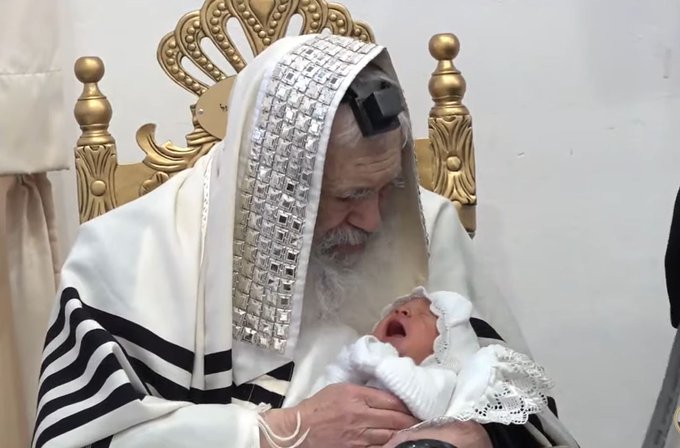

NEW YORK (VINnews/Rabbi Yair Hoffman) – It is Chol HaMoed Pesach. You are in shul. There is a bris happening right after davening. This is common on Chol HaMoed, the intermediate days of Pesach, when a baby boy was born just before the holiday began. The mohel — the specially trained person who performs the circumcision — has a packed schedule. Baruch Hashem, he is in high demand. Three, maybe four brissin today, one after another, in different shuls and halls across the neighborhood.
He cannot be late to any of them.
So the gabbai, the man who runs the shul, is watching the clock. The chazan — the prayer leader — knows to keep things moving. And honestly? The whole congregation is thinking about the food sitting or not yet sitting at home that still needs cooking. It is erev Yom Tov, the day before the final days of Pesach. There is a lot to do.
And then something happens that feels, under these circumstances, like a gift straight from Heaven. The chazan reaches a certain point in Hallel — and stops. Not because anything went wrong. Because that is exactly what halacha — Jewish law — tells him to do.
Half a Hallel. The shul may be quietly exhaling.
But here is the thing. A few months later, on Chol HaMoed Sukkos, that same chazan will say the complete Hallel. Every single word. No stopping, no skipping. The whole thing.
Why? Sukkos is a wonderful Yom Tov — but Pesach is when the greatest miracle in Jewish history happened. The sea split. The most powerful empire on earth collapsed. Two hundred and ten years of brutal slavery ended.
So why does the bigger miracle get the shorter Hallel?
The answer turns out to touch on one of the deepest moral questions in all of Torah: Is it okay to celebrate when your enemies are destroyed?
THE GEMARA’S ANSWER
The Gemara in Arachin (9a) gives us the first answer. It is a technical one, but important. When the Beis HaMikdash — the Holy Temple — stood in Jerusalem, special holiday offerings called korbanos were brought every day. On Pesach, those offerings were exactly the same every single day of the Yom Tov. On Sukkos, they were different each day. Since each day of Sukkos had its own special identity, each day deserved its own full Hallel. On Pesach, since every day was the same, a full Hallel was not required for each day.
That explains part of the picture.
But it does not explain everything. For the deeper answer, we need to go to a Midrash. And it is stunning.
THE MALACHIM WHO WERE SILENCED
The Shibolei HaLeket, quoted by the Bais Yosef (Orach Chaim 490), brings down this Midrash: When the Egyptians were drowning in the Yam Suf — the Red Sea — the malachim, the Heavenly angels, wanted to burst into song. It was an incredible moment. The Jewish people were free. The enemy was gone. Of course the malachim wanted to sing!
But Hashem stopped them. And He said something that has stayed with the Jewish people ever since:
“Maasei Yadai tovim bayam v’attem omrim shira? — My handiwork — My creations — are drowning in the sea, and YOU are singing Hallel?!”
The Egyptians were human beings. They were created by Hashem. Their deaths, even though they were necessary and deserved, were not something to celebrate with a full song of joy.
This raises a big question though. If Hashem silenced the malachim — why do we say any Hallel at all on Pesach? And why is the first day of Pesach different? On the first day we say the full Hallel. Why is Chol HaMoed cut short?
THE TAZ AND CHAVOS YAIR
The Taz (Orach Chaim 490:3) and the Chavos Yair (responsum 225) answer this. The seventh day of Pesach — the day the sea actually split and the Egyptians drowned — cannot have a full Hallel, because of that Midrash. Once the seventh day itself is limited, it would be embarrassing — a bizayon, a disgrace — if Chol HaMoed had more Hallel than the last day of Yom Tov. So Chol HaMoed gets cut short too, to match.
RAV AHARON KOTLER’S BIG PICTURE
So now we have two different reasons. Why do we need both? Rav Aharon Kotler zt”l, one of the greatest Torah leaders of the twentieth century, explains this in his sefer Mishnas Rebbe Aharon, Maamarim (Vol. II, p. 3).
He says there are actually two completely different kinds of Hallel. One kind is said because of Yom Tov — because it is a holiday. The other kind is said because of a Nais — a miracle.
Pesach has both.
The Mussaf offerings explain why the Yom Tov-Hallel does not need to be full. But the miracle of the splitting of the sea is so enormous that the Nais-Hallel would demand a full Hallel — except for the fact that people died. That fact brings the Hallel back down. You need both reasons together to understand the whole picture.
One more interesting point: we call it “half Hallel,” but it is actually about eighty-one percent of the full Hallel — sixty-two lines out of seventy-seven in the ArtScroll siddur. It is not really half. But the name makes a point. Something is missing. Something is being held back on purpose.
TWO VERSES IN MISHLEI THAT SEEM TO CONTRADICT EACH OTHER
Now we get to the really deep part. Shlomo HaMelech — King Solomon, the wisest man who ever lived — wrote the book of Mishlei. And in that book, he seems to say two completely opposite things.
In chapter 24, verse 18, he writes: “B’nfol oyvecha al tismach — When your enemy falls, do not rejoice.”
But in chapter 11, verse 10, the very same Shlomo HaMelech wrote: “U’va’avod resha’im rinah — When the wicked are destroyed, there is joy and singing.”
So which is it? Are we supposed to be happy or not when evil people are destroyed?
THE RALBAG: TOO MUCH CELEBRATING IS DANGEROUS
The Ralbag, a great medieval Torah commentator, explains the verse in chapter 24 this way. The problem is not joy itself — it is too much joy. When someone celebrates too wildly over an enemy’s downfall, something dangerous happens: Hashem removes His anger from that enemy and turns it toward the person who is gloating. Celebrate too much, and you might bring trouble on yourself.
The Alshich, in his commentary to Esther (5:3), shows how this actually played out in history. He explains that Esther made Haman happy at her party on purpose — to get him to start gloating. Once Haman started rejoicing over the upcoming destruction of the Jewish people, Hashem’s anger turned against Haman. Esther used this principle as a weapon.
WHAT KIND OF HAPPINESS IS ALLOWED?
So celebrating a little is fine — but what kind of celebrating, exactly?
The Maharsha in Megillah (28a) says the verse “do not rejoice” is talking about someone who is happy because he personally hates his enemy. That kind of joy — joy that comes from hate — is wrong.
Rabbeinu Yonah, in his commentary to Pirkei Avos (4:19), gives us the right kind of joy. He says it is permitted — maybe even required — to feel happy when evil is destroyed, if the happiness comes from Kavod Shamayim — from the honor of Hashem. If you are happy because justice was done and Hashem’s glory was upheld, that is a good and holy feeling.
The Alshich in his commentary to Tehillim (5:11) adds another angle. He says the verse “do not rejoice” only applies to a personal enemy — someone you happen to dislike. But when someone is deeply, fundamentally evil — an enemy of Hashem Himself — rejoicing at their downfall is actually the right thing to do. That is what the verse in chapter 11 is talking about.
THE MESHECH CHOCHMA AND THE GERRER REBBE DISAGREE
Not everyone agrees with those distinctions. The Meshech Chochma (Shmos 12:16) takes a simpler and stricter position. Good people, he says, simply do not celebrate the death of other human beings — period. It does not matter how evil the enemy was. It does not matter what your spiritual level is. It is just not something a person of good character does.
That is why, he explains, we celebrate our freedom on Pesach — not the punishment of Egypt. And on Chanukah, we celebrate the miracle of the oil lasting eight days — not the military defeat of the Greeks. The joy is always about what Hashem gave us, not about what happened to our enemies.
The Gerrer Rebbe, in a Torah thought from Sukkos 5658, made a similar point from a different angle. He noticed that the Torah uses the specific word “Simcha” — joy — when talking about Sukkos, but not when talking about Pesach. Why? Because the deaths of the Egyptians during Pesach make it inappropriate to use the full word of joy in connection with that holiday.
The Yalkut Shimoni (Mishlei 960) says this directly: we do not say full Hallel on Pesach — except for the first day — because of the principle of not rejoicing too much over the deaths of enemies. The same Midrash points out that Noach — Noah — refrained from marital intimacy for the entire duration of the flood, while the evildoers of his generation were being wiped out. He did this out of respect for the very same verse in Mishlei chapter 24.
WAS THIS STANDARD UNIVERSALLY KEPT?
It may be that this elevated standard was not always kept, even by some of the greatest people in Jewish history. The Mishna in Pirkei Avos (4:19) records that Shmuel HaKatan used to quote the verse from Mishlei about not rejoicing at the fall of an enemy. The Rambam and the Bartenura both point out that the Mishna singles Shmuel HaKatan out for this — which implies that this level of restraint was not the norm. If everyone did it, why would one person be singled out for it?
Even more striking: the Midrash Tehillim (7) raises the possibility that Dovid HaMelech himself — the father of Shlomo, the author of Tehillim, one of the greatest figures in all of Jewish history — may have made an error in this very area, when he composed a joyful song at the fall of Kush Ben Yemini. If Dovid HaMelech could stumble here, the rest of us need to be especially careful.
CONCLUSION
We do say Hallel on Chol HaMoed Pesach. But not the full Hallel. The truncation is not an accident of history — it is a moral statement, built into our davening, repeated every single year.
The words of Rabbeinu Yonah give us perhaps a clear path forward. If your joy at the downfall of evil comes from a genuine sense that Kavod Shamayim — the honor of Heaven — has been upheld and that justice has been done, then that joy is not only permitted but holy. But even then, it must be kept in check. Even then, something must be held back.
That is what the half Hallel teaches us every Chol HaMoed Pesach. Sing — but not everything. Rejoice — but not without limit. Remember that the ones who drowned in that sea were Hashem’s creations too.
The author can be reached at [email protected]