
 Matzav
CHUTZPAH: Russia and China Veto UN Resolution On Reopening Strait of Hormuz
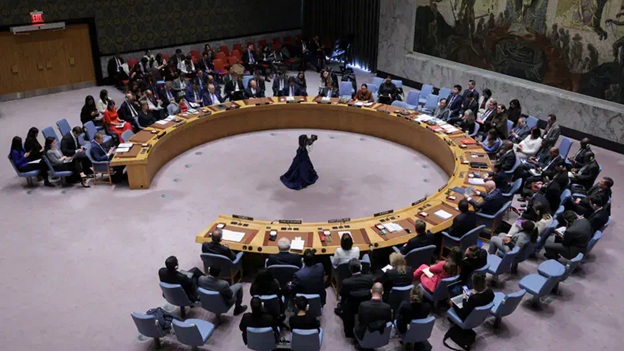
Russia and China on Tuesday vetoed a United Nations Security Council resolution urging the reopening of the Strait of Hormuz, preventing the measure from passing despite majority support, AFP reported.
The proposal had already been significantly scaled back from its original version, which Gulf nations had pushed to include authorization for the use of force to secure the crucial shipping route.
The revised draft, introduced by Bahrain with backing from the United States, received 11 votes in favor, two opposed, and two abstentions.
Bahrain’s Foreign Minister Abdullatif bin Rashid Al Zayani expressed disappointment following the outcome, saying the Gulf states “regret” the rejection of the measure.
Iran has effectively blocked the strategic waterway since the United States and Israel launched military operations on February 28, disrupting a passage through which roughly 20 percent of the world’s oil supply typically flows and sending shockwaves through global markets.
The vote came just hours before President Donald Trump’s deadline for Iran to reopen the strait, during which he warned that failure to comply could result in catastrophic consequences, including that “a whole civilization will die” in Iran.
Following the vote, U.S. Ambassador Mike Waltz emphasized that Washington retains the ability to act independently, stating: “Today’s result does not restrict the United States to continue to act in its own self defense and in the collective defense of our allies and partners.”
Speaking on behalf of Gulf oil-producing nations, Al Zayani warned that the failed resolution carries broader implications, saying it “sends the wrong signal to the world.”
He elaborated: “This signal that the threat to international waterways can pass without any decisive action by the international organization responsible for the maintenance of international peace and security,” he said.
Bahrain had begun discussions two weeks earlier on a stronger resolution that would have explicitly authorized countries to use force to reopen the strait.
However, resistance from several permanent members of the Security Council with veto power—including France, Russia, and China—led to repeated delays and a weakened final version of the text.
The revised resolution “strongly encourages states…to coordinate efforts, defensive in nature, commensurate to the circumstances, to contribute to ensuring the safety and security of navigation, including through the escort of merchant and commercial vessels,” rather than explicitly authorizing force.
It also “demands” that Iran “immediately cease all attacks against merchant and commercial vessels and any attempt to impede transit passage or freedom of navigation in the Strait of Hormuz.”
In addition, the proposal called for an end to strikes targeting civilian water, oil, and gas infrastructure.