
 Matzav
Iran Calls for Human Chains to Protect Power Plants as Trump’s Deadline Nears
Airstrikes struck Tehran on Tuesday as Iran urged civilians—especially young people—to form human chains around power plants, just hours before President Donald Trump’s deadline for reopening the Strait of Hormuz, raising fears of a dramatic escalation.
With the 8 p.m. Washington deadline approaching, tensions surged on both sides. Trump signaled that this cutoff may be final after extending previous deadlines, warning that failure to comply would lead to sweeping attacks on Iran’s infrastructure. Tehran responded with defiant rhetoric, including a claim by its president that 14 million citizens had volunteered to fight.
Although Iran lacks the advanced capabilities of U.S. and Israeli forces, its control over the Strait of Hormuz has disrupted global energy markets, increasing pressure on Washington to resolve the standoff.
Diplomatic sources said negotiations were still underway, but Iran had rejected the latest U.S. proposal, leaving uncertainty over whether a deal could be reached in time. International leaders and legal experts cautioned that the scale of strikes being discussed could violate the laws of war.
At the same time, waves of strikes hit targets across Iran, including residential neighborhoods in Tehran, leaving dozens dead. Iran retaliated with attacks on Israel and Saudi Arabia, forcing the temporary closure of a key regional bridge.
Reiterating the deadline, Trump warned that “the entire country can be taken out in one night.”
“Every bridge in Iran will be decimated by 12 o’clock tomorrow night,” he said Monday, adding that power plants would be “burning, exploding and never to be used again.”
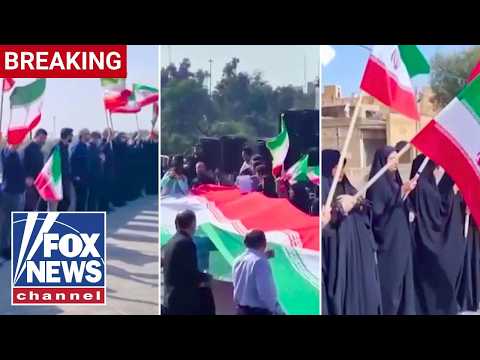
In response, Iranian officials called on the public to physically protect key infrastructure. They urged “all young people, athletes, artists, students and university students and their professors” to form human chains around power facilities.
“Power plants that are our national assets and capital,” Alireza Rahimi, identified by Iranian state television as the secretary of the Supreme Council of Youth and Adolescents, said in a video statement.
While similar demonstrations have occurred in the past around nuclear facilities, it remained unclear how many would participate this time. Reports indicated that at least one major power plant in Tehran had already been closed off for security reasons ahead of the planned gatherings.
Iranian President Masoud Pezeshkian claimed widespread public mobilization, writing: “I too have been, am, and will remain ready to give my life for Iran.”
Iran’s Revolutionary Guard issued further warnings, saying it would “deprive the U.S. and its allies of the region’s oil and gas for years” and expand its attacks across the Gulf if the U.S. follows through.
A senior Guard official also encouraged parents to send their children to staff checkpoints, which have been frequent targets of airstrikes.
Inside Tehran, the atmosphere was described as tense and fearful. One resident, speaking anonymously, said the country faces worsening conditions, including the possibility of widespread power outages. “I feel we are stuck between the blades of a pair of scissors,” he said.
International leaders continued to call for restraint. French Foreign Minister Jean-Noël Barrot warned that attacks on civilian and energy infrastructure “are barred by the rules of war, international law.”
“They would without doubt trigger a new phase of escalation, of reprisals, that would drag the region and the world economy into a vicious circle,” he added.
UN Secretary-General António Guterres also cautioned that targeting civilian infrastructure would violate international law, according to his office.
Despite those warnings, Trump dismissed concerns, saying he is “not at all” worried about potential accusations of war crimes.
Airstrikes continued across Iran, including in densely populated areas. Israel said it struck a petrochemical facility in Shiraz for a second consecutive day and issued a Farsi-language warning advising civilians to avoid trains, suggesting possible further strikes on transportation infrastructure.
Additional attacks were reported at Khorramabad International Airport and in Alborz province, where state media said 18 people were killed. Other strikes in Shahriar and Pardis left at least 15 more dead.
Iran also launched missiles toward Saudi Arabia early Tuesday, with debris reportedly falling near energy facilities after interception. The attack led Saudi authorities to temporarily shut down the King Fahd Causeway, the only land connection between Bahrain—home to the U.S. Navy’s Fifth Fleet—and the Arabian Peninsula.
Missile alerts were also reported in Israel, including in Tel Aviv and Eilat.
Since the war began, more than 1,900 people have been killed in Iran, though official figures have not been updated in recent days.
In Lebanon, fighting between Israel and Iran-backed Hezbollah has killed more than 1,400 people and displaced over one million, while 11 Israeli soldiers have died there. Additional casualties have been reported across the region, including in Gulf Arab states, the West Bank, Israel, and among U.S. forces.
Iran’s closure of the Strait of Hormuz since the start of the conflict on February 28 has had far-reaching economic consequences, with disruptions to global oil supply driving up prices worldwide.
Brent crude rose above $108 per barrel on Tuesday, representing an increase of roughly 50 percent since the outbreak of hostilities.
While Iran rejected a 45-day ceasefire proposal on Monday, insisting on a permanent end to the war, diplomatic efforts continued. Officials said indirect talks between Washington and Tehran were ongoing, with mediators from Pakistan, Egypt, and Turkey “are racing against time” to reach a deal.
According to one official, Iran has tied reopening the strait to sanctions relief, and the United States has indicated willingness to ease some restrictions, particularly on Iran’s oil sector, in an effort to stabilize global markets.