
 Matzav
The Secret, Never-Before-Used CIA Tool That Helped Find Airman Downed In Iran
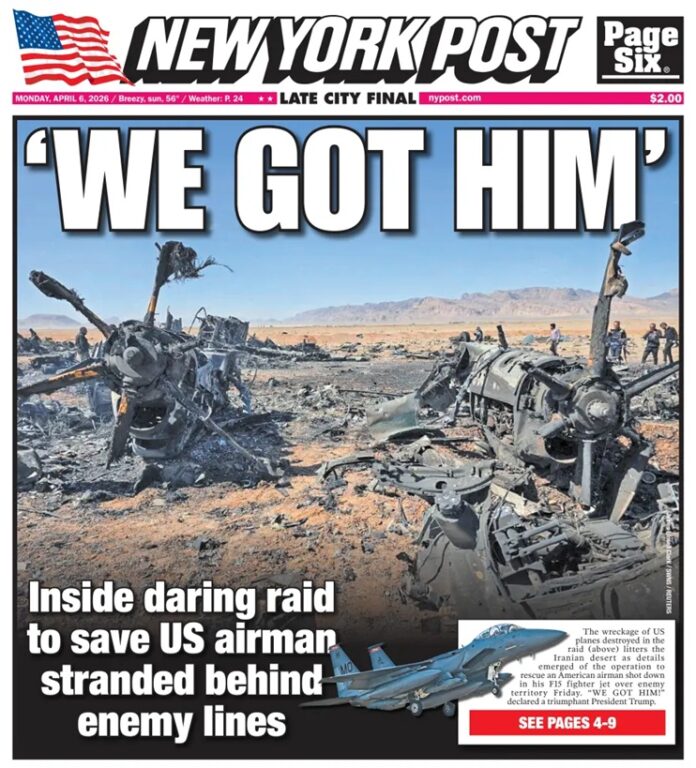
The CIA relied on a highly classified system known as “Ghost Murmur” to locate and help rescue a second American airman who was shot down in southern Iran, according to a report by The New York Post citing sources familiar with the operation.
The tool, described as a cutting-edge intelligence capability, uses long-range quantum magnetometry to detect the electromagnetic signature of a human heartbeat, then combines that data with artificial intelligence to distinguish it from surrounding interference, sources said.
This marked the first known operational deployment of the technology in the field by the agency, and it was indirectly referenced during a White House briefing by President Donald Trump and CIA Director John Ratcliffe.
“It’s like hearing a voice in a stadium, except the stadium is a thousand square miles of desert,” a source familiar with the program told The Post. “In the right conditions, if your heart is beating, we will find you.”
According to sources with knowledge of Lockheed Martin systems, the technology was developed by the company’s Skunk Works division, though the firm declined to comment on the report.
The system has reportedly been tested aboard Black Hawk helicopters and may eventually be integrated into F-35 fighter aircraft, according to one of the sources.
The downed crew member, publicly identified only as “Dude 44 Bravo,” had taken cover in a mountain crevice after his F-15 was shot down, surviving for two days in harsh terrain while Iranian forces searched the area.
The remote and sparsely populated environment made conditions especially suitable for the first real-world use of Ghost Murmur, one source explained.
“The name is deliberate. ‘Murmur’ is a clinical term for a heart rhythm. ‘Ghost’ refers to finding someone who, for all practical purposes, has disappeared,” the source said.
The technology performed optimally due to minimal electromagnetic interference, limited human presence, and temperature differences at night between the human body and the surrounding desert, which helped confirm readings.
“Normally this signal is so weak that it can only be measured in a hospital setting with sensors pressed nearly against the chest,” the source said.
“But advances in a field known as quantum magnetometry — specifically sensors built around microscopic defects in synthetic diamonds — have apparently made it possible to detect these signals at dramatically greater distances.”
The same source cautioned that the system is not all-powerful. “The capability is not omniscient. It works best in remote, low-clutter environments and requires significant processing time,” this person said.
It remains unclear how long the system took to process data during the rescue or whether it has additional offensive military applications.
Although the airman activated a Combat Survivor Evader Locator beacon, his exact position remained uncertain until Ghost Murmur helped narrow and confirm his location.
The breakthrough came when the system identified the airman’s position, working alongside the beacon to refine the search.
“He had to come out [of the crevice] to send the beacon,” the source said. “It was less important the signal they sent and more important that he had to come out to send [it].”
During a briefing, Ratcliffe described the moment the agency confirmed the airman’s survival. “achieved our primary objective by finding and providing confirmation that one of America’s best and bravest was alive and concealed in a mountain crevice — still invisible to the enemy, but not to the CIA.”
“That confirmation was relayed by Secretary [of War Pete] Hegseth to the president, and the operation quickly moved to the execution phase,” he said.
Trump told reporters the CIA had identified the missing airman from a considerable distance. “It’s like finding a needle in a haystack, finding this pilot, and the CIA was unbelievable,” Trump said. “The CIA was very responsible for finding this little speck.”
He also praised Ratcliffe’s role in the operation, saying: “did a phenomenal job that night — he did something that I don’t know if you want to talk about it. If you want, you can. I’m not sure he’s supposed to.”
Trump joked about the secrecy surrounding the system, adding that the technology “might be classified, in which case I’d have to put him in jail if he talks about it and I don’t want to put him in jail. He doesn’t deserve that.”
Sources indicated that the classified nature of Ghost Murmur explains why officials have been reluctant to detail how the airman was located.
“I don’t think people even know this technology is possible from this distance,” one source said.