
 Vos Iz Neias
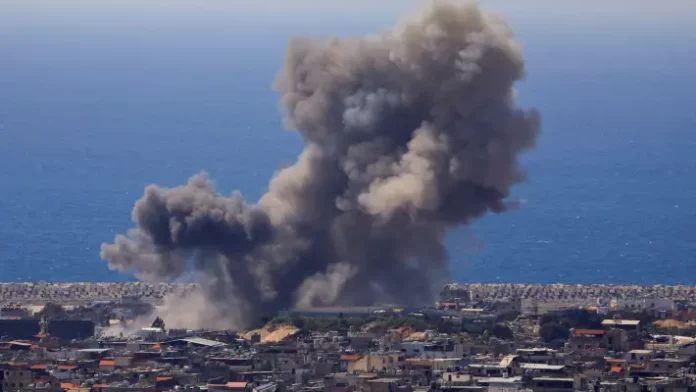
IDF Launches Operation ‘Eternal Darkness’, Striking Over 100 Hezbollah Terror Targets
JERUSALEM (VINnews) — The IDF launched an offensive strike on Wednesday, considered the largest attack across Lebanon since the start of Operation “Roaring Lion.” Within 10 minutes, more than 100 terror targets were struck, including Hezbollah command centers. The IDF stated that the operation was called “Eternal Darkness,” but later clarified that this was only the name of the order, and that it is a direct continuation of activities carried out in Lebanon since Operation “Roaring Lion.”
Images and videos from the strike sites show extensive destruction, while the Al-Mayadeen network claimed that “Israel is massacring Lebanon.” Lebanese Health Minister Rakan Nasser al-Din, affiliated with Hezbollah, told Lebanon’s NBN network: “The number of dead and wounded has exceeded 100.” He later told Reuters that “hospitals are overwhelmed with casualties.” The Red Cross told Lebanon’s LBCI network that “there are many fatalities, many injuries, the situation is severe, and they are doing everything possible to save lives.”
As part of the unusual strike, launched less than 12 hours after the announcement of a ceasefire with Iran, the IDF targeted headquarters, command-and-control centers, and Hezbollah’s military infrastructure. The IDF stated that the targets included intelligence headquarters and central command hubs used by the organization to plan and direct terror operations against IDF forces and Israeli civilians. Also targeted were infrastructure belonging to Hezbollah’s firepower and naval units, responsible for launching missiles at IDF forces on land and at sea, as well as at Israeli territory, along with assets of the Radwan Force and Unit 127 (the aerial unit), considered elite units of the organization.
The strike was based on precise intelligence and had been carefully planned for weeks by personnel from the Operations Directorate, Intelligence Directorate, the Air Force, and Northern Command, with the goal of deepening the damage to Hezbollah.
IDF Chief of Staff Lt. Gen. Eyal Zamir was present in the command bunker during the strike and emphasized that this is only the beginning of the operation:
“We will continue to strike the Hezbollah terrorist organization and seize every opportunity. We will not compromise on the security of northern residents. We will continue to attack without pause.”
The IDF stated that “most of the infrastructure targeted was located within civilian population centers, as part of Hezbollah’s cynical use of Lebanese civilians as human shields to protect its operations. Prior to the strikes, steps were taken to minimize harm to uninvolved civilians as much as possible. Hezbollah chose to join the conflict and operate under the sponsorship of the Iranian terror regime, while harming the State of Lebanon and its citizens. The Lebanese state and its citizens must oppose Hezbollah’s entrenchment in civilian areas and its efforts to build up military power.”
Defense Minister Israel Katz later said:
“Hundreds of Hezbollah terrorists were targeted in a surprise strike on headquarters across Lebanon, in the largest concentrated blow Hezbollah has suffered since the pager operation. We warned Naim Qassem that Hezbollah would pay a very heavy price for attacking Israel on behalf of Iran, and his personal turn will come as well.”
Ground forces operating in Lebanon are receiving close air support, as in recent weeks, with conditions now enabling this operation. There is complete separation between the different theaters of operation. Although the operation began immediately after the ceasefire announcement with Iran, it is not a concluding strike; the goal is to deliver a significant blow to all Hezbollah command centers in Lebanon.
The military has set clear objectives and continues to work toward them. Forces are operating in dominant terrain along anti-tank lines and strengthening their hold on the ground. At the same time, strikes against Hezbollah continue across Lebanon, with the aim of creating the conditions necessary for its disarmament.
Lebanese Prime Minister Nawaf Salam criticized the Israeli attack and called for assistance: “While we welcomed the agreement between Iran and the United States and intensified our efforts to reach a ceasefire in Lebanon, Israel continues to escalate its attacks, targeting densely populated residential areas and claiming the lives of innocent civilians across Lebanon, especially in Beirut. Israel is ignoring all regional and international efforts to end the war and is blatantly violating the principles of international law and humanitarian law, which it has never respected. All of Lebanon’s friends are called upon to help us stop these attacks by all means.”
Iran also sharply criticized the Israeli attacks, stating that it would respond to Israel’s “violations” of the ceasefire in Lebanon with further attacks on Israel.
The working assumption within the Air Force and the IDF is that fighting with Iran will resume, requiring forces to act again on short notice. Regarding the temporary ceasefire, the IDF says it provides Iran time to deploy launchers, but not enough to rebuild all the damage to its various systems. Additionally, the United States is not withdrawing forces from the Middle East: “They are maintaining full readiness to continue whenever necessary.” Negotiations with Iran are not being handled at the military level, but the Air Force is prepared for any scenario in accordance with directives from the political leadership.