
 Vos Iz Neias
Op-Ed: A Badge, a Split Second, a Prison Sentence: Justice Gone Wrong in the Bronx
NEW YORK (VINNews/Shira Miller) – The Railroading of Sgt. Erik Duran — and What It Means for Every Police Officer in New York
His decision took two and a half seconds.
Sgt. Erik Duran had to decide how to stop a drug dealer with a previous narcotics record on a motorized scooter bearing down on his officers and bystanders on a crowded Bronx sidewalk. On Thursday, April 9, 2026, a judge sentenced him to three to nine years in state prison for what he did in those two and a half seconds.
This verdict is an unmitigated travesty of justice. It is wrong legally, wrong morally. And if it stands, every police officer in New York will hesitate the next time a split-second decision is required — and people will die because of it.
What Happened
On August 23, 2023, Sgt. Duran’s Bronx narcotics unit ran a buy-and-bust on Aqueduct Avenue — a stretch where families walk their dogs and children play. Eric Duprey, 30, sold drugs to an undercover officer, then fled on a motorized scooter when detectives moved to arrest him.
Duprey mounted the scooter — without a helmet — and drove it at high speed onto the sidewalk, heading toward the officers and pedestrians. Sgt. Duran grabbed a cooler from a nearby picnic table and hurled it. Duprey lost control, slammed into a tree, and died of the head injuries he sustained — because he chose to run away from police and chose not to wear a helmet.
Duprey has a previous arrest for a narcotics case from March, police sources and in a bizarre manner of irony also has an open felony assault case in the Bronx from June 2022 for allegedly throwing a two-liter bottle of soda through someone’s driver-side window.
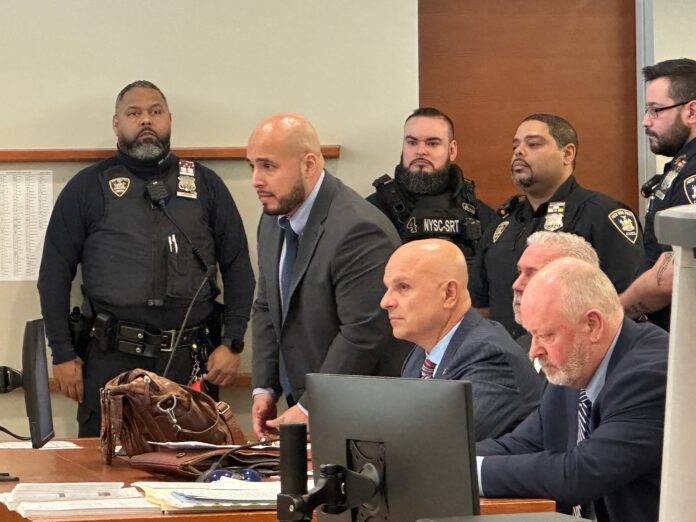
Duran, to his credit, immediately tried to help Duprey. He said at sentencing: “I took this job to save lives. I felt terrible once I saw Eric Duprey crash. I never wanted this to happen.” He addressed Duprey’s family directly, in Spanish. And then he was taken into custody.
Judge Guy Mitchell, who presided over a bench trial — Duran having waived a jury — concluded that the sergeant was not scared for anyone’s safety, but was simply “upset that Mr. Duprey was getting away.” This armchair retrospective judgment, rendered months after the fact by a judge comfortably seated in a Bronx courtroom, overrode the testimony of a trained officer who was on that sidewalk when a scooter was hurtling toward him.
The Legal Case for Reversal
Legal experts note that New York Penal Law § 35.30(1) is clear. A police officer attempting to prevent an escape “may use physical force when and to the extent he or she reasonably believes such to be necessary… or in self-defense or to defend a third person from what he or she reasonably believes to be the use or imminent use of physical force.” The key word is “reasonably.”
Furthermore, § 35.30(1)(c) specifically authorizes even deadly physical force when “the use of deadly physical force is necessary to defend the police officer or peace officer or another person from what the officer reasonably believes to be the use or imminent use of deadly physical force.” A motorized scooter driven at speed toward a group of people on a sidewalk is precisely that — an instrument of deadly physical force under Penal Law § 10.00(11)’s definition.
This is also where the Supreme Court’s landmark ruling in Graham v. Connor, 490 U.S. 386 (1989) comes into play. The Court held that “the reasonableness of a particular use of force must be judged from the perspective of a reasonable officer on the scene, rather than with the 20/20 vision of hindsight,” and that courts must allow for the fact that “police officers are often forced to make split-second decisions about the amount of force necessary in a particular situation.”
Judge Mitchell did precisely what Graham forbids: he substituted his own retrospective judgment for a real-time decision made in a crisis.
The Appellate Division, First Department, should grant bail pending appeal and reverse this conviction. The Sergeants Benevolent Association has already called the verdict “clearly against the weight of the credible evidence” — the exact statutory language for reversal under New York Criminal Procedure Law § 470.15. The surveillance video showed the scooter heading toward the officers. The judge simply chose not to believe the officer who was there.
The Message This Sends — and Why It Is Dangerous
Sergeants Benevolent Association president Vincent Vallelong said it plainly at sentencing: “Today will forever be remembered as one of the darkest days in the history of our profession. This puts in the back of a police officer’s mind that they can lose their freedom for making a split-second decision.”
He is right. And the consequences flow directly: officers will hesitate. Suspects will know that flight — especially on a vehicle — is effectively a get-out-of-jail-free card. If an officer who intervenes in 2.5 seconds faces a felony conviction and prison, the rational choice is to stand aside. And innocent people will be hurt as a result.
The Torah commands: “Lo sa’amod al dam re’echa” — do not stand idly by the blood of your fellow (Vayikra 19:16). This is not merely a nice sentiment. It is a direct obligation. A society that punishes those who act on this obligation — who intervene to save others at personal risk, in a moment of crisis — is a society that has lost its moral bearings.
Eric Duprey’s death was a tragedy.
His three young children deserve compassion. But Eric Duprey sold drugs to an undercover officer, had sold drugs previously, had committed felony assault previously, fled police, drove a scooter helmetless at dangerous speed on a sidewalk toward a group of people, and died from injuries caused by his own refusal to wear a helmet.
The entire chain of events leading to his death was initiated and sustained by his own freely-made decisions. Assigning criminal culpability to the officer who acted in two and a half seconds to stop a lethal threat — and sending him to prison for it — is not justice. It is a political verdict dressed as one.
Sgt. Erik Duran’s attorney Arthur Aidala has announced he will seek bail pending appeal. The Appellate Division, First Department must scrutinize this conviction against the plain language of Penal Law § 35.30 and the mandate of Graham v. Connor.
While having empathy for the man and his family our elected officials must demand accountability from an Attorney General’s office that prosecuted a decorated officer for a split-second act of courage. And the appellate courts should do what the trial court failed to do: apply the law as written, not as a political statement.