
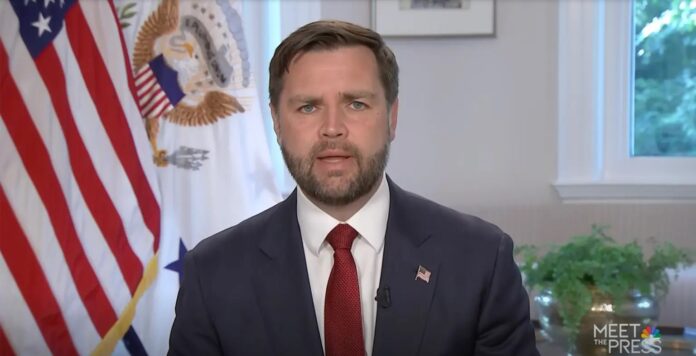

Vice President JD Vance cautioned Iran that it would be unwise to risk the fragile ceasefire with Washington over disagreements tied to Israeli operations in Lebanon, signaling rising tensions over the scope of the truce.
While Pakistan, which helped broker the agreement, indicated that Lebanon was included in the two-week ceasefire, Vance said the United States never accepted that Israel would halt its actions there.
“If Iran wants to let this negotiation fall apart – in a conflict where they were getting hammered – over Lebanon, which has nothing to do with them and which the United States never once said was part of the ceasefire, that’s ultimately their choice,” Vance said as he left Hungary.
“We think that would be dumb, but that’s their choice.”
Earlier that day, Iranian Foreign Minister Abbas Araghchi circulated a statement from Pakistani Prime Minister Shehbaz Sharif announcing the ceasefire and drew attention to the portion referencing Lebanon.
“The Iran-US Ceasefire terms are clear and explicit: the US must choose – ceasefire or continued war via Israel. It cannot have both,” Araghchi wrote.
Despite that, President Donald Trump and officials in his administration have maintained that Lebanon was never part of the agreement.
Vance characterized the disagreement as stemming from confusion rather than deliberate deception.
“There’s a lot of bad faith negotiation and a lot of bad faith propaganda going on,” he said. “I think this comes from a legitimate misunderstanding. I think the Iranians thought that the ceasefire included Lebanon, and it just didn’t.”
It remains unclear how such a gap in understanding emerged during sensitive negotiations. U.S. officials have not clarified why Pakistan’s announcement appeared to include Lebanon within the ceasefire framework.
Israel has previously been accused of breaching ceasefire arrangements, including a truce reached with Lebanon in November 2024. Since that time, Israeli strikes in Lebanon have reportedly continued almost daily for more than a year.
On Wednesday, Israel carried out one of its most extensive rounds of airstrikes, launching dozens of attacks that reportedly left at least 254 people dead and more than 1,100 injured.
Even so, Vance indicated that Israel has signaled a willingness to exercise some restraint.
He said the Israelis have committed “to check themselves a little bit in Lebanon, because they want to make sure” that the US-Iran negotiations are successful.
Fighting in Lebanon escalated sharply in early March after Hezbollah fired rockets at Israel in response to prior Israeli strikes and the killing of Iranian Supreme Leader Ali Khamenei.
Hezbollah has since faced growing criticism within Lebanon, with opponents accusing the group of pulling the country into conflict as part of its alignment with Iran.
At the same time, Iranian officials have made clear they intend to continue backing Hezbollah.
On Wednesday, Iran’s Islamic Revolutionary Guard Corps (IRGC) warned that hostilities could resume if Israel does not halt its actions in Lebanon.
“If the aggressions against dear Lebanon are not stopped immediately, we will do our duty and give a regretful response to the evil aggressors in the region,” it said.