
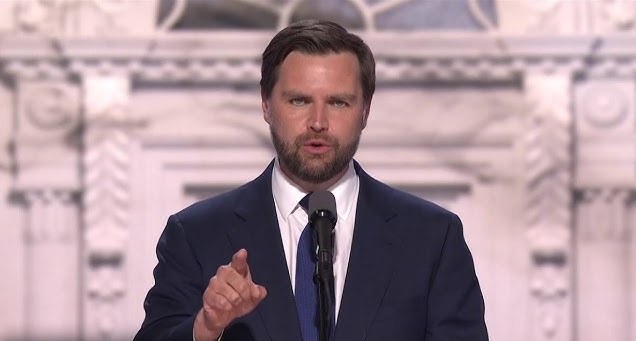

Vice President JD Vance departed Friday for high-stakes negotiations with Iran, cautioning Tehran against attempting to manipulate the United States as efforts intensify to bring the ongoing war to a close.
President Donald Trump has assigned Vance—who has often expressed reservations about the conflict—to spearhead the diplomatic push aimed at ending the six-week war and avoiding the realization of Trump’s stark warning about destroying Iran’s “whole civilization.”
Known for his skepticism toward prolonged foreign military involvement, Vance is now leading mediated discussions in Islamabad, Pakistan, as part of a renewed diplomatic effort.
As he boarded Air Force Two en route to Pakistan, Vance struck a cautiously optimistic tone, telling reporters, “We’re looking forward to the negotiation. I think it’s gonna be positive. We’ll of course see.”
Referencing Trump’s position, he added, “If the Iranians are willing to negotiate in good faith, we’re certainly willing to extend the open hand.” At the same time, he issued a warning: “If they’re gonna try and play us, then they’re gonna find that the negotiating team is not that receptive.”
Vance said the president had provided “pretty clear guidelines” for the talks, though he declined to offer specifics and did not take further questions from reporters traveling with him.
His trip comes at a moment when the fragile ceasefire appears increasingly unstable, with deep disagreements between Iran and the U.S.-Israel alliance over key terms. Domestically, Vance also faces growing political and economic pressure to help bring the conflict to an end.
Joining him in the negotiations are Trump’s special envoy Steve Witkoff and senior adviser Jared Kushner, both of whom participated in earlier rounds of indirect discussions with Iranian representatives before the war began on February 28. Those talks focused on Iran’s nuclear and ballistic programs as well as its backing of regional proxy forces.
The White House has offered few details about how the upcoming negotiations will be structured, including whether they will involve direct engagement or continue through intermediaries, and has not outlined clear expectations.
Still, Vance’s presence marks a rare instance of senior U.S. officials engaging directly at a high level with Iranian counterparts, something largely absent since the 1979 Islamic Revolution. The last comparable contact occurred in 2013, when President Barack Obama spoke by phone with Iranian President Hassan Rouhani regarding Tehran’s nuclear program.
Tensions over the ceasefire emerged almost immediately after it was announced Tuesday evening, with conflicting interpretations of its scope.
Iran has maintained that halting Israeli military activity in Lebanon was part of the agreement. However, Israeli Prime Minister Benjamin Netanyahu and Trump both stated that Lebanon was not included, and Israeli operations there have continued.
At the same time, Washington has insisted that Iran must reopen the Strait of Hormuz, which Tehran had shut down in response to intensified Israeli strikes against Hezbollah in Lebanon.
Trump voiced frustration Thursday over Iran’s handling of shipping traffic, saying the country was “doing a very poor job” and posting online, “That is not the agreement we have!”
White House spokeswoman Anna Kelly said that Vance, Witkoff, Kushner, and Secretary of State Marco Rubio “have always been collaborating on these discussions,” adding that Trump remains hopeful a lasting agreement can be reached during the two-week ceasefire.
“President Trump has a proven track record of achieving good deals on behalf of the United States and the American people, and he will only accept one that puts America first,” Kelly said.
The negotiations represent a significant test for Vance, who until recently played a quieter role within the administration as other senior figures took more visible advisory positions.
However, his responsibilities have expanded rapidly—from tackling domestic issues like government fraud to now taking a leading role in resolving a complex international conflict.
Despite his military service in Iraq as a Marine and his time in the Senate representing Ohio, Vance has relatively limited diplomatic experience.
Addressing speculation earlier in the week that Iran had requested his involvement, Vance dismissed the idea, saying, “I don’t know that. I would be surprised if that was true. But, you know, I wanted to be involved because I thought I could make a difference.”
Analysts say his selection could be strategic. Jonathan Schanzer, a former Treasury official and current executive director of the Foundation for Defense of Democracies, noted that Vance’s skepticism toward foreign interventions might appeal to Iranian negotiators.
“I think they probably prefer him knowing that his perspective on foreign intervention is one of skepticism,” Schanzer said of the Iranians. “I do think that he’s going to need some help. I don’t think he’s ever been engaged in negotiations with this kind of weight, this kind of seriousness. This is as serious as it gets.”
The White House has rejected suggestions that Iran specifically sought Vance’s participation, framing such claims as potentially harmful to the negotiation process.
While officials have confirmed that Vance, Witkoff, and Kushner will attend, Kelly said personnel from the National Security Council, State Department, and Pentagon will also “play a supportive role.”
Earlier rounds of talks drew criticism from Democrats and nuclear policy experts, who questioned whether Kushner and Witkoff possessed sufficient technical expertise. The administration has not clarified whether nuclear specialists were involved.
Experts note that vice presidents have occasionally been tasked with significant diplomatic missions, but rarely in circumstances involving active wartime negotiations.
Joel Goldstein, a law professor at Saint Louis University who studies the vice presidency, said, “I don’t recall a situation where a vice president has been sent to negotiate a ceasefire or peace in connection with a war the United States was involved with.”
Vance, along with Rubio, is widely viewed as a leading contender for the Republican presidential nomination in 2028, though neither has publicly committed to a run.
According to a source familiar with internal discussions, Vance’s team is focused on the immediate diplomatic mission rather than any future political considerations.
Still, his visible role in the negotiations could carry long-term implications. As Goldstein noted, “The fact that he’s involved in the negotiations in a very visible way, that means that, if things go south, that people will be pointing fingers at him.”
At the same time, he added, “If things go well, then it will be something that he could point to.”