
 Matzav
Artemis II’s Grand Moon Finale Almost Here With a Pacific Splashdown to Cap NASA’s Lunar Comeback
The Artemis II mission was set to conclude Friday with a dramatic splashdown in the Pacific Ocean, bringing to a close humanity’s first crewed journey to the moon in more than half a century.
Inside Mission Control, tension steadily increased as the spacecraft carrying four astronauts drew closer to Earth. Engineers and flight teams focused intently on the capsule’s heat shield, a critical component designed to endure extreme temperatures during reentry. During a previous uncrewed test in 2022, the shield returned heavily scarred, raising heightened attention for this mission.
Commander Reid Wiseman, pilot Victor Glover, mission specialist Christina Koch, and Canadian astronaut Jeremy Hansen approached Earth traveling at roughly Mach 32, a speed not experienced since the Apollo era. Their Orion capsule, named Integrity, was designed to operate autonomously, with the crew prepared to intervene only in the event of an emergency.
As the spacecraft entered its final phase, mission leaders braced for the most nerve-wracking moments of the descent, including a communications blackout lasting several minutes before parachutes were expected to deploy. Lead flight director Jeff Radigan acknowledged the anxiety surrounding that period, saying he expected some of that “irrational fear that is human nature.” Recovery teams, including the USS John P. Murtha and supporting aircraft, stood ready to retrieve the astronauts upon landing.
The return marked the first collaboration between NASA and the U.S. military for a lunar crew recovery since Apollo 17 in 1972. The capsule was expected to reenter at speeds exceeding 23,000 miles per hour before slowing dramatically to a controlled splashdown.
Since launching from Florida on April 1, the crew had successfully completed a series of milestones, demonstrating key capabilities for NASA’s renewed lunar program aimed at eventually establishing a sustained presence on the moon.
Although Artemis II did not land on the lunar surface or enter orbit, it surpassed previous records, traveling farther from Earth than any human mission before it. At its peak, the crew reached a distance of 252,756 miles. During one of the mission’s most emotional moments, the astronauts requested permission to name two lunar craters in honor of their spacecraft and Wiseman’s late wife, Carroll.
The mission also provided rare and stunning views of the moon’s far side, along with a total solar eclipse visible from space. Reflecting on the experience, Glover said the eclipse “just blew all of us away.”
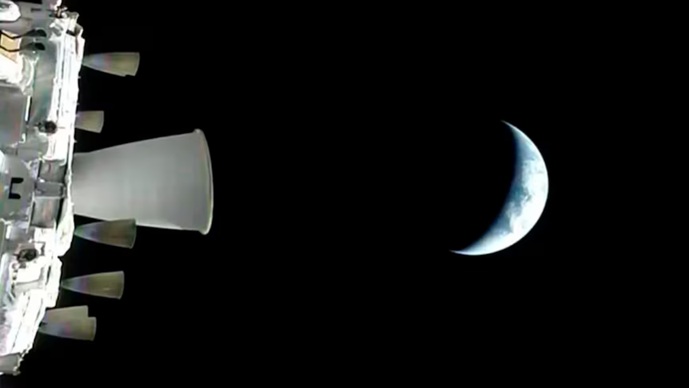
Images captured during the mission captivated audiences worldwide, including a view of Earth setting behind the lunar horizon, echoing the iconic Earthrise image from Apollo 8. The crew’s reflections and discoveries reignited global fascination with space exploration.
“It just makes you want to continue to go back,” Radigan said on the eve of splashdown. “It’s the first of many trips and we just need to continue on because there’s so much” more to learn about the moon.
The mission drew attention and praise from global leaders and public figures, including President Donald Trump, Canadian Prime Minister Mark Carney, Britain’s King Charles III, and prominent actors such as Ryan Gosling, Scarlett Johansson, and William Shatner.
Despite its successes, the nearly 10-day journey encountered several technical challenges. Issues arose with the spacecraft’s water and propulsion systems, and a malfunctioning toilet forced the crew to rely on backup methods for much of the flight.
The astronauts downplayed the difficulties, emphasizing the importance of pushing forward despite setbacks. “We can’t explore deeper unless we are doing a few things that are inconvenient,” Koch said, “unless we’re making a few sacrifices, unless we’re taking a few risks, and those things are all worth it.”
Hansen echoed that sentiment, noting, “You do a lot of testing on the ground, but your final test is when you get this hardware to space and it’s a doozy.”
Looking ahead, NASA’s Artemis program will continue to build on this mission. Artemis III is expected to involve docking exercises in Earth orbit, while Artemis IV aims to land astronauts near the moon’s south pole by 2028.
For Wiseman and his crew, the mission carried a deeper purpose beyond its technical achievements. “But we really hoped in our soul is that we could for just for a moment have the world pause and remember that this is a beautiful planet and a very special place in our universe, and we should all cherish what we have been gifted,” he said.