
 Matzav
Artemis II Astronauts Return Safely to Earth After Historic Moon Mission
Four astronauts safely returned to Earth late Friday, splashing down in the Pacific Ocean and completing NASA’s first crewed journey beyond low Earth orbit in more than half a century, a mission seen as a major step toward sending humans back to the moon.
After a 10-day voyage that carried them around the moon and back, the Artemis II crew reentered Earth’s atmosphere at extreme speeds before landing off the coast of San Diego inside NASA’s Orion capsule. The successful return marked the conclusion of a mission that tested critical systems needed for future lunar landings.
“We are back in the business of sending astronauts back to the moon. This is just the beginning,” NASA Administrator Jared Isaacman said from the deck of the USS John P. Murtha, the Navy vessel that served as the recovery ship.
Reflecting on the moment, he added, “I’m honestly still at a loss for words,” and said, “The childhood Jared right now can’t believe what I just saw.”
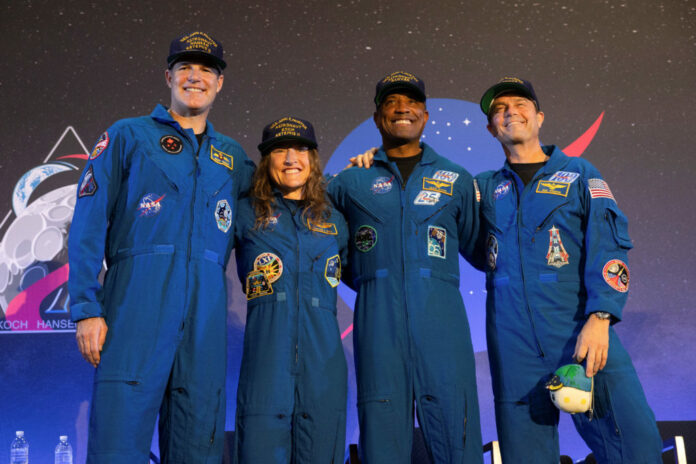
The capsule splashed down at 8:07 p.m. EDT, following a high-risk descent through Earth’s atmosphere. During reentry, the spacecraft reached speeds approaching 25,000 miles per hour, placing the astronauts among the fastest-traveling humans in history. On board were NASA astronauts Reid Wiseman, Victor Glover and Christina Koch, along with Canadian Space Agency astronaut Jeremy Hansen.
“What a journey,” Wiseman said as he floated in the Pacific Ocean inside the Orion capsule shortly after landing.
Recovery teams from the U.S. Navy quickly moved in, removing the astronauts from the capsule and transporting them by helicopter to the USS John P. Murtha. From there, they are expected to return to Mission Control in Houston for debriefing and evaluation.
The mission, launched on April 1, sent the crew on a lunar flyby without landing, allowing NASA to test life-support systems, propulsion, and navigation capabilities in deep space. Artemis II is the first crewed mission in NASA’s Artemis program to travel beyond Earth orbit, and its success is expected to pave the way for a planned moon landing later this decade.
With the mission now complete, attention is already turning to Artemis III, which NASA hopes will land astronauts on the lunar surface as early as 2028.
Following the successful splashdown, NASA officials expressed enthusiasm about what lies ahead and emphasized the significance of the mission’s achievements.
“It’s good to be NASA, it’s good to be an American today,” said Shawn Quinn at a post-mission news conference.
Lori Glaze, a senior NASA official overseeing exploration systems development, highlighted the broader impact of the mission, saying, “Welcome to our moonshot,” and adding, “NASA has shown that ambitious goals are worth pursuing and can inspire the world.”
Rick Henfling, the Artemis II entry flight director, pointed to key metrics that underscored the mission’s precision and success.
“Integrity and her crew of four astronauts flew 700,237 miles,” he said. “We reached a peak velocity of 24,664 miles per hour. We hit our flight path angle target within .4 percent. We flew an entry range of 1,957 miles and we landed within less than a mile of our target. What a tremendous day.”
He also described the tense moments surrounding reentry, widely regarded as one of the most dangerous phases of the mission.
“We all breathed a sigh of relief once the side hatch opened up,” he said. “We turned around to the families and waved to the families and gave them a thumbs up.”
NASA leadership framed the mission as the beginning of a new era in space exploration, with a long-term goal of sustained human presence beyond Earth.
“Fifty three years ago humanity left the moon,” said Amit Kshatriya. “This time we return to stay. Let us finish what they started. Let us focus on what was left undone. Let us not go to plant flags and leave but to stay with firmness in our purpose.”
Howard Hu, Orion program manager, said the agency will now study the mission’s data closely as it prepares for future flights.
“This is the start of a new era of human space.”