
 Vos Iz Neias
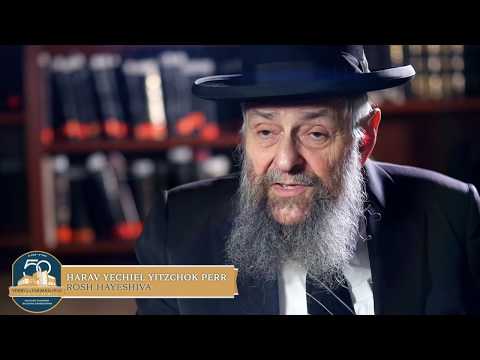
Rav Yechiel Yitzchok Perr zt“l A Tribute on the Second Yahrtzeit • 25 Iyar 5784
New York (VINNEWS/Rabbi Yair Hoffman) Two years ago, on the 25th of Iyar, 5784 — Erev Shabbos, May 3, 2024 — Klal Yisroel lost a Rosh Yeshiva, a Gadol, and a Mussar giant in Rav Yechiel Yitzchok Perr zatzal’s passing. He was 89 years old, the founder and Rosh Yeshiva of Yeshiva Derech Ayson (Yeshiva of Far Rockaway) in Far Rockaway, New York. Rabbi Perr was a close Talmid of Rav Aharon Kotler zt”l and took physical care of him during Rav Aharon’s last illness.
His Father: Rav Menachem Mendel Perr zt“l
To understand Rav Yechiel Yitzchok Perr, one must first appreciate the home and the father who shaped him. Rav Menachem Mendel Perr was a talmid of the Slabodka Yeshiva, a contemporary of Rav Aharon Kotler zt”l in that yeshiva, and served as the Rav of South Ozone Park, Queens, for over 50 years. He came to America on August 20, 1920, having been born in Drogierzyn, near Grodno. As a leading student of the famed Slobodka Mussar yeshiva in Europe, he transmitted that Mussar inheritance directly to his son.
He married Pearl Weinreb, daughter of Rabbi Yosef Weinreb, the Rav of Toronto — himself a scion of the distinguished Weinreb rabbinic family of Galicia, documented in Rav Meir Wunder’s Encyclopedia of Galician Sages. Rabbi Yosef Weinreb of Toronto descended from Rabbi Baruch Shlomo Zalka Weinreb of Bosk, a family that produced multiple generations of rabbinic figures across Galicia and Canada. Thus Rav Menachem Mendel Perr, himself a product of the great Slabodka yeshiva, married into a distinguished Galician rabbinic dynasty — and his son Rav Yechiel would later marry into the Novardok dynasty as well, combining three of the towering streams of Eastern European Torah into a single remarkable family.
Rav Menachem Mendel Perr was born on December 25, 1894, and spent the overwhelming majority of his rabbinic career in South Ozone Park, Queens, where he served his kehillah for over fifty years. In his final years, he relocated to Far Rockaway, Queens — the very community his son Rav Yechiel had built into a makom Torah — so as to be nearer his family. He passed away there in October 1981, having lived 86 years and having witnessed the flourishing of the yeshiva his son had established twelve years earlier.
The depth of Rav Menachem Mendel’s ahavas Yisroel expressed itself in a particularly poignant way in the years following World War II. Rav Menachem Mendel would actively seek out Jewish immigrants who had arrived from Europe, feeling a profound personal responsibility for their welfare and absorption into the community. His motivation, rooted in Slabodka’s philosophy of human dignity and Jewish kinship, was captured in the phrase “kulanu b’nei dodim” — we are all family, and therefore responsibility for every Jew rests on every Jew. This postwar chesed was a direct expression of the same character that made him a beloved rav in South Ozone Park for half a century.
Rav Menachem Mendel Perr was also a close enough confidant of Rav Aharon Kotler that he served as a primary historical source for Rav Aharon Sorotzkin’s authoritative biography of Rav Aharon, Aish HaTorah. The biography cites Rav Menachem Mendel directly as a witness to episodes in Rav Aharon’s life, including Rav Aharon’s fierce opposition to Brandeis University as a spiritually corrosive environment — more dangerous, Rav Aharon argued, than a secular university, because Brandeis presented itself under a Jewish banner while harboring kefirah within.
Rav Menachem Mendel also served as a source for accounts of Rav Aharon’s uncompromising standards of integrity, including his insistence that a yeshiva dinner to which he lent his name not derive even a single pruta of personal benefit for himself. His son Rav Yechiel Yitzchok Perr likewise served as an independent source for the same biography, testifying to Rav Aharon’s practice of delivering sharp mussar shmuessen to bochurim even at festive donor dinners — urging the young men not to waste their years and to throw themselves into avodas Hashem with urgency.
Rav Menachem Mendel Perr served as a lighthouse to lost and drifting Jewish neshamos. He was learned yet humble, eschewing the kavod of leading larger, more successful shuls, or even of just sitting on the mizrach vant. Instead, he chose to sit among his balabatim, gravitating toward those who talked in shul, seeking to improve their conduct without explicit tochachah.
He was a soft, shy person, but tough and unyielding when he saw a threat to kevod Shamayim. One telling incident: when Yechiel was just a young boy learning Mishnayos Bava Metzia with his father, they came across the halachah that if a Kohein tells his son to retrieve a lost item from a cemetery, the son may not obey. Reb Menachem Mendel paused, then said to his son: “Yechiel, I want you to know, if I ever tell you to do something that you think is wrong, you shouldn’t listen to me.” That lesson became a cornerstone of Rav Yechiel Perr’s own philosophy of life. It is a remarkable testament to Rav Menachem Mendel’s legacy that his son later memorialized him in the biography Tzidkus Stands Forever: The Life and Lessons of Rabbi Menachem M. Perr zt“l, published in September 2011 — thirty years after his passing.
Early Life and Yeshiva Years
Born on June 23, 1935, in South Ozone Park, Rav Perr was raised surrounded by Torah.
As a youth, Rav Perr attended Mesivta Yeshiva Rabbi Chaim Berlin, where Rav Avigdor Miller zt“l’s Slabodkan Mussar became second nature. After completing high school, Rav Aharon sent Rav Perr to learn at Yeshiva of Philadelphia and be a member of the group of the founding talmidim of the yeshiva, and then he continued at Bais Medrash Gavoha in Lakewood, where he learned under the Rosh Yeshiva, Rav Aharon Kotler, from 1954 to 1962.
Rabbi Perr would cry every year as he was maspid Rav Kotler on his yahrtzeit. In his final years, when asked about the last days of Reb Aharon’s life, he would begin to sob uncontrollably as if those events had occurred only hours earlier.
Marriage and the Novardok Connection
Rav Perr married his wife, Rebbetzin Shoshana, née Nekritz, daughter of Rav Yehuda Leib Nekritz, granddaughter of Rav Avraham Jofen, and great-granddaughter of the Alter of Novardok. One would never know that Rabbi Perr married into the family of Novardik — it was as if he were born into it. He referred to Rav Avraham Yaffen not as “Rabbi Yaffen” or “the Rosh Yeshiva,” but as “the Zaydie.” After his marriage, he went on to study at Yeshivas Beis Yosef-Novardok in Brooklyn, New York, incorporating the Novardok tradition deeply into his Mussar ouvre. The Yated Ne’eman Mussar profile describes Rav Perr as son-in-law of Rav Yehuda Leib Nekritz zt“l, Rosh Yeshiva of the Novardok Yeshiva in America, and identifies him as one who transmitted the authentic Novardok tradition to a new generation of American bochurim.
Thus Rav Yechiel Perr inherited Slobodka from his father, married into Novordok, and nurtured the next generation of Mussar adherents, becoming not only a prime teacher of Mussar in the last half century, but a reliable collector of anecdotes and historical data of the century before.
Later in life, he spent summers in Camp Bnos and davened in Camp Agudah, where in the Masmidim minyan he would often argue in learning with Rav Belsky zt“l after the Dvar Halacha given by Rav Michoel Levi shlita of Beis Yaakov D’Rav Meir.
Building the Yeshiva
In 1969, he established the Yeshiva of Far Rockaway. He led the yeshiva for decades together with the late menahel, Rav Ahron Brafman zt“l. They lived on Roosevelt Street in Far Rockaway — just blocks from the yeshiva he had built and into which he had poured his life. He would remain a fixture of that neighborhood for the rest of his days. The fact that he had come to a neighborhood where people were suspicious of bnei Torah, and not only allayed their suspicions but made those very people into bnei Torah, was remarkable — it changed the face of the whole area and redirected entire generations. Together with Rav Brafman, they changed the landscape of Far Rockaway and built a community where hundreds of alumni settled.
A particularly important dimension of Rav Perr’s vision was his deliberate decision to build a yeshiva that did not restrict itself to only the most elite bochurim. Rav Perr argued passionately from Mussar principles that a Rosh Yeshiva who accepts only the top tier of students abandons the broader Jewish community. Every Jewish boy, he believed, deserves access to authentic Torah education delivered with care and depth — and the educator’s responsibility extends precisely to those who might otherwise fall through the cracks. This philosophy shaped the entire character of Yeshiva of Far Rockaway and accounts for the extraordinary breadth of its alumni.
At the hesped, Rav Naftali Yeger explained that Rav Perr lived a life of kedushah in a society that pushed the opposite dictum, which enabled the Rosh HaYeshiva to understand how an American boy thinks, allowing his influence to make an impact felt forever.
His Mussar Legacy and Teachings
Rav Perr’s Mussar Vaadim were masterful works that inspired thousands. He taught deeply from the Alter of Novardok’s classical work, Madreigas HaAdam, knowing its contents thoroughly. Rav Yehuda Keilson published two books — Mind Over Man and Faith Over Fear — based on Rav Perr’s Mussar lectures on Madreigas Ha’adam, and David Jemal published Choosing Not To Choose in 2022, based on Rav Perr’s Mussar lectures on the Tekufos Ha’Olam section of the same work.
Some of his most penetrating Mussar teachings. On the topic of negi’os — inner biases that distort self-perception — Rav Perr taught that genuine self-knowledge (hakaras ha’atzmi) is wholly dependent on identifying one’s negi’os. A negi’ah is a deep inner pull that clouds a person’s vision of himself. A person can perceive everyone else’s qualities and failings with relative clarity — but what he cannot see objectively is what the people around him truly give him, because he is accustomed to receiving from them and his perspective is therefore distorted.
True self-knowledge, he taught, can only emerge through radical honesty — emes in its deepest sense. The path toward genuine self-improvement (avodos hamidos) runs directly through this honest accounting of one’s own soul.
He preached the Alter of Novardok’s intense form of bitachon, but also encouraged people far from that level to take, as he would say, “just a sliver of bitachon into our little pockets.”
A Living Chain of Transmission
One of the most precious dimensions of Rav Perr’s Mussar teaching was his role as a living conduit between the great European Mussar masters and the American talmid.
Both he and his father were a source of that connection. They vividly described Rav Aharon’s extraordinary diligence in preparing for Shabbos, his practice of receiving talmidim with words of encouragement before Yom Kippur, and his uncompromising standards of kedushah in every aspect of yeshiva life.
Rav Perr also transmitted directly in his father’s name the following teaching: guard well the thought, the speech, and the deed — for before them stand the malachei hashares, who possess a daas that penetrates to the inner secrets of a person.
His Koach HaTziur — The Power of Vivid Illustration
Rav Perr zt“l had a unique koach hatziur — a power of vivid illustration — which helped all his listeners relate to the emotional depth of what was being conveyed. An example of this in some of his thoughts from Bereishis:
And she bore Kayin, saying, “I have acquired a man with Hashem.” And additionally, she bore his brother Hevel. (Bereishis 4:1–2)
The differences that human beings have in their separate spiritual journeys are illustrated in the Torah almost at its very beginning, with the story of Kayin and Hevel. It may not have been an innate shortcoming in Kayin. His mother had named him Kayin out of the thrill of having borne him. He was her precious acquisition. And every time she called him by his name, he heard the importance of acquisition, of ownership. We are not told why Chavah then called her second son Hevel — but the name speaks for itself. Hevel. Vanity. Emptiness. “Everything is empty.” Now it was Kayin who first conceived the idea of thanking Hashem with a sacrifice. Yet Kayin would not give the best of his produce. After all, the best was the most valuable — and Hashem doesn’t need the best, does He? Hevel, on the other hand, had no problem bringing the best. Who needs the best? All acquisitions are emptiness. Kayin was then zoche to a “mussar shmuez” from the Creator Himself. Sin, he is told, lies at the door. It is waiting for you to go anywhere, do anything. But sin desires you — it needs you! Therefore, you are its master, and you can control it. Just don’t open the door!
We can picture the excitement with which Kayin shared this vital information with Hevel. “And Kayin said to Hevel his brother…” (Bereishis 4:8). Perhaps it was this that Kayin said: “You hear, Hevel? Just be aware when you open the door!” But Hevel didn’t respond. He was not concerned with the sin lying at the door. He had no interest in going through that door or any other door. He had no need to conquer or acquire the world. Havel havalim — all is emptiness.
Kayin saw Hevel’s lack of interest, and suddenly realized that he alone faced a lifetime of struggle. When Kayin understood this, he was filled with rage over the unfairness of it all. He could no longer live with Hevel. “…and it was when they were in the field that Kayin rose against Hevel his brother and he killed him” (ibid., v. 8).
His Courage and Advocacy
Aside from his deep mehalech haLimmud and unique Mussar insights, Rav Perr cared deeply for Klal Yisroel — helping agunos throughout his life, standing up for the downtrodden, the poor, baalei teshuvah, geirim, and standing strongly for kiruv. Whenever a danger to Klal Yisroel arose, he stood at the forefront to stop it. Rav Perr was one of the first to stand strong against molesters in Jewish education. He challenged others in yashrus, backing the following declaration when others did not:
We, the undersigned, affirm that any individual with firsthand knowledge or reasonable basis to suspect child abuse has a religious obligation to promptly notify secular law enforcement. Lives can be ruined or ended by unreported child abuse. The Torah’s statement in Leviticus 19:16, “Do not stand by while your neighbor’s blood is shed,” obligates every member of the community to do all in one’s power to prevent harm to others.
He lent strong support to others who swam against the tide to make things better for Klal Yisroel, and was an unabashed supporter of the need for Mussar and for strengthening its study everywhere.
The Levayah and Legacy
At the levayahs on Sunday in Far Rockaway and Monday in Eretz Yisrael, the maspidim included Rav Yisrael Reisman, Rav Malkiel Kotler, Rav Moshe Hillel Hirsch, Rav Binyamin Carlebach, Rav Yaakov Bender, Rav Moshe Brown, and Rav Perr’s sons and talmidim. Rav Yaakov Bender and Rav Malkiel Kotler noted the way in which the Rosh Yeshiva opened the world of his rebbeim and the gedolei Torah of Europe to his talmidim, despite the fact that Rav Perr was born and raised in the US. Rav Chaim Bressler called Rav Perr “an investor in neshamos” who always paid homage to his parents.
His son, Rav Moshe Perr, a remarkable Talmid Chochom, is the current Rosh Yeshiva of Yeshiva Derech Ayson (Yeshiva of Far Rockaway). Many maspidim noted that his loss leaves talmidim both bereft but also filled with a new purpose: to carry on the lessons they learned from him.
The author can be reached at [email protected]