
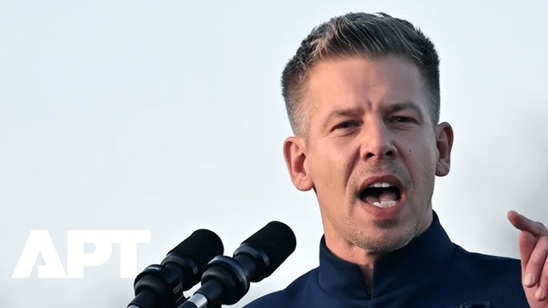

Early election results in Hungary are pointing to a dramatic political shift, with Prime Minister Viktor Orban appearing headed for defeat after 16 years in power as opposition leader Péter Magyar’s party surges to a commanding lead.
With approximately half of the votes counted, projections show Magyar’s party capturing 136 out of 199 parliamentary seats, comfortably surpassing the 133-seat threshold needed for a two-thirds majority.
Such a result would hand the opposition sweeping authority, including the ability to change the constitution and roll back policies put in place during Orban’s long tenure.
By comparison, Orban’s ruling Fidesz party is expected to secure just 63 seats, marking a sharp decline in support.
Magyar stated that Orban had already reached out to acknowledge the outcome. In a public statement, Orban conceded defeat, saying, “The results are clear and they are painful for us. I congratulated the party that won. We will continue to serve the people from the opposition.”
Speaking earlier from Budapest, constitutional law expert Yaniv Roznai of Reichman University emphasized that Magyar represents a unique figure within Hungarian politics. “He comes from within the ruling camp itself,” Roznai said. “He is a right-wing candidate, but one capable of replacing the current government.”
Roznai explained that dissatisfaction among younger voters has been driven in part by economic pressures and Hungary’s tense relationship with the European Union. “They feel the country is missing out on funding because it does not meet European standards on judicial independence, rule of law, separation of powers, and human rights,” he said. He added that everyday concerns—such as the economy, healthcare, and education—have also played a significant role in shaping voter sentiment and fueling the push for change.
Addressing the outlook for Hungary’s Jewish community, Roznai described a nuanced situation. While Orban’s government has been viewed as supportive of Israel and aligned with Prime Minister Netanyahu, some of its political messaging—particularly efforts to link Magyar with figures like George Soros and Volodymyr Zelenskyy—has drawn criticism as antisemitic.
According to Roznai, a Magyar-led government is not expected to bring major changes for the Jewish community. “He is also a right-wing figure, opposed to immigration, so policy in that area is not expected to shift significantly,” he said, adding that Hungary’s Jewish population remains a key constituency. At the same time, he noted that Hungary’s future foreign policy direction toward Israel remains unclear.