
 Matzav
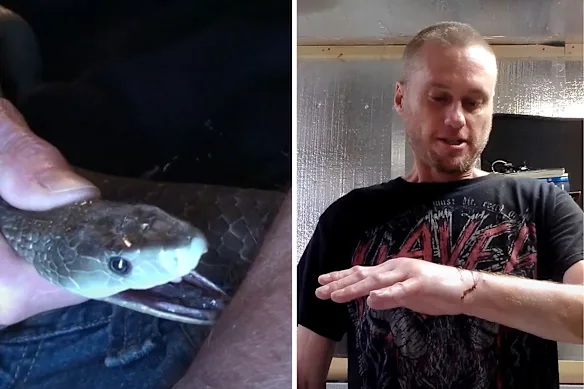
Man Intentionally Bitten by Snakes Over 200 Times in Unusual Quest for Universal Antivenom
A 58-year-old man has subjected himself to more than 200 snake bites over nearly two decades in an effort to develop immunity that could help create a broad, potentially universal antivenom, a breakthrough researchers say could save thousands of lives worldwide.
The effort comes as experts warn that climate change is expected to increase human encounters with venomous snakes. In response to this growing threat, Tim Friede deliberately exposed himself to repeated snake bites in hopes of building resistance that could later be used for medical purposes.
For close to 20 years, Friede allowed some of the world’s most dangerous snakes to bite him as part of a self-driven mission to develop immunity. His goal was to eventually contribute to the creation of a universal antidote to snake venom.
The extraordinary and often dangerous undertaking, carried out without formal scientific training in the basement of his Wisconsin home while he worked as a window cleaner, nearly cost him his life. At various points, he almost lost his leg and fingers, and at one stage fell into a coma.
“People said I was crazy, of course. There were people who tried to stop me,” he told The Guardian. “I knew it was dangerous but people die from snakebites and that made me angry. I couldn’t get it out of my head. I put myself at risk and I’m glad I did it.”
His efforts may now be yielding results. Scientists say his antibodies could help pave the way for a new type of antivenom capable of preventing some of the estimated 138,000 deaths and 400,000 serious injuries caused annually by snake bites, most of them affecting poor populations in Asia and Africa. Globally, up to 5.5 million people are bitten by snakes each year.
Treating snake bites remains challenging because different species require different antivenoms, with hundreds of dangerous species capable of harming humans. Centivax, a California-based vaccine company where Friede now works, is attempting to develop a near-universal antivenom using the antibodies he built up through repeated exposure.
Friede was exposed to venom from “very deadly snakes that would normally kill a horse,” according to Centivax CEO Jacob Glanville, who has reviewed the research. A study conducted last year found that Friede’s antibodies were able to neutralize toxins from 19 snakes in the elapid family, which includes roughly half of all venomous species, such as cobras, mambas, taipans, coral snakes, and kraits.
Testing of the new antivenom is expected to begin on animals in Australia later this year, before any potential human use. Reflecting on his unusual path, Friede said, “I wanted to make sure all of this wasn’t for nothing, so people couldn’t say I was an idiot for doing it.”
“I knew I was immune and that I could help bridge that gap, and I’m confident that I did. I wanted to do this for humanity, for the people most at risk on the planet.”
Beginning in 2001, Friede started injecting himself with small amounts of venom mixed with saline in order to gradually build immunity before eventually allowing snakes to bite him directly, typically on his forearms or fingers.
“For me it was a puzzle of how to not die from a snake bite. I wanted to figure out a way to become immune,” he said. Friede continued working as a window cleaner while pursuing his self-taught experiments, maintaining a collection of about 60 snakes in the basement of his home in Two Rivers, Wisconsin. The snakes were purchased from a breeder in Florida and shipped to him in wooden crates, secured in sealed bags.
One early experiment nearly ended in disaster. On September 12, 2001, Friede allowed himself to be bitten by a monocled cobra and then an Egyptian cobra—two of the world’s most dangerous snakes—and fell into a coma for several days.
“If my neighbor hadn’t been there to call emergency services, I would have died in 15 minutes,” he said. “I know what it’s like to be almost dead. Cold and dark, you can’t talk, my body just froze. I could still think and hear everything around me.”
Despite concerns from his wife—whom he has since divorced—Friede quickly resumed his efforts, believing that real bites were necessary to accurately simulate actual encounters with venomous snakes.
Over the years, he suffered additional severe injuries and near-death experiences. He lost consciousness multiple times due to anaphylactic shock, one of his fingers turned black and nearly had to be amputated after a particularly severe bite, and venom from a cobra caused significant muscle damage in his leg.
Describing the pain, Friede said a snake bite feels “like a bee sting, but 1,000 times worse, it just hurts terribly and there’s nothing you can do about it.” He added that some of the most dangerous snakes, such as certain cobras, inject necrotic venom that destroys body tissue.
In total, Friede endured more than 200 bites, nearly half of them from mambas.
He eventually developed immunity to one of the most venomous snakes in the world—the taipan, native to semi-arid regions of Australia. A single bite from a taipan can contain enough venom to kill more than 100 people.
“It was a big goal of mine to beat taipan. I spent four months preparing for it to build up my immune system,” he told The Guardian. “I knew that if I could beat that I could beat anything. Now I’ve been bitten 22 times by a taipan, so now I can say I can do it.”