
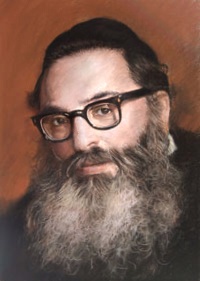

New York (VINNEWS/Rabbi Yair Hoffman) Rav Yitzchok Hutner zt”l (March 6, 1906 – November 28, 1980 – 20 Kislev) was undoubtedly one of the most brilliant Torah minds of the last century. His utter mastery of the entire oeuvre of Shas, Midrashim, Kaballah, Maharal, and even secular philosophy, history, and world events reflects something that it is clear he purposefully hid. And as he once wrote to Rav Kook’s son, Rav Tzvi Yehudah Kook, in 1961, I find that I now understand the Rebbe far more than many of those who supposedly grasped his teachings immediately.
The article below is somewhat speculative (excluding of course the sections of Rav Hutner’s own thoughts), but this author believes that it helps capture some of the transformative events in Rav Hutner’s life and further helps illuminate much of his writings and hashkafos and how, perhaps, they may have been formulated. Let us begin with a relatively little-known event:
It was Sukkos of October 1943 — somewhere between the 13th and the 20th. Rav Hutner was already the Rosh Yeshiva of Chaim Berlin and had developed and formed some remarkable talmidim. On that Sukkos, his Sukkah had burned down. His talmidim were gathered around him, and Rav Hutner zatzal was bereft. He cried uncontrollably.
His tears, of course, came to the fore particularly because of the Nazi destruction of European Jewry — and in particular, Warsaw, the city where he had been born thirty-seven years earlier.
The Warsaw Ghetto was systematically burned down and destroyed by the Nazis on Erev Pesach of 1943 — between April 19th and May 16th — during the Warsaw Ghetto Uprising. SS commander Jürgen Stroop yemach shmo had ordered the building-by-building and block-by-block burning of residential buildings. Well over 50,000 neshamos were either murdered or deported for extermination, culminating in the destruction of the Great Synagogue on May 16, 1943. Nazi troops had used flamethrowers and incendiary bottles to burn down Jewish Warsaw, and by that date the entire area had been reduced to a smoking ruin. The SS General yimach shmo reported coldly: “There is no longer a Jewish district in Warsaw.”
His own Sukkah’s destruction brought out Rav Hutner’s deeply felt emotions. He cried out in painful agony: “Mein Sukkah brent! Varshaw hot gebrent!” — and he wept. The talmidim were bewildered, never having seen him like this. One talmid, still a bachur, approached him respectfully and said, “Rebbe, v’samachta b’chagecha gilt oich en tof shin gimel.” Rav Hutner composed himself and responded quietly: “Du bist gerecht.”
The words hung in the air. In that moment, the Rebbe had allowed his talmidim a rare glimpse behind the curtain — into the depths of a soul that carried Warsaw within him always.
The Hidden Man
To truly understand Rav Hutner zt”l, one must first understand what he chose to conceal. His public persona — the commanding Rosh Yeshiva, the author of the thoughts in the magisterial theological and Mussar work Pachad Yitzchak, the fearless leader who once stared down hijacking terrorists on a Jordanian tarmac in 1970 — concealed much of his ability to synthesize a remarkable world view.
Rav Hutner had been a student of the Alter of Slabodka, Rav Nosson Tzvi Finkel zt”l (1849–1927), the towering architect of the Mussar movement’s most life-affirming stream. One of the Alter’s central ideas was that of Gadlus HaAdam, as seen in the remarkable work, Sichos HaSabba MiSlabodka.
GREATER THAN THE ANGELS
Man is greater than the angels in that he has freedom of choice, bechirah — something that the angels do not possess. In this, man reflects the Creator Himself (SHM p. 231). In a similar vein, only man truly perceives the idea of Kavod Hashem, the Honor of Hashem — angels do not (p. 654). We recite the Kaddish in davening every day — this is something that the malachim cannot do, and they wait in careful anticipation for man to recite it (p. 345).
EVEN A RASHA
Man was created with a Chailek Elokah mimaal — a Divine portion from Above. Even a Rasha, an evil-doer, possesses this in his possession of free choice (p. 75). Indeed, the world was created even for Rashayim — evil-doers — since they can choose to do Teshuvah by exercising their free will (pp. 288, 579).
THE WORLD CREATED FOR EACH INDIVIDUAL
The world was both created and continues to be renewed for each and every individual. In other words, one of the underlying themes of the Alter that were repeated many times was that even for the sake of each individual person, this world would have been created (pp. 222, 521, 530). He created the world for the ideal of freedom of choice; Hashem knew that Adam HaRishon would sin — but He created it for this point of bechirah (pp. 231, 274, 604).
MAN’S INITIAL LOFTINESS
The Alter was of the position that even after Adam HaRishon’s fall, mankind can still be on a very lofty, Divine level (pp. 636, 656, 573, 713). Indeed, he held that it was still possible for man to reach the lofty level of Adam HaRishon before his fall (pp. 275, 900). Man’s greatness is still retained, and man will be punished for not having realized this greatness (pp. 428, 796).
Man has remarkable kochos — unimaginable strengths and abilities (p. 879). This is why there is an obligation of emulating Hashem — because we have such a capacity. Man has the capability of seeing from one corner of the universe to the other (p. 240). That is why the Gemara tells us: Just as He is merciful, so too must you be merciful. Just as He is kind, so too must you be kind.
PRACTICAL IMPLICATIONS
Someone noticed that the Alter used to fast frequently, and discovered that he would fast whenever he saw a student not succeeding in his learning and growth. When asked why he did so, the Alter responded, “If one truly understood that each student is a ben melech — there is no other choice.” (Darchei Mussar p. 221)
There is no question that the topography of today’s Torah world would have been vastly different were it not for the vision and hard work of the Alter of Slabodka and his conception of Gadlus HaAdamA major component of his influence upon the world was his conception of Gadlus HaAdam and that the greatness of Adam HaRishon before the cheit can still be accessed.
Rav Hutner absorbed this teaching to its marrow — and then went somewhere his Rebbe had not. Rav Hutner turned his gaze inward. He wanted to know what was happening inside Adam HaRishon’s mind, as Dr. Dov Finkelstein pointed out in a Tradition article a number of years ago.
What was the psychological reality of Adam HaRishon when that reality was shattered, what remained hidden within us — dormant and waiting?
I am suggesting that these questions were not merely academic for Rav Hutner zt”l. They were personal, existential, and were forged, this author believes, in the fires of Warsaw.
The key to Rav Hutner’s entire psychological portrait of the human soul is a single fact that the Torah records almost in passing: Adam was created alone.
Every other species of animal was created as a group — as a species. They have no individual standard of wholeness, no personal telos to strive toward. Adam was different. He was one unique individual with one perfect standard. And from this, Rav Hutner zt”l builds an entire architecture of man’s neshama (Pachad Yitzchak: Shavuos 16:10; Pesach #48; Rosh Hashana 11:20–21).
Because Adam was singular, his descendants received two extraordinary gifts simultaneously: each person is utterly unique — since “the progenitor bestows his nature on his children” — and yet each person remains profoundly connected to every other neshama, since all of them share one father. The Mishnah captures both poles at once: “Bishvili Nivrah haOlam — The world was created for me” (Sanhedrin 4:5).
Adam could say this and mean it absolutely, without arrogance, because he never doubted his own infinite worth. And he felt genuinely at one with every soul that would ever exist, because all souls were contained within him. He experienced both immortality and unity — timelessness and deep interconnection.
Then death (read – Warsaw, the Churban of Europe, his entire world – gone) entered the picture.
Rav Hutner stresses that death caused not merely a physical rupture but a profound psychological break. When mortality arrived, Adam HaRishon, suggests Rav Hutner, began to doubt whether he and his descendants were truly of infinite worth. If the world was created for them, why would it continue without them? Death severed him from the felt sense of connection to other souls. And when people lose confidence in their own worth, they can no longer feel themselves joining together with others to build something greater. This lost sense of self-worth even affects how one relates to Hashem: if you are unsure whether you matter, you feel less grateful simply to be alive.
This is the hidden wound at the center of the human psyche. And it is the wound that Rav Hutner zt”l spent his entire life trying to heal — in his talmidim, in his writings, and within himself, and to the hijackers in 1970.
Warsaw and the Torah of the Churban
No event pressed more urgently upon Rav Hutner’s inner life than the Holocaust. And yet — and this is the key — Rav Hutner refused to allow the churban to be experienced as merely a catastrophe. His genius was to see in it something more: a turning point in the cosmic unfolding of Jewish history, one that carried within it the seeds of geulah — redemption.
And in a landmark address delivered on 12 Sivan 5736 (June 10, 1976) to approximately one hundred Menahelim assembled at Mesivta Rabbi Chaim Berlin — later published in The Jewish Observer — Rav Hutner laid out his Torah perspective on the Holocaust with characteristic precision and daring.
He began with the principle that “The Jewish people and the Torah are one” (Zohar, Acharei Mos 73). Whatever happens in the world to Klal Yisroel must have a counterpart in the Torah itself — and whatever trajectory the Torah describes for the Jewish people will, inevitably, unfold in history.
If you want to understand what is happening in the world, you must study Torah. And if you study Torah honestly, you will find the present moment already written there.
With this lens, Rav Hutner identified two entirely new directions in Jewish history that converged in the Holocaust, the Churban of Europe — neither of which had ever occurred before in all of our millennia of exile.
The first he called the era of disappointment. Throughout history, Jewish persecution by the nations of the world was, while horrific, at least consistent. The oppressors announced their hatred and acted on it. And then he elaborated upon world history. Beginning with the French Revolution and continuing through the Treaty of Versailles, Lenin’s Soviet Minority Rights Law, the Balfour Declaration, and most catastrophically the emancipation edicts of Germany — Jews were granted equality, welcomed into the family of nations, and then betrayed. Rights were given legally and taken away legally. The Nuremberg Laws of 1935 were drafted using the very legal categories that had been used to emancipate Prussian Jews in 1812. What had been granted was rescinded — and the Jewish neshama was left with a shattering, irreversible disillusionment.
Rav Hutner zt”l found this pattern encoded in Devarim (31:16–17): “This nation will arise and fall prey to the lure of strange nations and trust in them… and great evils and troubles will come upon them.” Following Onkelos, who translates the key phrase not as “idol worship” but literally as “the temptation of the nations,” Rav Hutner reads this as a precise description of modernity: the seduction of the Jewish people by the promise of equality and acceptance among the nations, and the punishment — in the form of the nations’ own betrayal — that followed.
But the pasuk continues: “Then shall they declare: it is because my G-d has not been in my midst that these evils have befallen me.” This declaration, as the Ramban explains, is not yet full teshuvah. It is proto-teshuvah — the first stirring of return. The lowest rung of evil is the disavowal of wrongdoing; once a person or a nation stops saying “I have not sinned,” the road to repentance has been cleared. The era of disappointment, precisely because it shattered the Jewish people’s misplaced trust in the nations, removed the first and greatest stumbling block to teshuvah. Out of the ash and ruin came — quietly, unexpectedly — an entire generation of baalei teshuvah.
Rav Hutner once found himself in Eretz Yisroel among a group of confirmed leftists on Ben Gurion’s yahrzeit and was asked to speak. He turned to each person in the room and asked: “Do you recall a mechalel Shabbos in your city who had a son who became shomer Shabbos?” Each answered with an emphatic no. Ben Gurion had believed that time was on the side of the secularists — and by his era’s own logic, he was right. But he could only calculate chronological time, said Rav Hutner. He knew nothing of the eschatological movement of generations. The era of disappointment had torn a generation loose from “the temptation of the nations” — and the Pachad Yitzchak saw in that tearing the first light of the final geulah.
This brings us back to the hidden light that Rav Hutner zt”l believed still lives within every Jewish Neshama, dormant and waiting.
He found its key in the luchos, the stone tablets of Har Sinai. The tablets were broken when the people sinned with the Golden Calf. But Rav Hutner insists: the light was not extinguished. Both the broken tablets and the second tablets were placed together in the Ark. Drawing on Bava Batra 14b — “Be careful with a wise elder who has forgotten his learning, because the tablets and the broken tablets were both placed in the Ark” — Rav Hutner teaches that just as a scholar who has forgotten his Torah still carries all of it within him, waiting to be reawakened, so the pre-sin light of the first tablets remains hidden within the Jewish people. Through learning the Torah of the second tablets, the light of the first is recovered. The dormant fire can be lit again.
Specific mitzvos serve as the key. The shofar on Rosh Hashana — the very day when Adam’s full spiritual experience “turned into a remnant” — works in reverse: it takes the remnant and transforms it back into a lived experience (Pachad Yitzchak: Rosh Hashana #20). Teshuvah reconnects a person to their source, precisely as the second luchos reconnect to the light of the first (Pachad Yitzchak: Yom Kippur #25). And Shabbos — which Rav Hutner said directly represents the pre-sin world — gives every Jew a weekly taste of Gan Eden (Pachad Yitzchak: Shabbos 7:10–11).
“Du Bist Gerecht”
Let’s return now to that October in 1943. The Sukkah burning. Warsaw burning. The Rebbe weeping.
The bachur who approached him and quoted v’samachta b’chagecha was in a sense doing exactly what Rav Hutner’s entire Torah demands: he was pointing his Rebbe back toward the hidden light. The obligation of joy on Yom Tov is not a denial of suffering. It is the assertion — rooted in Torah, engraved like letters in stone — that even in the most broken moment, the fire is still there. The broken tablets are still in the Ark.
Rav Hutner composed himself. And in that composure, one sees, perhaps, the full arc of his life’s work. Warsaw burned — and the Rebbe carried it. But he also carried the luchos, the shofar, the Shabbos candles, and the radical conviction that the pre-sin greatness of Adam HaRishon still lives within every Jewish neshama — waiting, dormant, for the moment when someone with the courage to say v’samachta b’chagecha helps awaken it once more and for the courage to stand before Palestinian terrorists hijacking innocents. Today is Yom HaShoah, a name that Rav Hutner zt”l was not into at all. But it is perhaps a time when we can reflect upon the hashkafos and Torah of a remarkable Gadol B’Yisroel and how his entire life’s mission of rebuilding Torah, has succeeded. Look at Yeshiva Chaim Berlin. Look at its Talmidim and all the Torah that has flowed from it. Look at their yungeleit. Look at their Alumni. And you will see how he remarkably he has succeeded.
The author is indebted to Rav Pinchas Stopler zt”l who first introduced me to the depth of Rav Hutner zt”l’s writings, to Dr. Dov Finkelstein’s groundbreaking article, “The Psychology of Human Greatness: Rav Hutner Between Slabodka and Psychoanalysis,” published in Tradition 54:2 (2022), for its illuminating analysis of the relationship between Rav Hutner’s thought and modern psychoanalysis and to the article published in The Jewish Observer (October 1977, Vol. XII, No. 8), translated and transcribed by Rabbi Chaim Feuerman shlita and Rabbi Yaakov Feitman, for its penetrating Daas Torah analysis of the Churban Europa within the broader framework of Jewish history.
The author can be reached at [email protected]