
 Vos Iz Neias
OP-ED: Israel Must Demand Compensation From Lebanon And Outlawing Of Hezbollah
JERUSALEM (VINnews) — Dr. Eddy Cohen is an Arabist and senior researcher specializing in analyzing media and political discourse in Arab countries. Cohen, born in Lebanon, is an expert in the history of Jews in Arab lands and in minorities in the Middle East. He shared his views on the direct negotiations currently taking place between Israel and Lebanon.
The Lebanese government, led by President Joseph Aoun and Prime Minister Nawaf Salam, has recently made repeated requests to conduct direct negotiations with Israel.
Prime Minister Benjamin Netanyahu officially announced this: “In light of Lebanon’s repeated requests to open direct negotiations with Israel, I have instructed the cabinet to begin direct negotiations with Lebanon as soon as possible,” he said less than a week ago. Netanyahu also addressed residents of northern Israel, clarifying that there is no ceasefire in Lebanon, while in Lebanon they are relying on direct negotiations to achieve a ceasefire.
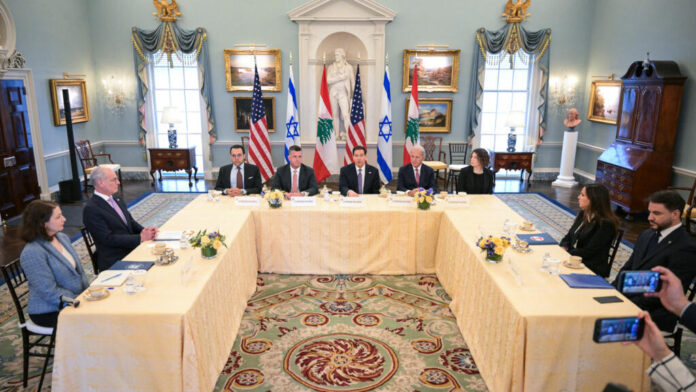
In any case, the talks were held on Tuesday for the first time in the United States between Israel’s ambassador to the U.S., Yehiel Leiter, and Lebanon’s ambassador to the U.S., Nada Hamadeh Mouawad, with American mediation. This marks the first open direct negotiation between the two countries since the 1980s, aside from the indirect maritime agreement of 2022. An atmosphere of optimism emerged from the meeting. The Israeli ambassador conveyed strong optimism: “The talks were excellent, in a great atmosphere. We are united in the need to free Lebanon from Hezbollah.”
The question now being asked is: why now? Why are the Lebanese, who until recently boycotted Israel, declared us enemies, refused to be photographed with Israelis at international events, and stigmatized anyone supporting normalization, now seeking, even pleading for, direct negotiations? The simple answer is: they want a ceasefire and fear that the ongoing war between Israel and Hezbollah will expand and damage the country’s interests to the point of collapse.
It is important to note that the Lebanese government and much of the Lebanese public are not particularly concerned about Hezbollah, except for the Shiite community. Any harm to Hezbollah serves the interests of the Lebanese establishment and most of the population. Southern Lebanon is already largely devastated. The south, long neglected by successive Lebanese governments, is of little interest to the Lebanese elite.
However, now that Israel has begun striking buildings in Beirut, alongside warnings of attacks on strategic sites throughout Lebanon, and not just in the south, Lebanese leaders understand they must achieve an immediate ceasefire. Not out of love for Israel or concern for northern Israeli residents, but out of fear of a broader escalation that would severely damage what remains of Lebanon.
We should remember that the country is in a severe economic and social crisis, and the war with Israel, triggered by Hezbollah joining the “Swords of Iron” war in October 2023, has caused widespread destruction in southern Lebanon, heavy casualties, and mass displacement from the south toward Beirut and further north. The Lebanese leadership-Aoun, Salam, and Parliament Speaker and Amal Movement leader Nabih Berri- hopes to restore state sovereignty, disarm Hezbollah or at least weaken it, stop the fighting, and secure international aid. They see direct negotiations as an opportunity to separate “the State of Lebanon” from “the State of Hezbollah” and save the country from collapse. In contrast, Hezbollah, led by Naim Qassem, strongly opposes this, calling it a “humiliating surrender.”
From Israel’s perspective, Netanyahu emphasizes that the negotiations will focus on disarming Hezbollah and achieving a historic peace arrangement, and Israel does not agree to a ceasefire in advance. In Lebanon, however, officials clarify that the purpose of direct negotiations is solely to achieve a ceasefire and nothing more. No one on the Lebanese side is talking about normalization.
A preliminary security agreement with Lebanon may be achievable. The points of dispute are not numerous. Lebanon demands a ceasefire, Israeli withdrawal, and arrangements for existing border disputes. There are still 13–14 disputed points along the land border, including Rosh HaNikra, the Shebaa Farms, Mount Dov, and the village of Ghajar. These are not currently the top priority but may arise later.
As someone who was born and raised in Lebanon and knows the country well, I can say with certainty that a significant portion of the population wants normalization with Israel. Another segment wants to be saved from Hezbollah, as they believe they were saved from the Palestinians in 1982 during the 1982 Lebanon War, which led to the election of Bachir Gemayel as president. However, we all know what happened after his election and assassination.
Israel must think outside the box and conduct a different kind of negotiation. Even if Hezbollah is involved, the Lebanese establishment is responsible for it, and this has been the consistent claim of Israeli leaders. In my view, the first clause in the negotiations must focus on the Lebanese side. Israel should demand that Lebanon pay compensation for all damages caused by Hezbollah. After all, Hezbollah is a Lebanese organization, and Lebanon initiated the last two wars against Israel, not the other way around. Demanding compensation would also serve as a deterrent in the near future.
Additionally and most importantly, Israel must demand that the Lebanese government designate Hezbollah as a terrorist organization. While it may be difficult for Lebanon to disarm Hezbollah, it should not be difficult to pass a government resolution to this effect. Without such a designation, there is no point in continuing negotiations. Such a definition would prevent Lebanon and its leaders from playing a double game, a tactic our enemies excel at.
Perhaps it is time to learn from the Iranians how to conduct negotiations. From the Jibril deal to the Gilad Shalit deal, Israel has not exactly excelled in negotiating with its enemies.