
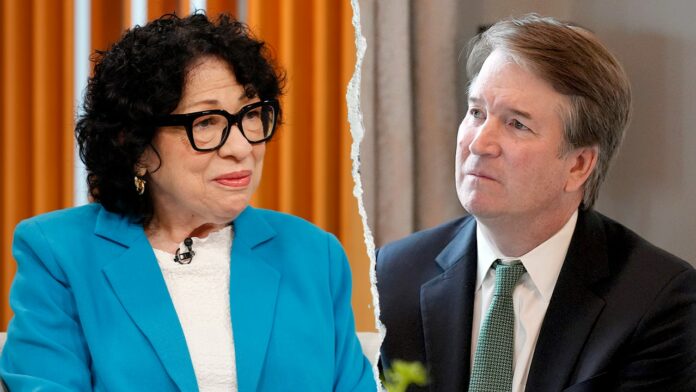

Supreme Court Justice Sonia Sotomayor said she regrets comments she made about a colleague during a recent public appearance, calling her remarks “inappropriate” and confirming that she has issued a personal apology.
“At a recent appearance at the University of Kansas School of Law, I referred to a disagreement with one of my colleagues in a prior case, but I made remarks that were inappropriate,” Sotomayor said in a statement issued by the court, Politico reported.
“I regret my hurtful comments. I have apologized to my colleague.”
Her statement followed comments she delivered last week in Lawrence, Kansas, where she spoke critically about another member of the court—widely understood to be Justice Brett Kavanaugh—regarding his stance in an immigration-related case.
Although she did not mention him by name, Sotomayor alluded to his concurring opinion in Noem v. Perdomo, which involved an unsigned order allowing immigration enforcement operations in Los Angeles to resume.
During her remarks, she challenged what she suggested was a limited perspective on how such enforcement actions impact workers.
“I had a colleague in that case who wrote, you know, these are only temporary stops,” she said. “This is from a man whose parents were professionals. And probably doesn’t really know any person who works by the hour.”
In his concurrence, Kavanaugh stated that interactions between lawful residents and immigration authorities are “typically brief.”
Sotomayor argued that even short encounters can carry meaningful consequences, particularly for workers paid by the hour, who may lose wages or face job-related repercussions.
She said such interactions carry “financial consequences” that may not be fully appreciated in the court’s legal analysis.
The episode underscores continuing ideological divides within the Supreme Court, especially in cases involving immigration policy and the tension between enforcement authority and individual rights.
At the same time, public criticism between justices—particularly when perceived as personal—has drawn attention and concern in the past.
Sotomayor’s apology represents a relatively rare moment in which a sitting justice has publicly expressed regret for remarks directed at a colleague.
The court has faced heightened scrutiny in recent years over its internal dynamics and public credibility, with ongoing calls for increased transparency and stronger adherence to ethical standards.