
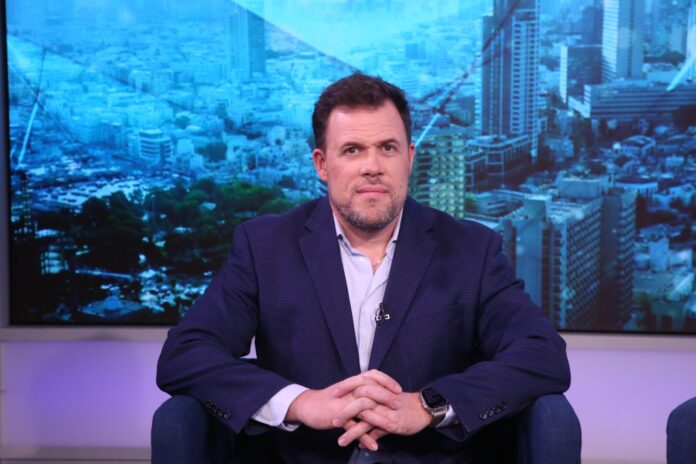

Jonathan Conricus (born August 14, 1979) is a retired Israel Defense Forces (IDF) lieutenant colonel who served for approximately 24 years in a range of combat, command, diplomatic and public affairs roles. He served as a combat officer in the Givati Brigade, including operational service in Lebanon and the Gaza Strip, and he later held positions in military diplomacy and international relations.
He was seconded to United Nations Headquarters in New York, where he worked on strategic analysis and coordination related to UN peacekeeping operations, becoming one of the first IDF officers assigned to that role.
Conricus served as the international spokesperson for the IDF from 2017 to 2021 and returned to the role in 2023 during the Israel-Hamas war, becoming one of its most visible global media representatives.
Following his military service, he became a senior fellow at the Foundation for Defense of Democracies (FDD), a Washington, DC-based think tank focused on national security and foreign policy.
Let’s start with your perspective on the war. How surprised, impressed or disappointed are you with the fact that Israel and the United States have fought—or are still fighting; I’m not sure what the current status is—against Iran?
To begin with, I’m very satisfied with the fact that the US and Israel are fighting together against this evil—an enemy of the free world, an enemy of democracy, an enemy of Israel, the US and many other Western countries who aren’t able to fight for themselves. The fact that we are fighting together in an unprecedented way is in itself a very important milestone that I think will have long and far-reaching positive consequences for Israel.
Second, I would say that I’m deeply impressed and grateful for the professional level of fighting by the Israeli Air Force, the Mossad and their American counterparts. I think they’ve done an outstanding job in military terms of outsmarting, outflying, outfighting and outmaneuvering a significant enemy. I’m very grateful that we haven’t had any combat casualties. It’s sad, of course, to see American servicemen wounded and killed by Iranian rockets, missiles and drones, and of course there are the Israeli civilians who were killed, but we haven’t had military casualties, which I think is a testament to the level of professionalism.
The achievements on the ground, militarily speaking, are very good. They aren’t yet sufficient, but they are progress in the right direction. In this sense, I choose to assess what’s going on now as a big and very important chapter in the ongoing story of the battle between the Islamic Republic of Iran and Israel. It is by no means the last chapter. The last chapter will be the fall of the regime and the demise of that empire of evil and the victory of Israel, but this chapter is the first substantial one that starts to tell the story in a very positive way.
What I’m less satisfied with is the fact that the cruel, oppressive, terrorist supporting regime of Iran has now been given an opportunity to catch their breath and recover from the military beating that they’ve been getting, and that they have the chance to wiggle out of this situation using diplomacy. I’m not happy with the fact that there’s a ceasefire, because I think there’s still so much more that needs to be achieved against the Islamic Republic.
I am happy that Hezbollah, which for many years was the most daunting and menacing enemy that Israel had close to its borders, to the point that it really deterred and influenced Israeli decision making, is now at the lowest point I’ve ever seen it in history, and there are positive prospects for the future for the continued degradation of their military capabilities and for possible developments with the State of Lebanon, which was inconceivable and impossible until recently.
I’m not naïve, but I am happy that there are going to be direct peace talks tomorrow in the US thanks to American diplomacy, which I think is a positive step forward.
You said a lot of things, so let’s break some of that down. You started with the unprecedented alliance between the air forces of the United States and Israel. I’ve asked a number of professionals this question, and I’ll ask you as well: How do you perceive the division of tasks between the two? Are they both doing the same thing and just taking turns?
As far as I understand from Israeli pilots, planners and operators, there’s a division of labor based on the specific advantages and strengths of each air force. The American strength is mass—the ability to provide strategic logistics, airlifts, firepower, and a large number of planes and assets. They’re also well equipped with signals, electronic warfare, jamming and communications.
Both air forces have very strong guided munitions and strike capabilities, with Israel probably having a slight advantage because it’s so combat experienced. There’s also an ability to plan at a very high level of detail—how to strike, where to strike, at what angle, at what depth, and with what payload—to achieve optimal combat results. The IDF may have more experience in that regard than almost any military in the world.
The Israeli Air Force is also very good at quick turnaround, with short maintenance intervals and the ability to get planes back up for continuous operations in a short period of time. In terms of intelligence and strike capabilities, though, I think the militaries are broadly similar, although the IDF has extensive experience striking targets in densely populated areas.
From what I understand from Israeli pilots, there’s a very positive division of labor: whichever side has the greatest advantage or capability for a specific task is assigned to carry it out. So far, that approach has worked extremely well.
Are you surprised by the level of coordination between two completely separate air forces?
I am. I’ve participated in joint exercises with the US Air Force and air defense units, and we’ve done a great deal of planning, intelligence sharing, drills and simulations, but that’s very different from reality. Real-world conditions are volatile, dynamic, fast-paced and high-pressure, and I’m very impressed by both the level and quality of cooperation under those circumstances.
The way the US and Israel were able to extract the two downed American pilots was truly masterful. That represented the highest level of real-time coordination. While the US, with Israeli support, carried out that rescue and brought the airmen out safely, other operations continued simultaneously. Highly complex aerial missions—striking targets across Iran from multiple locations, while managing air traffic control conflicts and other challenges—continued without disruption. That speaks to an exceptionally high level of military coordination.
Yes, it is surprising. I didn’t expect this level of integration to come together so quickly and so effectively, without significant incidents between the US and Israel. There were accidents involving the US and Kuwait, which sadly resulted in the loss of American aircraft. But in terms of US-Israel coordination, quite remarkably—and as a testament to the professionalism of both air forces—there have been no major incidents. That’s something that shouldn’t be taken for granted.
To read more, subscribe to Ami

