

President Donald Trump said a temporary ceasefire between Israel and Lebanon will take effect tonight, outlining a 10-day pause aimed at opening the door to broader negotiations between the two countries.
In a statement posted on Truth Social, Trump wrote: “I just had excellent conversations with the Highly Respected President Joseph Aoun, of Lebanon, and Prime Minister Bibi Netanyahu, of Israel. These two Leaders have agreed that in order to achieve PEACE between their Countries, they will formally begin a 10 Day CEASEFIRE at 5 P.M. EST.”
He went on to describe recent diplomatic efforts, adding: “On Tuesday, the two Countries met for the first time in 34 years here in Washington, D.C., with our Great Secretary of State, Marco Rubio. I have directed Vice President JD Vance and Secretary of State Rubio, together with the Chairman of the Joint Chiefs of Staff, Dan Razin’ Caine, to work with Israel and Lebanon to achieve a Lasting PEACE. It has been my Honor to solve 9 Wars across the World, and this will be my 10th, so let’s GET IT DONE! President DONALD J. TRUMP”
In a subsequent post, Trump said he plans to bring both leaders to Washington, writing that he will invite them for “the first meaningful talks between Israel and Lebanon since 1983, a very long time ago. Both sides want to see PEACE, and I believe that will happen, quickly!”
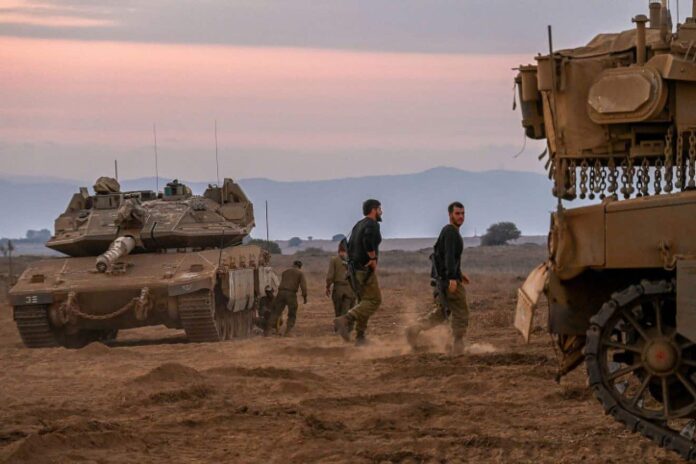
Despite the announcement, Israeli officials indicated that military positions on the ground will remain unchanged during the ceasefire period. A senior Israeli source told Reuters that the IDF is not preparing to pull back from southern Lebanon.
Under the arrangement, Israeli forces will continue holding the so-called “anti-tank line,” the furthest distance from which anti-tank missiles could threaten Israeli communities, and will maintain control of key elevated positions throughout southern Lebanon.
Officials further stressed that Israeli forces will retain freedom of action, noting that if Hezbollah or other hostile elements pose an immediate danger, the IDF will act to neutralize the threat.
Lebanese Prime Minister Nawaf Salam publicly welcomed the development, calling it “a central Lebanese demand we have pursued since the first day of the war, and was our primary goal in the Washington meeting on Tuesday.”
He continued: “As I congratulate all Lebanese on this achievement, I pray for the martyrs who fell, and affirm my solidarity with their families, with the wounded, and with the citizens who were forced to flee their cities and villages, and I hold full hope that they will be able to return to them as soon as possible.”
Salam also expressed appreciation to international players involved in the diplomatic effort, thanking “the regional and international efforts exerted to reach this outcome, especially those by the United States of America, France, European Union countries, and all Arab brothers, led by the Kingdom of Saudi Arabia and the Arab Republic of Egypt, in addition to the State of Qatar and the Hashemite Kingdom of Jordan.”
In Israel, opposition leaders sharply criticized the move. Yesh Atid Chairman Yair Lapid said: “Not for the first time, all the promises of this government are crashing into reality.”
He added: “The confrontation in Lebanon can only end with the removal of the threat to the northern communities permanently. Under this government, that will no longer happen.”
Yisrael Beytenu Chairman MK Avigdor Liberman also voiced strong opposition, stating: “The ceasefire in Lebanon is treason against the residents of the north. We again allow Hezbollah to recover and become stronger. We can not end the war without a clear decision and the elimination of Hezbollah.”
Earlier Thursday, Axios reported, citing a Lebanese presidential source, that Trump had already informed President Joseph Aoun that a ceasefire decision had been finalized and would take effect within hours.
An Israeli official confirmed that Washington has been pressing for an agreement, and while discussions are advancing, a final deal has not yet been formally completed.
According to various reports, U.S. officials initiated the diplomatic push, believing that direct engagement between Israel and Lebanon could pave the way for either a temporary or permanent cessation of hostilities.
Even as optimism grew around the ceasefire announcement, Hezbollah responded with renewed attacks. Shortly after reports of the agreement surfaced, the group fired five missiles toward Haifa and surrounding areas. Some were intercepted by Israel’s Iron Dome system, while others landed in open areas.
A day earlier, Trump had signaled his intentions in another Truth Social post, writing: “Trying to get a little breathing room between Israel and Lebanon. It has been a long time since the two leaders have spoken, like 34 years. It will happen tomorrow. Nice!”
However, behind the scenes, diplomatic friction persisted. A Lebanese source claimed that when Secretary of State Marco Rubio suggested including Prime Minister Benjamin Netanyahu in a joint call with President Aoun, the Lebanese leader strongly rejected the idea.
After Aoun declined to participate in the proposed three-way conversation, Rubio informed him that Trump would resume discussions at a later time. Lebanese reports indicated that Aoun “insisted on an immediate ceasefire” and was assured that U.S. efforts would intensify.
Meanwhile, fighting on the ground continued. Earlier in the day, a rocket barrage struck the northern city of Kiryat Shmona, with one missile directly hitting a building. Emergency responders from Magen David Adom said no injuries were reported, though the strike caused significant property damage.