
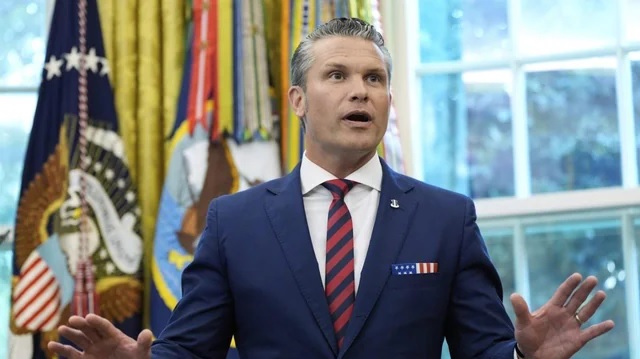

War Secretary Pete Hegseth said Thursday that the United States is fully prepared to intensify military action against Iran if diplomatic efforts collapse, emphasizing that American forces are ready to act immediately if ordered.
Speaking at his weekly Pentagon briefing alongside Chairman of the Joint Chiefs of Staff Gen. Dan Caine and CENTCOM Commander Admiral Bradley Cooper, Hegseth declared, “We are locked and loaded on your critical dual-use infrastructure, on your remaining power generation, and on your energy industry,”
He added that while the U.S. would prefer to avoid further conflict, it stands ready to proceed without delay. “We’d rather not have to do it, but we’re ready to go at the command of our president and at the push of a button,” Hegseth told reporters, with his comments airing live on Newsmax and Newsmax2.
Addressing Iran’s military leadership directly, Hegseth argued that the disparity in strength between the two sides is overwhelming.
“Our capabilities are not the same,” he said. “Remember, this is not a fair fight. We know what military assets you are moving and where you are moving them to.”
He described Iran’s current position as severely weakened, claiming its military infrastructure has been badly damaged and cannot be rebuilt.
“You are digging out of bombed-out and devastated facilities,” Hegseth said. “You are digging out your remaining launchers and missiles with no ability to replace them. You have no defense industry, no ability to replenish your offensive or defensive capabilities. You only have what you have.”
In contrast, Hegseth said the United States continues to reinforce its own military capabilities.
“You can dig out for now, but you can’t reconstitute. But we can,” he said. “We are reloading with more power than ever before and better intelligence, even more importantly, better intelligence than ever before.”
He characterized the current U.S. posture as an ongoing naval blockade and dismissed Iranian claims of control over the Strait of Hormuz.
“You like to say publicly [to] Iran, that you control the Strait of Hormuz, but you don’t have a navy or real domain awareness. You can’t control anything,” he said. “Threatening to shoot missiles and drones at ships, that is not control. That’s piracy. That’s terrorism.”
Hegseth also highlighted what he described as U.S. dominance in the region’s waterways.
“The United States Navy controls the traffic going in and out of the strait, because we have real assets and real capabilities,” Hegseth said. “We’re using 10% of the world’s most powerful navy, and you have 0% of your navy. That’s real control.”
He indicated that the blockade could be sustained indefinitely but warned that failure to reach an agreement could lead to further military action.
“We can do this all day,” he said. “But if Iran chooses poorly, then they will have a blockade and bombs dropping on infrastructure, power, and energy.”
Hegseth noted that the pressure campaign extends beyond military measures to include economic steps coordinated with the Treasury Department.
“Treasury Secretary Scott Bessent and our friends over at Treasury are launching Operation Economic Fury as well, maximizing economic pressure,” he said.
Bessent said during a White House briefing on Wednesday that the administration intends to increase sanctions and financial pressure on Iran, describing the effort as the “financial equivalent” of a bombing campaign.
Hegseth said the military remains capable of rapidly shifting back into full-scale combat operations if directed.
“The world watched as the U.S. military moved seamlessly from major combat operations to a world-class blockade,” he said. “We can make that transition again very quickly and even more powerfully than ever at the direction of President [Donald] Trump.”
He closed by underscoring the administration’s core objective regarding Iran’s nuclear ambitions.
“The War Department will ensure that Iran never has a nuclear weapon, never,” Hegseth said.
While reiterating a preference for a negotiated solution, Hegseth made clear that military action remains an option.
“We’d prefer to do it the nice way through a deal … or we can do it the hard way,” Hegseth said.
{Matzav.com}