
 Matzav
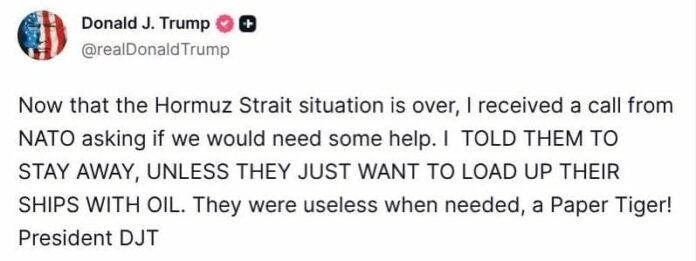
Trump Mocks NATO, Calls It ‘Useless, Paper Tiger’, Tells Them To ‘Stay Away’
Leaders in France and the United Kingdom on Friday responded positively to the announcement by Iran and the United States that the Strait of Hormuz has reopened, while stressing that safe and unrestricted passage through the vital oil corridor must be secured on a permanent basis following disruptions caused by the U.S.-Israeli war with Iran.
French President Emmanuel Macron and British Prime Minister Keir Starmer said they will continue preparing a multinational effort aimed at restoring maritime stability. Starmer indicated the initiative would be launched “as soon as conditions allow,” adding that military officials are scheduled to convene in London next week to advance planning.
After hosting a meeting involving roughly 50 nations and international bodies, Macron declared that “we all demand the full, immediate and unconditional reopening of the Strait of Hormuz by all parties.”
While those discussions were taking place, President Donald Trump and Iran’s foreign minister separately confirmed that the waterway had been reopened to commercial traffic. Markets reacted quickly, with oil prices dropping after Iranian Foreign Minister Abbas Araghchi wrote on X that shipping lanes would remain “completely open” during a 10-day ceasefire in Lebanon.
At the same time, Trump emphasized that U.S. military pressure would not be lifted immediately, stating in a social media post that the naval blockade of Iranian vessels and ports would continue “UNTIL SUCH TIME AS OUR TRANSACTION WITH IRAN IS 100% COMPLETE.”
Starmer welcomed the development with caution, saying the arrangement must evolve into “both lasting and a workable proposal.”
The Paris gathering reflects broader efforts by countries not directly involved in the conflict to reduce its economic fallout. The war, which began on Feb. 28 when Iran effectively closed the narrow strait through which about 20% of the world’s oil supply flows, triggered a sharp spike in energy prices and widespread economic strain.
The United States is not participating in the proposed operation, known as the Strait of Hormuz Maritime Freedom of Navigation Initiative. Macron described it as “a neutral mission, entirely separate from the belligerents to escort and secure the merchant ships transiting the Gulf.”
Starmer, dealing with domestic political pressures, arrived at the Elysee Palace for the meeting, where he was welcomed by Macron. Among those attending in person were German Chancellor Friedrich Merz and Italian Prime Minister Giorgia Meloni. Other world leaders—including those from Australia, Canada, South Korea, and Ukraine—as well as officials from China and India, joined virtually.
Starmer said that, similar to previous multinational security arrangements, Britain and France would spearhead a coalition to safeguard maritime movement once conditions permit.
“This will be strictly peaceful and defensive, as a mission to reassure commercial shipping and support mine clearance,” he said.
He added that more than a dozen nations have committed resources so far, though participation remains smaller than earlier coalition efforts in the region.
The U.K. has explored deploying mine-detection drones launched from the support ship RFA Lyme Bay as part of the effort.
The conflict has underscored the reduced capabilities of the Royal Navy, which has sent only one major vessel—the destroyer HMS Dragon—to the eastern Mediterranean. France, by contrast, has dispatched its nuclear-powered aircraft carrier along with additional naval assets, including a helicopter carrier and several frigates.
Meloni said Italy is prepared to assist, stating she had offered her country’s “willingness to make its naval units available,” while Merz said Germany could contribute to mine-clearing and maritime intelligence, provided it receives parliamentary approval and a ″secure legal basis″ such as a U.N. Security Council resolution.
He added that Germany, ″if possible, would also like to see the United States of America participate; we believe this would be desirable.″
That stance differs from Macron’s position that the mission should consist of countries not directly involved in the conflict.
According to Macron’s office, coalition members could take on roles including “intelligence, mine-clearing capabilities, military escorts (and) communication procedures with coastal states.”
Sidharth Kaushal, a sea power specialist at the Royal United Services Institute, said the coalition is more likely to focus on clearing mines and establishing maritime warning systems than on escorting oil tankers through the strait.
“You need huge numbers of vessels for that sort of thing, which nobody has,” he said.
Ellie Geranmayeh, an Iran expert at the European Council on Foreign Relations, said European nations may be better positioned to handle mine-clearing operations than the United States.
“They would be a better party to do this than the United States, because once you have U.S. military doing this and lingering on Iranian shores, it creates a potential arena for Iran and the U.S. to have miscalculations and get back into a sort of military tension,” she said.
The initiative also reflects a response to criticism from Trump, who has sharply rebuked allies for not taking part in the conflict, calling them “cowards,” saying NATO “wasn’t there when we needed them” and telling Britain: “You don’t even have a navy.”
Kaushal said European governments are likely seeking “to demonstrate the ability to provide security in a way that’s distinct from, if not completely separate from, the U.S. and which also demonstrates a capacity for independent action.”
“How many states actually have spare capacity to offer to this is a pretty open question.”
Trump signaled skepticism toward European involvement, referencing NATO rather than the proposed coalition.
“Now that the Hormuz Strait situation is over, I received a call from NATO asking if we would need some help. I TOLD THEM TO STAY AWAY, UNLESS THEY JUST WANT TO LOAD UP THEIR SHIPS WITH OIL,” he posted on social media.
“They were useless when needed, a Paper Tiger!”
{Matzav.com}