
 Matzav
Yerushalayim Yeshiva Admissions Shift as New Schools Rise and Old System Fades
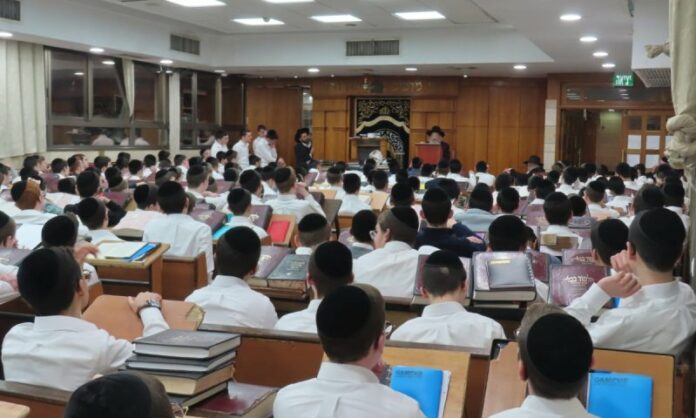
As registration season for yeshivos ketanos approaches across Israel, a closer look at the Yerushalayim landscape reveals a changing system, with new institutions gaining ground and traditional enrollment patterns undergoing significant shifts.
A Bechadrei Chareidim investigation explored the world of yeshivos ketanos in Yerushalayim—the city with the largest and most diverse talmidim population—and examined how both long-established and newer yeshivos are navigating this year’s admissions cycle.
Veteran yeshivos in Yerushalayim continue to hold their position at the top, maintaining stability and demand year after year. Among them is Yeshivas Kol Torah, where observers are watching closely to see whether it will retain its character and strength following the passing of its longtime mashgiach, Rav Aviezer Shapiro. Admissions are currently overseen by Rav Meisels, a member of the yeshiva’s staff. Another prominent institution is Tiferes HaTalmud–Shenker, which has steadily strengthened its standing and moved beyond the Machal label that once defined it.
Among the older yeshivos experiencing renewed growth, Yeshivas Chevron L’tzeirim has seen a notable surge in demand and is now considered one of the most sought-after options. It has become a primary pathway for talmidim aiming to continue on to Yeshivas Chevron. Its anticipated move to a large new campus at the entrance to Ramat Shlomo has further fueled interest, particularly from nearby neighborhoods such as Ramot, Ramat Shlomo, and Neve Yaakov.
Also noteworthy is Yeshivas Ateres Shlomo–Sorotzkin, led by Rav A. Breslauer, which currently enrolls around 300 top-tier talmidim—a particularly high figure for a yeshiva ketanah in Yerushalayim or elsewhere in the country. Alongside it, Yeshivas Tiferes Yaakov continues to maintain its reputation as a more “frum” and guarded environment, with many alumni choosing to send their own sons specifically there.
At the same time, several newer yeshivos have quickly climbed into the upper tier. Leading that group is Yeshivas Imrei Moshe, headed by Rav Y. Mishkovsky and founded under the direction of Rav Aharon Leib Shteinman, as well as Yeshivas Birchas Shmuel, led by Rav O. Leibovitz, which has established itself as a major presence in a relatively short time. With approximately 300 high-level talmidim, Birchas Shmuel stands out for its structure, dividing classes into three groups of no more than 30 talmidim each, combining strong academic standards with individualized attention. The yeshiva also has one of the largest spiritual staffs in Yerushalayim, with over 30 members. Recently, it opened a large new campus in the heart of Givat Shaul, built at a cost of millions. The yeshiva operates under the leadership of Rav D. Cohen, with roshei yeshiva Rav Tzvi Partzovitz and Rav Y. Weinberg.
According to findings by Bechadrei Chareidim, one of the most significant changes in recent years is how admissions are handled. In the past, enrollment was largely coordinated through the talmudei Torah and the melamdim. Today, however, yeshivos are increasingly reaching out directly to parents.
“This is no longer the system that existed in the past,” a senior cheder administrator in Yerushalayim told Bechadrei Chareidim. “Parents have become the central decision-makers, and to some extent, the cheders have lost control over the admissions process. Yeshivos are no longer relying solely on the melamdim but are building direct relationships with families.”
Another insider added, “Today, a yeshiva that doesn’t know how to work with parents simply loses out in admissions.” According to him, this shift has led more yeshivos to formally employ recruiters and even field representatives—a practice that was once uncommon in Yerushalayim.
The numbers help explain the intensity of the competition. Each year, roughly 1,500 talmidim in Yerushalayim move on to yeshivos ketanos, compared to about 700 in Bnei Brak and Modiin Illit. This creates a much more competitive environment, with around eight flagship yeshivos shaping the market and allowing the admissions landscape to shift rapidly from year to year.
Another major factor is the development of Neve Yaakov. Whereas the neighborhood was once part of the broader citywide admissions system, it is now emerging as an independent hub, driven by the opening of multiple new yeshivos alongside established ones such as Netivos Mordechai and Nachalas Shmuel.
Among the newer institutions is Yeshivas Mishnas Boruch, led by Rav Y. Eichenstein, who personally delivers a weekly shmuess and learns with the talmidim. Due to demand, the size of the class has already been increased from 20 to 30 talmidim—a step not even taken at Yad Aharon, which he also leads. Another new yeshiva has also opened under Rav Grunzweig.
This shift is having a direct impact on the broader Yerushalayim admissions map. As more talmidim from Neve Yaakov choose to remain within their neighborhood rather than attend yeshivos elsewhere, the balance of power is changing significantly, reducing the intake at many of the city’s older institutions.
{Matzav.com}