

A new national survey indicates that most registered voters believe President Donald Trump bears significant responsibility for the recent increase in gasoline prices.
According to a Quinnipiac University poll released Wednesday, 51 percent of respondents said they blame Trump “a lot” for the surge in fuel costs, while another 14 percent said they blame him “some.” In contrast, 11 percent said they blame him “not much,” and 23 percent indicated they do not blame him at all.
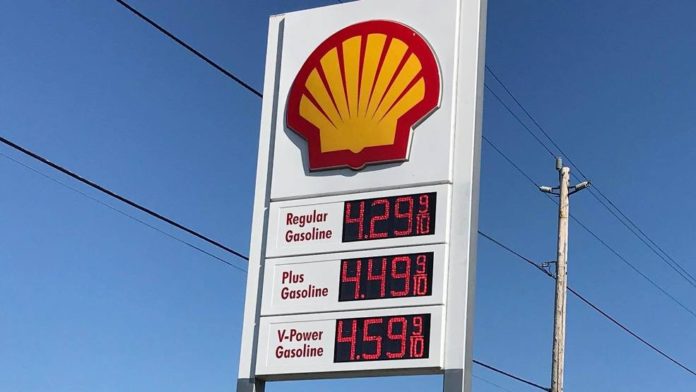
Fuel prices across the country currently average $4.04 per gallon, based on data from AAA. At the same point last year, the average stood at $3.17 per gallon, according to the U.S. Energy Information Administration.
The rise in prices has been largely attributed to disruptions in oil shipments through the Strait of Hormuz, a key global passageway that handles roughly 20 percent of the world’s daily oil supply. Iran closed the route following the outbreak of U.S.-Israeli military operations, contributing to supply constraints.
In response, the United States has implemented a naval blockade aimed at preventing Iran from controlling which vessels are allowed to pass through the strait.
Despite the current spike, Trump said on Wednesday that he expects prices to fall “tremendously” in the coming months and expressed confidence that oil costs will not remain elevated by the time of the midterm elections.
However, Energy Secretary Chris Wright said Sunday that gasoline prices may not dip below $3 per gallon until sometime next year.
The poll revealed sharp political divisions over who is to blame for the rising costs.
Among Democrats, 91 percent said they blame Trump “a lot,” 6 percent said “some,” and 1 percent said “not much.”
Independent voters were also more likely to fault the president, with 53 percent saying they blame Trump “a lot,” 20 percent saying “some,” and 10 percent saying “not much,” while 15 percent said they do not blame him at all.
Republicans showed a markedly different view. Just 9 percent said they blame Trump “a lot,” 13 percent said “some,” and 23 percent said “not much.” A majority, 53 percent, said they do not hold him responsible at all.
Meanwhile, diplomatic efforts to end the conflict are set to continue, with negotiations between the United States and Iran scheduled to begin this week in Islamabad, Pakistan.
Global leaders have been urging both sides to de-escalate tensions and work toward reopening the Strait of Hormuz to restore stability in energy markets.
The survey also measured public opinion on military involvement, finding that 40 percent of registered voters support U.S. military action against Iran, while 53 percent oppose it. Seven percent said they were unsure or declined to respond.
The Quinnipiac poll surveyed 1,028 registered voters nationwide between April 9 and April 13 and carries a margin of error of plus or minus 3.8 percentage points.
{Matzav.com}